




Recently, Prime Minister Shehbaz Sharif announced a severe emergency austerity program that would radically decrease fuel consumption and decrease government spending. One of the highlights of these Pakistan emergency economic action is the new Pakistan government 4 days work week introduction to some sectors.
Nevertheless, this abrupt change has left a lot of citizens puzzled, as thousands of people are wondering whether their banks and other vital services provided to the citizens will be operational under the new policy. A full detail of the Pakistan austerity plan 2026, which departments will be exempt, and the new policy of working at home will be presented here.
Are Banks Included in the 4-Day Work Week?
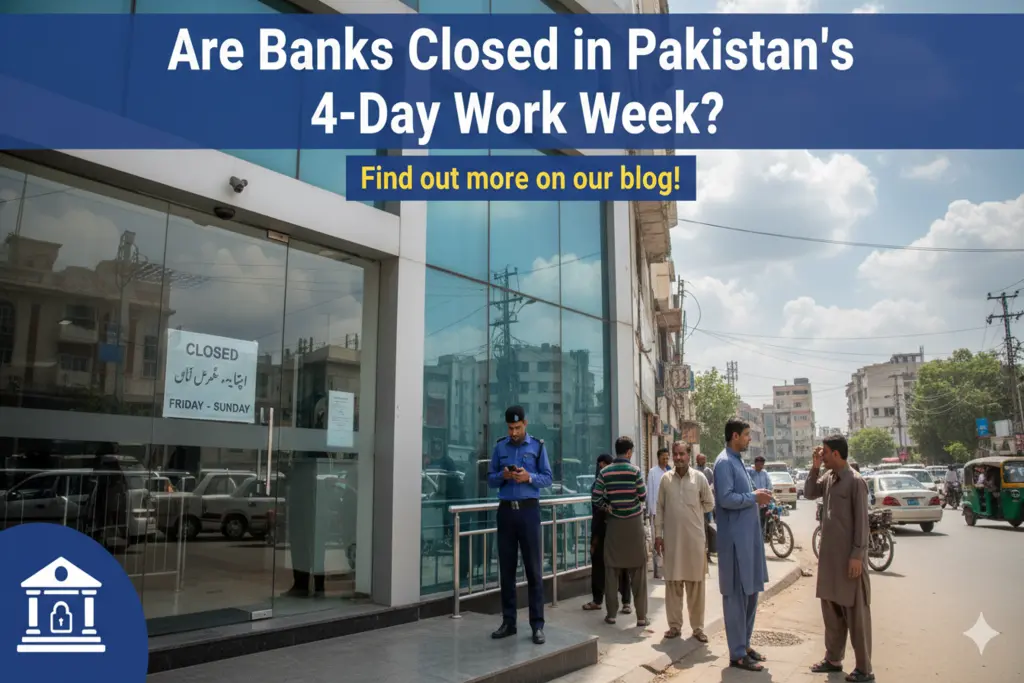
The most common question currently being asked is, are banks closed in Pakistan 4 day work week? The answer to this, briefly, is no. There is no way that banks and other financial institutions are included in the 4-day work week policy. These institutions need to be running their usual business in order to sustain the stability of the national economy as well as facilitating the flow of finances among the citizens and various companies.
The government has also officially stated that the whole financial services will be in full operation. Therefore, in case you are skeptical about the open Pakistan austerity plan by banks, you can be assured that the banking sector is not going to be disrupted by any means as it will stick to its normal 5-day or 6-day working hours.
Which Offices Must Work From Home?
The new policy primarily targets federal government departments. To successfully implement the Pakistan fuel saving plan, the government has mandated that 50% of federal government staff must work remotely on a rotational basis, effectively creating a Pakistan government 4 day work week for these specific employees.
In addition to the work-from-home mandate, the government has:
- Drastically cut fuel allowances for government officials.
- Reduced the usage of official state vehicles.
- Banned unnecessary foreign travel funded by the state.
The core purpose of these measures is to lower daily commuting across major cities, which will directly reduce the country’s overall fuel consumption.
<blockquote class=”twitter-tweet”><p lang=”en” dir=”ltr”>Prime Minister Shehbaz Sharif on Sunday reviewed several proposals and recommendations for implementing austerity and prudent spending, with a final action plan scheduled for formal announcement on Monday amid the widening Middle East crisis.<br><br>For more: <a href=”https://t.co/5ZOU3vwxwt”>https://t.co/5ZOU3vwxwt</a>… <a href=”https://t.co/iTwRrwSRO2″>pic.twitter.com/iTwRrwSRO2</a></p>— The Express Tribune (@etribune) <a href=”https://twitter.com/etribune/status/2030701339295285302?ref_src=twsrc%5Etfw”>March 8, 2026</a></blockquote> <script async src=”https://platform.twitter.com/widgets.js” charset=”utf-8″></script>
Public Services That Will Continue Normally
As the federal government offices reduce the amount of physical presence, there are several key sectors that are entirely immune to the austerity measure. Carrying out these sectors will not be impaired in any way since they will need to keep on providing basic services to the citizens:
Banks and Financial Institutions: Banks and Financial Institutions are open and closed to regular schedules.
Hospitals and Healthcare Facilities: Public and private hospitals, clinics, as well as pharmacies.
Emergency Services: The police, fire brigade, ambulance services and rescue teams.
Utility Services: Teams of maintenance of electricity, gas, water and telecommunications.
Critical Transport Services: Public transportation, freight, and logistical transport.
Why Pakistan Introduced the Austerity Plan
The introduction of the austerity plan comes in response to immense economic pressure and soaring global oil prices. Pakistan uses a colossal amount of its budget on the importation of fuel.
The government under the leadership of Prime Minister Shehbaz Sharif is trying to secure the dwindling foreign exchange reserves of the country and relieve the national exchequer. Cutting down on the consumption of fuel at the state level, the government is hoping to stabilize the economy and avoid any further burden of finances on the masses.
Who will get the 4 day work week in Pakistan?
The 4-day work week (and 50% work-from-home policy) applies primarily to federal government employees and specific state departments to reduce administrative and fuel costs.
Are banks closed in Pakistan’s 4 day work week?
No, banks are completely exempt from the 4-day work week policy. They will remain open and operate according to their standard schedules to ensure economic stability.
Which offices follow the Pakistan 4 day work week?
Currently, federal government offices and ministries are required to follow the 4-day work week and rotate 50% of their staff to work from home.
Why did Pakistan introduce the 4 day work week?
The government introduced this measure as part of a broader austerity and fuel-saving plan to reduce the country’s import bill, save foreign exchange reserves, and cut government spending amidst rising global oil prices.
How long will the Pakistan 4 day work week last?
The government has introduced this as an emergency economic measure. It will remain in effect until further notice, pending a review of the country’s economic and fuel consumption status.
Read: More Informative Content