
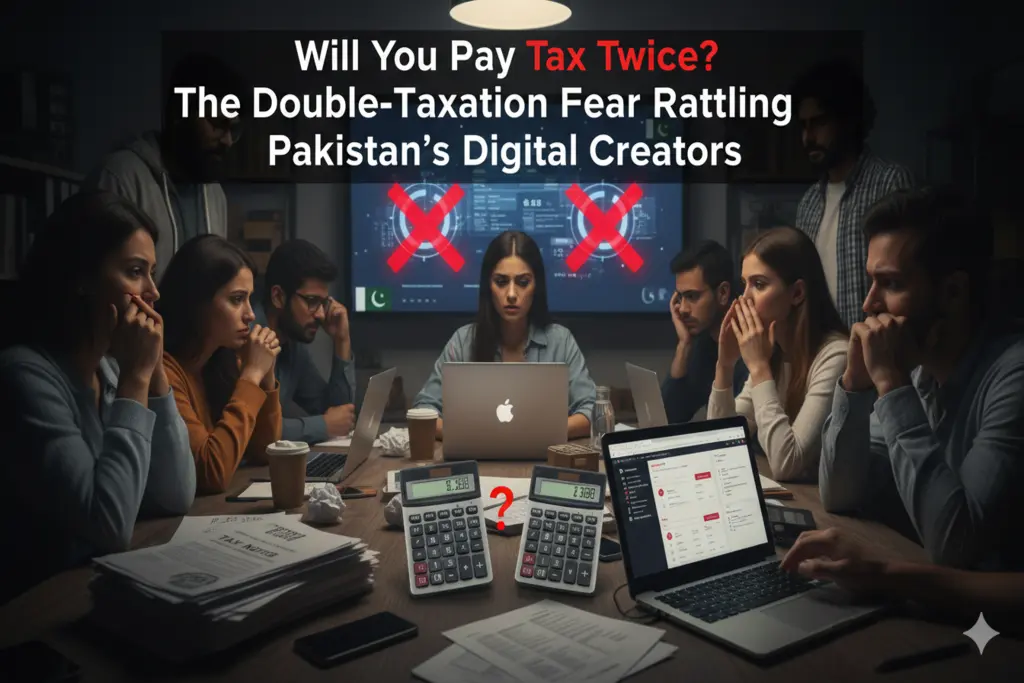
The morning of April 22, 2026, brought more than just the usual notifications for Pakistan’s digital community. A fresh update from the Federal Board of Revenue (FBR) has sent shockwaves through the industry, turning initial concerns about “view-based taxes” into a full-blown crisis of confidence. The burning question on every influencer’s mind: Is the government about to tax the same dollar twice?
For a sector that has been the backbone of Pakistan’s burgeoning digital exports, these new and increasingly complex regulations feel like a sudden brake on a high-speed train. While the FBR aims to widen the tax net, the blurring lines between “source of income” and “tax residency” have turned theoretical fears into a looming financial reality for thousands of creators.
The YouTube Dilemma: Why One Income is Being Hit Twice
Most Pakistani YouTubers are already intimately familiar with international tax laws. If your content reaches an audience in the United States, Google and YouTube are legally mandated to withhold between 15% and 30% of those earnings as part of U.S. tax compliance.
The nightmare scenario currently being discussed in creator circles is simple: If the FBR taxes the gross income before those international deductions are accounted for, or fails to provide a credit for taxes already paid abroad, a creator could see over half of their revenue vanish into thin air. For many, this isn’t just about paying their fair share; it’s about the mathematical impossibility of sustaining a production team when the tax burden exceeds the profit margin.
The DTAA Mystery: Can FBR’s New Model Be Adjusted?
On paper, the solution exists. Pakistan has signed Double Taxation Avoidance Agreements (DTAA) with several countries to ensure that citizens aren’t penalized twice for the same income. According to the Federal Board of Revenue (FBR), these treaties are designed to protect taxpayers.
However, the “human” problem lies in the execution. The FBR’s recent shift toward a view-based tax model—where tax is estimated based on reach—lacks a clear mechanism for adjusting foreign tax credits. Without a simplified, digital-first way to prove that tax has already been paid to the U.S. or other jurisdictions, local creators are left in a high-stakes waiting game.
A Threat to ‘Digital Pakistan’ and the Looming Brain Drain
The Ministry of Information Technology and Telecommunication (MoITT) has long promised to turn Pakistan into a global tech hub. Yet, experts warn that these “punitive-feeling” tax updates are pushing top-tier talent toward the exit. When the price of producing content in Lahore or Karachi becomes prohibitively expensive, the “Digital Brain Drain” will be sped up. Most developed creators are already looking at tax favourable locations such as Dubai in order to protect their resources and future development.
In order to rescue the vision of Digital Pakistan, the government will have to go beyond the rigid notifications and have a dialogue that understands the special, global character of digital work.