




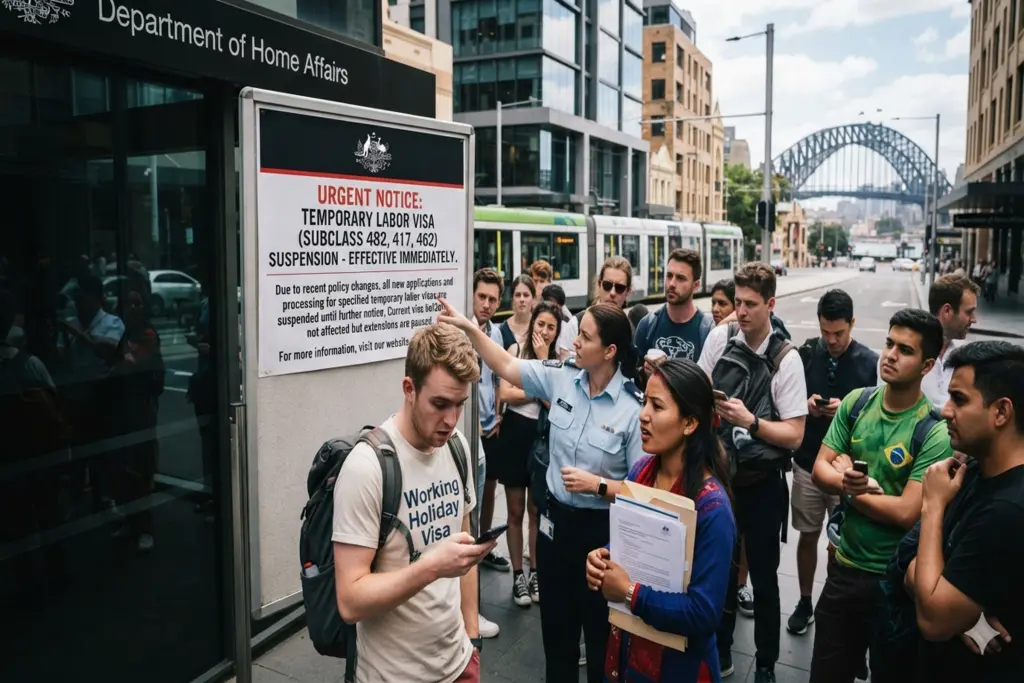
In a sweeping overhaul of its temporary economic migration framework, the Australian Federal Government has implemented a major structural adjustment by freezing inbound temporary labor visa intakes from nearly two dozen nations. The sudden administrative intervention, executed by the Australian Department of Home Affairs, has officially halted application submissions for the highly popular Work and Holiday Visa (Subclass 462) from 24 distinct partner nations.
The decision serves as a key cornerstone of the Albanese administration’s broader immigration management roadmap, which seeks to aggressively reduce Net Overseas Migration (NOM) and ease acute domestic pressures on urban housing markets and baseline infrastructure.
Complete List of the 24 Restricted Visa Jurisdictions
The Department of Home Affairs integrated the structural pause directly into its electronic immigration portals without prior warning to the international migration industry. According to official notification logs verified by Home Affairs Minister Tony Burke, the suspension cuts across major global manufacturing, corporate, and travel networks.
The 24 countries affected by the immediate Work and Holiday application halt include:
Asia & Middle East: Malaysia, Indonesia, Singapore, Thailand, Mongolia, and Israel.
Europe: Austria, Czech Republic, Greece, Hungary, Luxembourg, Poland, Portugal, Slovak Republic, Slovenia, and Spain.
South & Central America: Argentina, Brazil, Chile, Ecuador, and Uruguay.
Other Regions: Peru, Switzerland, and Papua New Guine.
Currently, within the capped programmatic streams, only Turkey and San Marino remain accessible to eligible applicants, primarily due to their minor baseline quotas. Meanwhile, standard uncapped Working Holiday (Subclass 417) pathways for citizens from 19 western economic powers—including the United Kingdom, Canada, France, and Germany—remain completely operational without programmatic pauses.
Decisive Operational Triggers Behind the Home Affairs Freeze
Federal immigration analysts note that the Australian Department of Home Affairs has driven this administrative closure using three primary macroprudential and logistical considerations:
Exhaustion of Annual Allocation Caps: Incoming applicant volumes from these 24 specific nations rapidly approached or hit 100% of their legislated annual structural caps within the initial months of the program year.
Mitigating Systemic Application Backlogs: The temporary pause allows federal processing centers to clear data pipelines and manage the severe workload of existing applications without creating lengthy manual backlogs.
National Immigration Rebalancing: The shift aligns directly with state directives to systematically taper the population growth driven by temporary resident classes, cooling localized rental and real estate sectors.
Supply Chain Impact and Elevated Visa Processing Costs
The immediate economic impact of the Subclass 462 pause is expected to ripple across Australia’s regional agricultural, hospitality, and seasonal tourism supply chains. Fruit growers and regional tourism associations have expressed immediate concerns regarding potential workforce deficits, as global backpackers and skilled temporary youth have historically provided crucial seasonal labor in remote territories.
Compounding the pause, recent federal budget updates have substantially raised baseline processing fees for temporary labor streams, positioning the Australian Work and Holiday network among the most expensive temporary visas globally. Executive migration watchdogs warn that these heightened entry fees, paired with the new application caps, may prompt global youth talent to pivot toward competitive labor markets in New Zealand or Canada.