



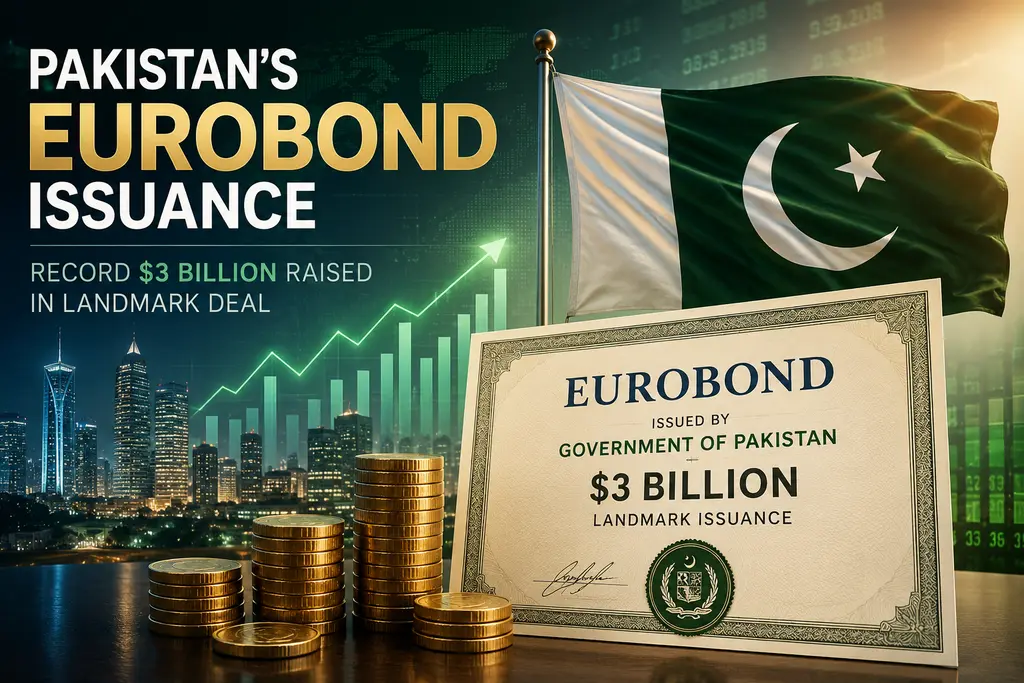
Pakistan has delivered a definitive statement of fiscal recovery to international capital markets by successfully executing its largest-ever sovereign debt transaction. According to an official notification from the Ministry of Finance, the government has capitalized on improving investor sentiment to raise a record-shattering $3 billion through a dual-tranche global bond transaction. Addressing a press briefing in Islamabad, Federal Minister for Finance and Revenue Muhammad Aurangzeb termed the capital drive a historic success. The massive scale of Pakistan’s Eurobond issuance proves that structural economic adjustments and recent global credit rating improvements have firmly restored international investor confidence.
The Benchmark Dual-Tranche Framework and Massive Market Over-Subscription
The landmark debt offering was strategically structured across two distinct tranches to capture divergent institutional investor pools. According to the final pricing sheet released by the national treasury:
5.5-Year Tenor: The government successfully issued $1.75 billion worth of notes maturing in 5.5 years, locking in a highly competitive final coupon rate of 7.50%.
10-Year Tenor: For long-term capital stability, the economic team placed $1.25 billion in 10-year sovereign bonds, yielding a final coupon rate of 7.90%.
The defining highlight of the transaction was the immense international demand generated during the bookbuilding phase. Total orders peaked at an explosive $6 billion, indicating a 200% over-subscription rate. This overwhelming interest allowed Pakistan’s joint lead managers to compress initial price targets significantly, securing optimal terms for the national exchequer.
𝘕𝘖𝘛 𝘍𝘖𝘙 𝘙𝘌𝘓𝘌𝘈𝘚𝘌, 𝘗𝘜𝘉𝘓𝘐𝘊𝘈𝘛𝘐𝘖𝘕 𝘖𝘙 𝘋𝘐𝘚𝘛𝘙𝘐𝘉𝘜𝘛𝘐𝘖𝘕 𝘐𝘕, 𝘖𝘙 𝘐𝘕𝘛𝘖, 𝘛𝘏𝘌 𝘜𝘕𝘐𝘛𝘌𝘋 𝘚𝘛𝘈𝘛𝘌𝘚, 𝘈𝘜𝘚𝘛𝘙𝘈𝘓𝘐𝘈, 𝘊𝘈𝘕𝘈𝘋𝘈 𝘖𝘙 𝘑𝘈𝘗𝘈𝘕.
— Ministry of Finance, Government of Pakistan (@Financegovpk) September 2, 2026
𝗣𝗮𝗸𝗶𝘀𝘁𝗮𝗻 𝗜𝘀𝘀𝘂𝗲𝘀 𝗥𝗲𝗰𝗼𝗿𝗱 𝗨𝗦$𝟯 𝗕𝗶𝗹𝗹𝗶𝗼𝗻 — 𝗦𝗶𝗻𝗴𝗹𝗲…
Global Institutional Backing and Economic Validation
A consortium of elite global banking institutions including Citi, Deutsche Bank, and Standard Chartered acted as joint bookrunners to execute the bookbuilding process. The bonds attracted top-tier, long-only institutional asset managers, pension funds, and sovereign wealth funds from Asia, Europe, the Middle East, and the United States.
The Finance Minister highlighted that this phenomenal reception validates the state’s aggressive revenue-mobilization measures, energy sector reforms, and fiscal discipline. Building on the momentum of a smaller $500 million short-term bond floatation in April 2026, the success of these long-term 5.5 and 10-year tranches officially confirms the market’s long-term faith in Pakistan’s macro-debt sustainability.
Strengthening SBP Foreign Exchange Reserves and Debt Profiling
The immediate structural impact of Pakistan’s Eurobond issuance will be a significant boost to the liquid foreign exchange reserves held by the State Bank of Pakistan (SBP). However, the economic team’s primary strategy extends beyond simple reserve accumulation.
The Ministry of Finance intends to utilize this low-cost, long-term injection to execute an early retirement strategy for its existing short-term, high-interest domestic and commercial bank borrowings. Replacing expensive, short-tenor liabilities with these newly issued Eurobonds will systematically reduce the country’s overall debt-servicing markup burden. This approach effectively diversifies funding channels and diminishes dependency on traditional bilateral roll-overs or concessionary multilateral emergency packages.