




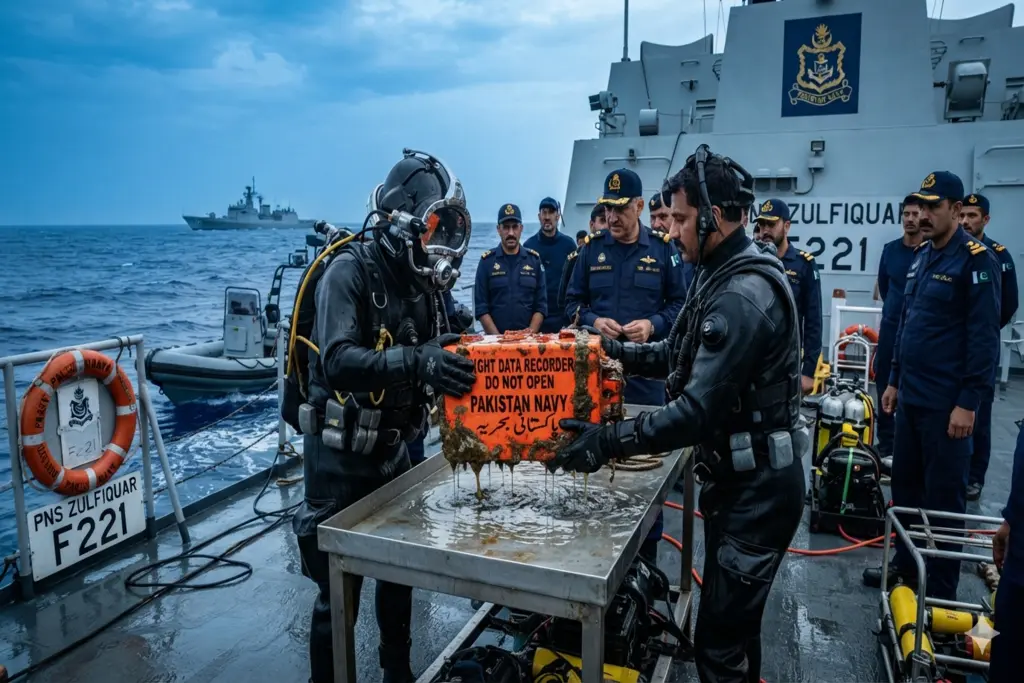
In a major geostrategic achievement for national maritime defense capabilities, deep-sea salvage engineering and international aerospace accident investigation the Pakistan Navy has successfully located the black box of a crashed K2 Airways cargo aircraft in the Arabian Sea. The highly complex deep-water deployment transitions traditional visual search workflows into a sophisticated system-vetted underwater discovery sandbox. Executed directly across a vast maritime search grid over a gruelling two-month lifecycle the milestone operation managed to pinpoint the submerged wreckage despite intensely hostile open-ocean environments setting a new benchmark for domestic military technology integration.
As maritime telemetry and deep-submergence recovery standards evolve globally, establishing domestic capabilities to execute deep-sea scanning operations remains an absolute priority for Pakistan’s naval planners. The retrieval of flight recorders from extreme ocean trenches bypasses long-term structural dependencies on foreign recovery fleets safely cutting down operational processing delays. By deploying highly specialized acoustic tracking scripts alongside locally engineered robotic exploration grids the naval command successfully minimizes documentation shortfalls, honors global air safety covenants and projects a highly sophisticated image of state maritime operations onto the global landscape.
Audit of NESCOM Submersibles and Deep-Sea Telemetry Layers
According to the official communique issued by the naval command headquarters the successful localization of the vanished flight recorder at an extreme depth of approximately 3,200 meters completely validates domestic defense engineering. Naval vessels systematically bypassed traditional import bottlenecks by utilizing custom specialized sensors.
The engineered deep-sea tracking sandbox operated on three critical performance vectors:
Indigenously Engineered Asset Deployment: Pakistan Navy search vessels systematically deployed advanced underwater scanning telemetry systems designed and manufactured by the National Engineering and Scientific Commission (NESCOM).
Ultra-Deep Spatial Ingestion: The custom NESCOM sonar matrix successfully mapped the dark ocean floor cross-referencing acoustic pings in real time to isolate the aircraft’s cockpit voice and flight data logs at 3,200 meters below sea level.
Friction-Free Inter-Agency Ingestion: The naval command immediately whitelisted and shared the high-precision telemetry coordinates with the Bureau of Air Safety Investigation to launch the next phase of the investigation.
Restructuring the Crash Timeline Matrix and Future Market Impacts
The historical and commercial implications of this deep-sea recovery are extensive, marking the first time in the state’s maritime history that a flight recorder has been successfully identified at such extreme depths. The recovery of this structural asset provides air safety experts with direct access to the vehicle’s final moments allowing data analysts to map engine parameters and cockpit logs against verified data models.
The underlying aviation event dates back to July 7, 2026, when the K2 Airways Boeing 737-400(BDSF) cargo plane registered under tail number AP-BOI plunged into the Arabian Sea while operating Flight 1732 from Sharjah to Karachi. Following the catastrophic incident the airline’s executive corporate centers were temporarily sealed for regulatory auditing. By executing this independent data recovery the state directly eliminates administrative blind spots, restores corporate regulatory predictability across domestic cargo channels and establishes a secure space for sustainable aviation transport brand development globally.