




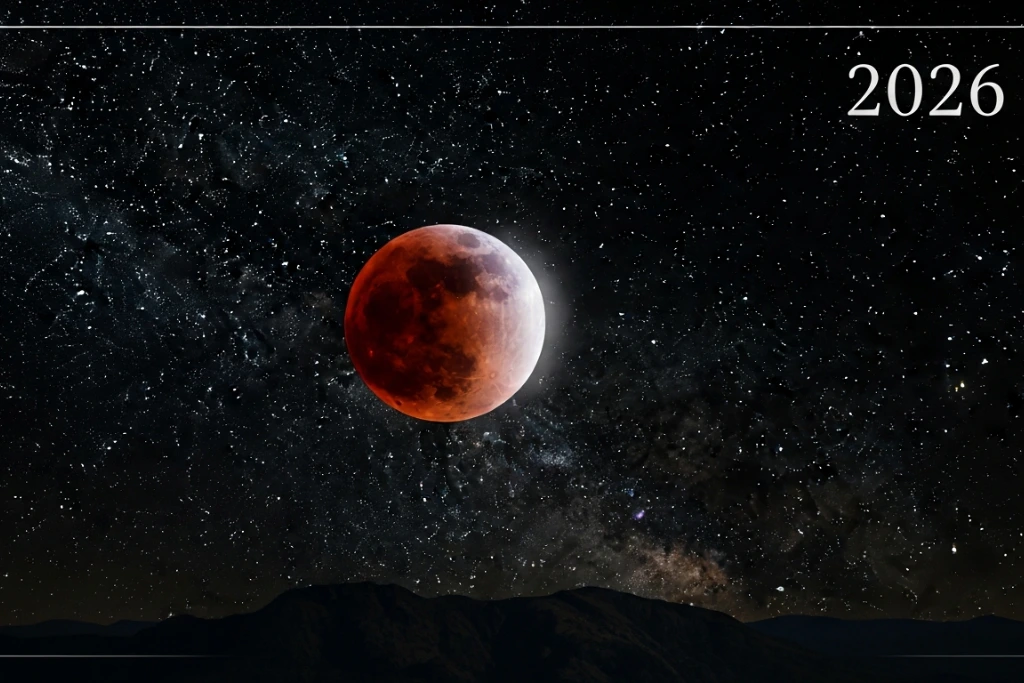
A total lunar eclipse, popularly known as a blood moon, will occur on Tuesday, March 3, 2026. The heavenly phenomenon will be fully seen in the western parts of North America, southwestern US, northwest of Mexico, and inland, Australia. It is the only total lunar eclipse of the year and the last one till December 31, 2028.
What Is a Total Lunar Eclipse?
The total lunar eclipse takes place when the Earth passes in a direct line between the Sun and the Moon throwing its shadow over the Moon entirely. In totality, the moon fades gradually and assumes a red hue creating the magnificent blood moon effect. This is unlike solar eclipses which are absolutely hazardous to observe using the naked eye.
Why This Total Lunar Eclipse Is Special
This eclipse will cover a total of 58 minutes and 18 seconds. That will be a spectacular sight. Although not as profound as other past eclipses, it will still be spectacular, particularly to the people in the western U.S and the parts with clear skies. The red moon will be seen by about 2.5 billion individuals representing 31 percent of the total population in the world.
Lunar EclipseTotality Timing by Region
| Location / Time Zone | Totality Time |
| Eastern U.S. (EST) | 6:04 – 7:02 a.m. |
| Central U.S. (CST) | 5:04 – 6:02 a.m. |
| Mountain U.S. (MST) | 4:04 – 5:02 a.m. |
| Pacific U.S. (PST) | 3:04 – 4:02 a.m. |
| Alaska (AKST) | 2:04 – 3:02 a.m. |
| Hawaii (HST) | 1:04 – 2:02 a.m. |
The best location will be Western U.S and Canada since the moon will be high in the sky. To watch the eclipse as the moon sets the eastern viewers require a clear western horizon.