



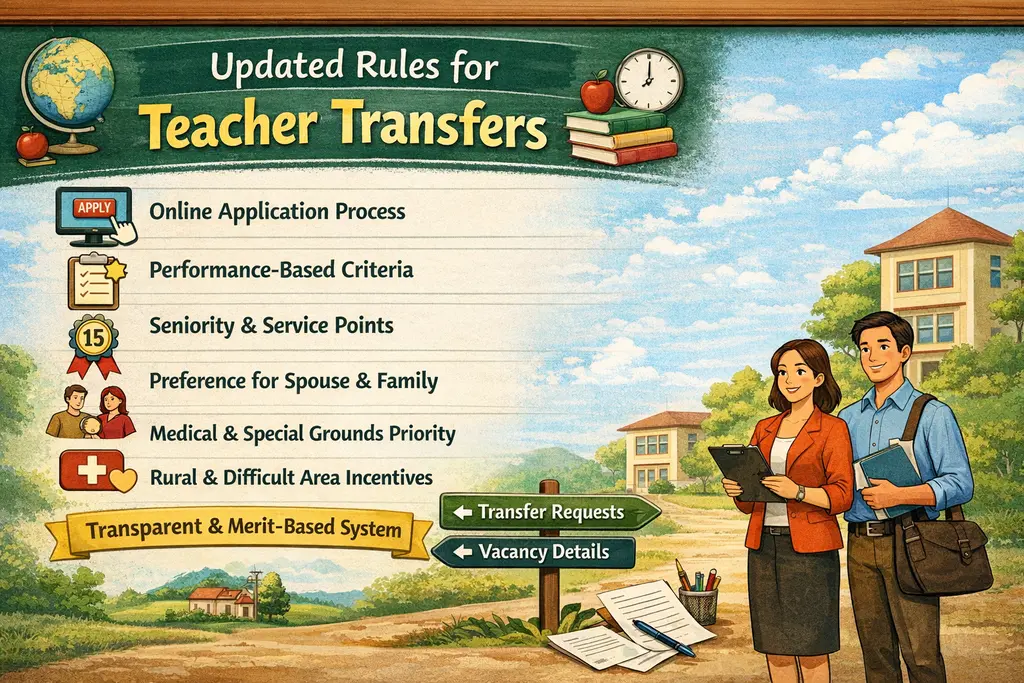
When it comes to applying for transfer, especially on hardship grounds, periods of stress and rigidity have historically marked the process for public school teachers in Punjab. But there seems to be a change in the air. Details of Policy Changes in E Transfer Scheme Punjab School Education Department 2022 Now to add another personal touch, apparently with the intention of making the process more transparent and humanizing, the department has decided that it will start conducting personal hearings for transfer requests in hardship categories. Here’s a full breakdown of what these new rules mean for teachers and what the updated evaluation process looks like in practice.
The Introduction of Personal Hearings
In the old system, applying to transfer often felt like sending a piece of paper into a black hole. That all appeals and hardship requests will now be fully contested, in-person hearings after recent revisions of the E-Transfer Policy. With this, teachers will have a fair chance to keep their jobs so that they are not dismissed purely on the basis of papers. This: The main purpose of this change is to facilitate a far more efficient, transparent and human review process as it pertains to bona fide hardship cases.
Two Separate Scrutiny Committees
To make sure these hearings are conducted smoothly and without unnecessary delays, the department has formed special scrutiny committees. To keep the workload manageable and relevant, these committees have been divided based on the pay scales of the applicants.
- Committee One: This group will exclusively handle the transfer cases and appeals of officers and teachers in Grade 17 and above.
- Committee Two: This group will review the applications submitted by employees up to Grade 16.
The Additional Secretary of the School Education Department has been officially appointed to serve as the convener for both of these committees.
Local Input and a Strict 10-Day Timeline
One of the biggest complaints about government administrative processes is how long they take. To counter this, the newly formed committees are legally required to examine each appeal on a case-by-case basis and submit their final recommendations within a strict 10-day window.
Furthermore, the process won’t just be dictated by officials sitting in the provincial capital. Active members on these committees would include the CEOs of the respective education districts. It ensures local-level input and on-the-ground realities are considered in each decision-making process. As a whole, I expect these new rules to greatly simplify the teacher transfer process while eliminating the opacity that had so many educators frustrated in years past.
What are the Punjab updated rules for teacher transfers?
The Punjab School Education Department has updated its E-Transfer Policy to include mandatory personal hearings for transfer requests submitted on hardship grounds. Special scrutiny committees have been formed to review these cases transparently.
Who will review the transfer applications?
Two separate committees have been established based on employee grades. One will handle applications for Grade 17 and above, while the other will review cases for Grade 16 and below. Both are headed by the Additional Secretary of the School Education Department.
Will local district officials be involved in the transfer decisions?
Yes. The Chief Executive Officers (CEOs) of the respective districts will act as members of the scrutiny committees to provide local-level insight into the transfer requests.
How long will it take for the committee to decide on a transfer appeal?
Under the new rules, the scrutiny committees are required to examine individual appeals and submit their final recommendations within 10 days.
READ : More Informative News