

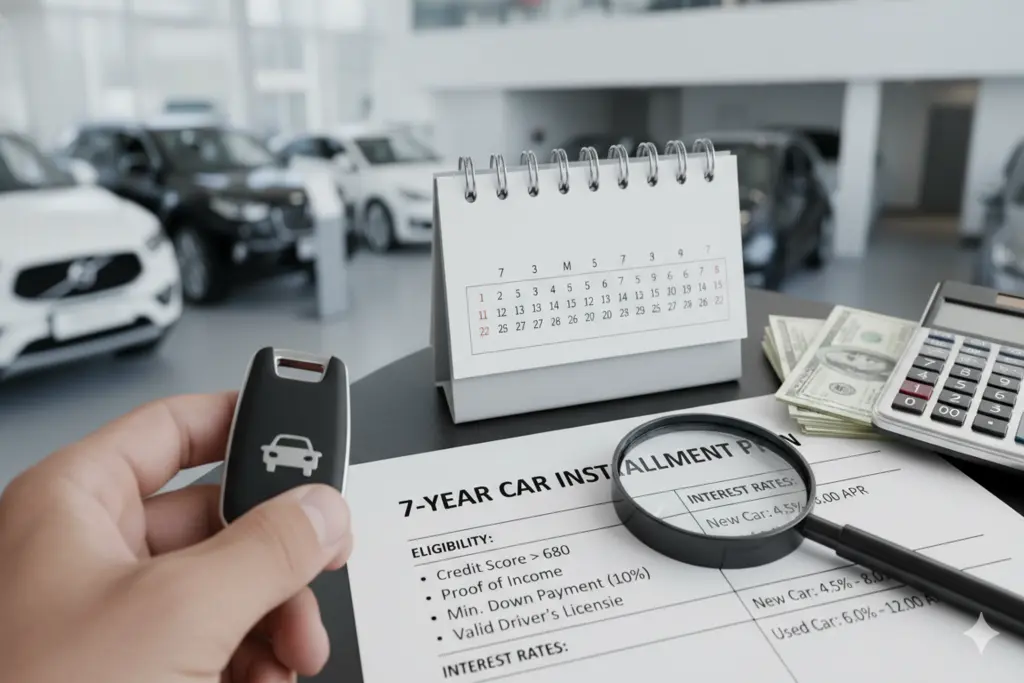
The Government of Pakistan is taking up a significant initiative to reform the narrow curtailments of the car industry for revival and to give a bump to consumer purchasing power in its upcoming regulations by adopting some measures of “structural relaxation”. The government is proposing to loosen restrictions on auto financing under the proposed Auto Industry Development and Export Policy (AIDEP), including hikes in loan interest ceilings and maximum loan tenures.
The rationale behind this change involves addressing the challenges facing middle-class customers and corporate professionals, as they have been shut out of the automobile market by inflation in car prices, macro prudential measures by the State Bank of Pakistan (SBP), and high interest rates for loans. The following is a detailed overview of what you can expect to see in the 7-Year Car Installment Plan, the qualifications required, the interest rates and a comparison of 5-year and 7-year auto loans.
Key Features of the New Auto Financing Policy
The draft framework recommends three key revisions to the existing rules of consumer financing in consultation with the State Bank of Pakistan (SBP) and the key automotive stakeholders:
Raised Maximum Process: The time of auto finance will be extended from 5 years to flexible 7-year installment autos. The SBP used to significantly shorten tenures when it was trying to reduce the import compression and homes the consumer demand by cutting tenures to 10 years (and for vehicles more than 1000 cc, 3 years).
Increased Debt ceiling: The debt ceiling for each individual auto loan will be increased to Rs. 10 million (Rs. 1 crore). The previous limited top-line offering will be replaced by a wider line-up, which will enable consumers to fund their mid-to-high model sedans and crossovers built locally.
Lower Equity Requirements: The minimum equity requirement, or down payment, is projected to drop from 30 to 15 percent for some entry-level and locally-assembled cars and trucks.
Eligibility Requirements for the 7-Year Plan
While commercial banks await the final implementation circular from the central bank, the standard eligibility criteria for this revised tier will include:
- Localization Mandate: The 7-year financing option will apply strictly to locally manufactured or assembled vehicles. Imported completely built units (CBUs) will remain under stricter regulatory timelines to protect foreign exchange reserves.
- Tax Compliance Status: For high-value loans approaching the Rs. 10 million ceiling, applicants must be active taxpayers listed on the FBR Active Taxpayer List (ATL). Documentation including verified salary slips, audited business accounts, and clean bank statements is mandatory.
- Creditworthiness (eCIB Clearance): Applicants must maintain an immaculate Electronic Credit Information Bureau (eCIB) record with the State Bank, showing no historical defaults or over-leveraged debt-to-income ratios.
Financial Comparison: Is a 5-Year or 7-Year Car Loan Better?
Choosing the right loan duration involves balancing immediate monthly affordability against long-term borrowing costs. To help evaluate both options, let us look at a case study of a Rs. 3,000,000 (3 Million) loan at an estimated average interest rate of 16% (comprising KIBOR plus the bank’s competitive spread):
Strategic Takeaways:
- Monthly Budget Relief: Opting for the 7-year track reduces your Equated Monthly Installment (EMI) by approximately Rs. 13,313 per month. This significantly lowers the barrier to entry for household cash flows.
- The Interest Cost Premium: The downside of the longer timeline is that you will pay an additional Rs. 640,028 in interest over the life of the loan.
- The Verdict: If you have enough money after paying your bills each month and you want to save on interest and can afford to make higher monthly payments you will be better financially doing the 5 year loan as you will save well over 600,000 rupees in interest. If you’re interested in purchasing a larger car for your family or a crossover that falls within your monthly payments, the 7 year car installment plan is a great financial option to consider.
Expected Auto Loan Interest Rates
Commercial auto financing products in Pakistan are floating-rate loans pegged directly to the KIBOR (Karachi Interbank Offered Rate).
As inflation cools down and the State Bank continues to lower its monetary policy rate, KIBOR has trended downward. For this new 7-year tier, commercial banks are expected to price their consumer auto loans at KIBOR plus a bank spread of 2% to 3.5%. This brings the net expected interest rate to a stable window of 15% to 17.5% per annum, depending on the borrower’s risk profile and chosen banking partner.
The government’s revised auto framework provides much-needed relief to consumers facing high vehicle prices. By raising loan limits to Rs. 10 million and extending tenures to 7 years, the policy makes it feasible for middle-tier salary earners to transition from basic compact hatchbacks into spacious, locally assembled family sedans and compact SUVs.
READ: More Informative Content