


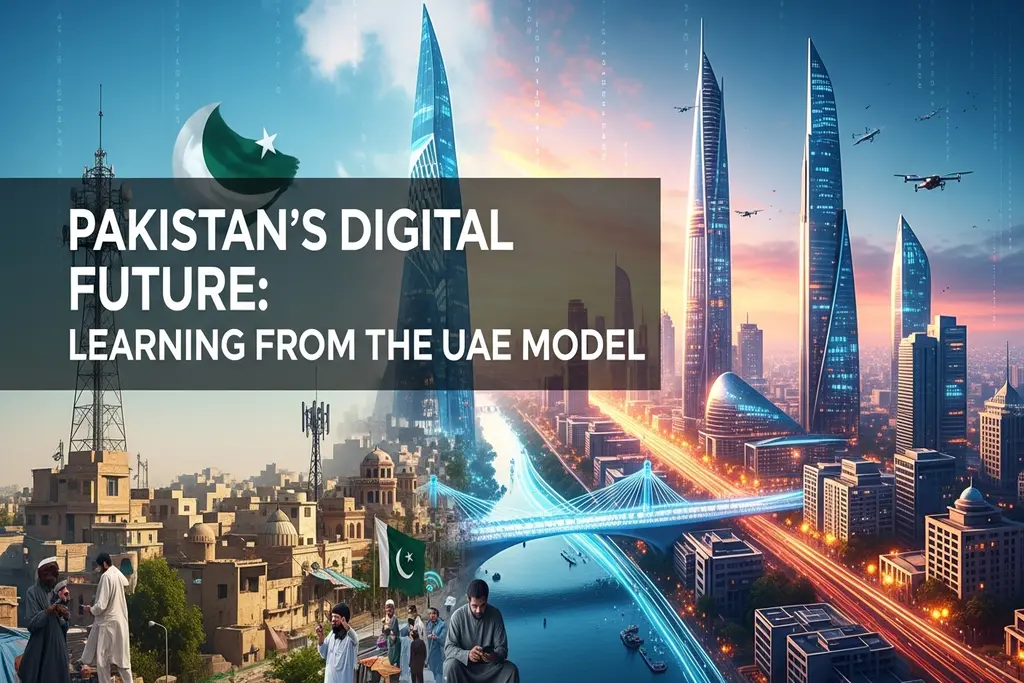
With Pakistan on the verge of a digital economic revolution, the way ahead will not only need ambition, but also a successful roadmap. Little more than a 30-minute flight, the United Arab Emirates (UAE) has become not a logistician center, but a capital of Artificial Intelligence and smart administration around the world.
To Pakistan, UAE is not just a neighbor, but a role model. Pakistan can accelerate the process of becoming a leading digital economy by examining the swift integration of AI in the UAE and capitalizing on the strong relationship that exists between our countries.
The Engine of Growth: Pakistan’s Push for IT Exports
The Pakistani economy is in the process of changing its tectonic plate and is shifting to high value technology exportation rather than the conventional textile.
The Target: The industry has an ambition of achieving one hundred billion dollars in terms of IT exports and currently enjoys an unparalleled rate of growth due to a youthful and tech-friendly population.
The Strategy: The pro-business climates in Dubai and Riyadh are being emulated by the recent reforms such as the Equity Investment Abroad (EIA) policy and the increase in the amount of foreign currency to be held by freelancers.
The Opportunity: Pakistan is establishing itself as the back office of the world, where high quality software development, BPO services and AI based solutions are available at a fraction of the global cost.
2. The Blueprint: UAE’s AI-Powered Governance Ecosystem
As Pakistan goes digital, UAE goes automatized. The Emirates is an example of the masterclass in implementing the use of technology in the very structure of the state.
Ministry of Possibilities: The UAE became the first country to designate a Minister of State of AI as a way of acknowledging that technology is not an IT department feature, but a priority of the cabinet.
Strategy 2031: The UAE National Strategy of Artificial Intelligence 2031 has set the objective of becoming the global leader in AI by the year 2031. This also involves 100 percent digital government services whereby paper bureaucracy is out of date.
Smart Cities: Autonomous transport in Dubai, AI-controlled energy in Masdar City, and Smart Cities are also evidence that smart governance can make life better in the UAE, which Pakistan is already attempting to take into account in its projects, such as the Digital Pakistan Stack.
3. The Human Bridge: Pakistani Talent in the UAE Tech Sector
The human capital is the secret weapon in this bilateral relationship. Pakistani professionals do not only work in the UAE, they are the principal contributors of its digital skyline.
- Tech Leadership: The UAE is the home to thousands of Pakistani software engineers, data scientists and startup founders. They are the pioneers of such critical projects in fintech, ride-hailing (such as Careem, which is also highly Pakistani in its origin), and e-commerce.
- Knowledge Transfer: This diaspora serves as a vital bridge. Professionals gaining experience in the UAE’s advanced regulatory sandboxes return to Pakistan with “future-ready” skills, accelerating local innovation.
- Collaborative Growth: Events like GITEX Global have become a meeting ground where Pakistani talent meets UAE capital, fostering cross-border startups that solve regional problems.
READ: More informative news