

A significant development has occurred, looking forward to furthering economic cooperation between Pakistan and Iran to new heights. The 10th meeting of the Pakistan-Iran Joint Trade Committee (JTC) has begun in the capital Islamabad. The two-day summit is of huge strategic and economic importance for both the neighboring countries. The meetings are being co-chaired by the Federal Minister for Commerce of Pakistan, Jam Kamal Khan and the Minister for Industry, Mining and Trade of Iran, Seyed Mohammad Atabek. The main goal of this landmark event is to accelerate the trade volume to boost bilateral trade, identify new investment opportunities and enhance regional connectivity, according to the officials of the Ministry of Commerce.
Joint Trade Committee Assembly: Delegation Structure and Key Sectors
The defining highlight of this 10th iteration is the participation of exceptionally large and influential delegations from both nations. An official government high-level delegation of 22 senior officials from Iran has come to Islamabad for the talks.
In addition to the state officials, a strong business delegation, headed by the Iran Chamber of Commerce, Industries, Mines and Agriculture (ICCIMA), is also actively involved in the negotiations.
Core Commercial Verticals: These are the commercial verticals which are important sectors such as food security, agribusiness, logistics, shipping, overland transportation, energy and heavy manufacturing.
This is an extensive inclusion that seeks to create direct institutional links between the private sectors of both nations and stimulate the development of business to business (B2B) collaboration schemes.
#Live: The 10th meeting of Pakistan-Iran Joint Trade Committee is underway in Islamabad.#News #RadioPakistan https://t.co/CPjCBpJ8T1
— Radio Pakistan (@RadioPakistan) August 4, 2026
Breakthrough Progress on the Pak-Iran Free Trade Agreement (FTA)
The most critical agenda item under active negotiation is finalizing the operational parameters of the Pak-Iran Free Trade Agreement (FTA) and eliminating barriers to its implementation. This follows a strategic blueprint set by both nations to expand their mutual trade volume to a target of $10 billion.
To achieve this milestone, the committee is holding detailed consultations on three core tactical interventions:
Customs and Banking Cooperation: The historical absence of direct banking channels has been a persistent roadblock to commercial growth. The delegation is negotiating alternative barter mechanisms and indirect financial arrangements to circumvent these friction points.
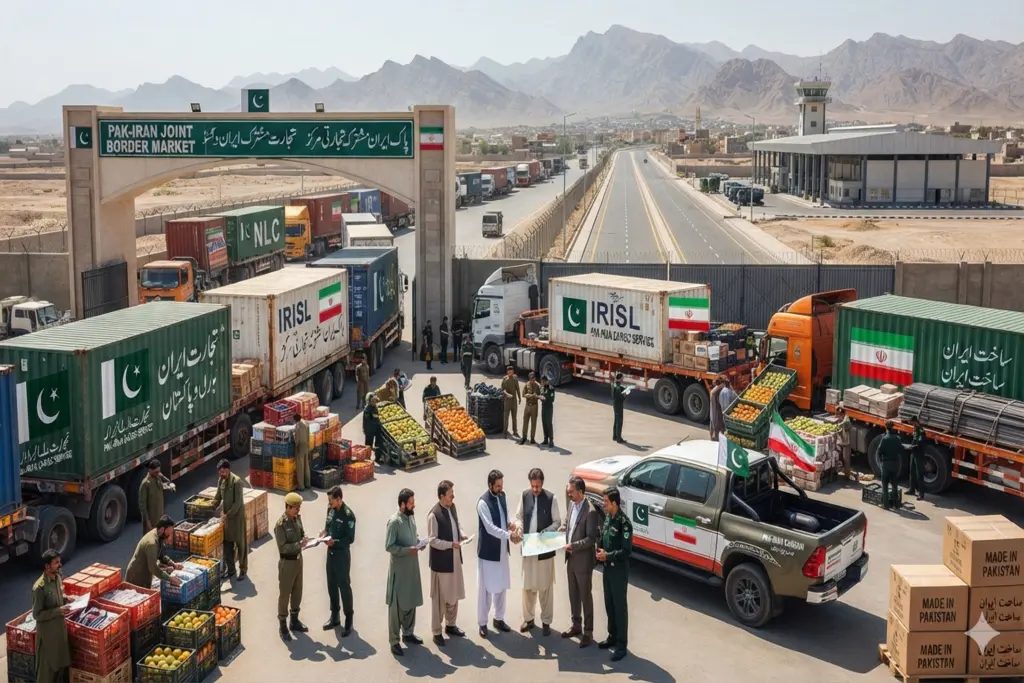
Border Infrastructure Upgrade: The council is currently working on putting in place joint market places at the borders and introducing digital customs clearance, which will help to reduce the time spent processing freight at the borders.
Transit and Transport Connectivity: Action is being taken to structurally reduce freight costs of cross-border merchants through improvements to dedicated cargo corridors and direct rail corridors.
Proposed Specialized Taskforce to Eliminate Non-Tariff Barriers
During the working sessions, the Vice President of the Iran Chamber of Commerce, Hossein Pirmoazzen, proposed creating a joint mechanism for the instant verification of trade documentation and origin certificates. The private sector delegates strongly recommended setting up a specialized task force bound to a fixed timetable. This body will be tasked with resolving merchant disputes, streamlining regulatory steps, and providing immediate remedies to exporters.
Given the shifting geopolitical realities, these economic negotiations are a vital step forward as Pakistan focuses on expanding its regional economic network. The conclusion of this 10th joint meeting is expected to yield several Memorandums of Understanding (MoUs) that will define the future trajectory of Pak-Iran trade relations.