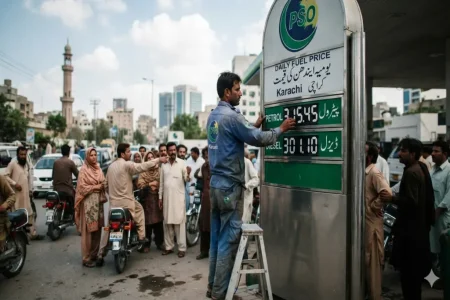




As global markets wax and wane, so too has diesel prices in Pakistan stubbornly and excessively high. For ordinary citizens, farmers and transporters alike, this means exorbitant inflation and rising cost of living. The solution to this crisis is not just global oil prices — it’s also a deeply flawed pricing mechanism set by the government andOil and Gas Regulatory Authority (OGRA), said former finance minister Miftah Ismail. Having that understanding of how this system operates reveals the source of this nonsensical additional cost consumers are bearing.
The Flawed OGRA Pricing Mechanism Explained
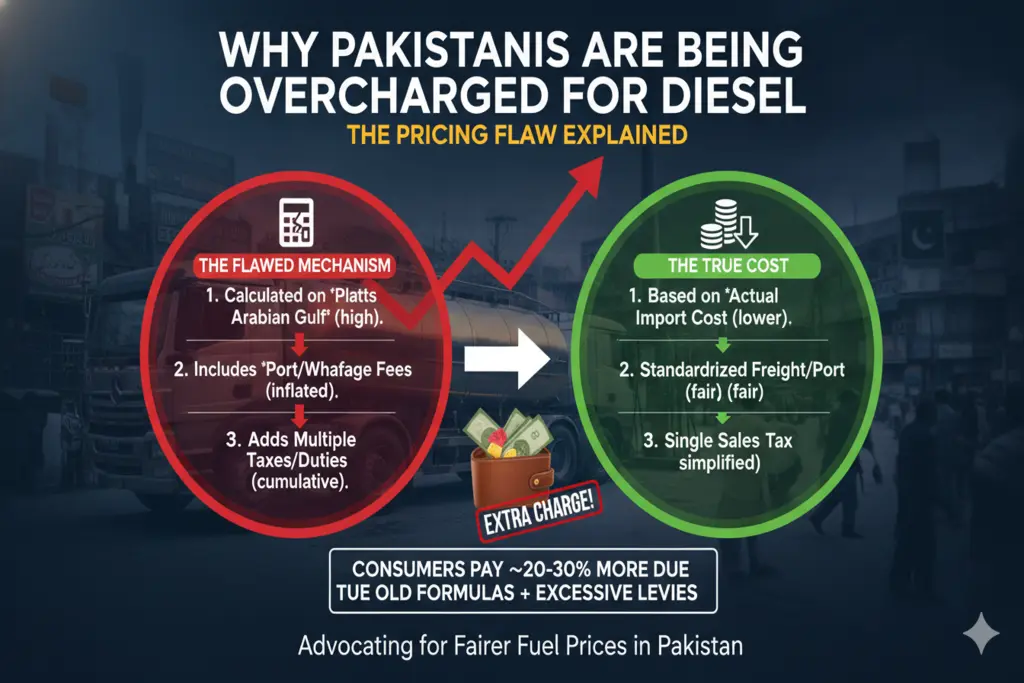
The root of the issue lies in exactly how Pakistan sources and prices its diesel. Pakistan currently produces approximately seventy-five percent of its diesel domestically through local refineries, importing only the remaining twenty-five percent from international markets to meet national demand. However, instead of calculating a fair, blended average price based on these two sources, OGRA sets the retail price for all diesel based entirely on the high cost of the imported portion. Because imported diesel is almost always significantly more expensive than locally produced diesel, applying the import rate to the entire domestic supply automatically and artificially inflates prices at the pump for every consumer.
The True Cost of Locally Refined Diesel
To understand the sheer scale of this overcharging, one must look at the actual mathematical numbers highlighted by the former Finance Minister. The true cost of producing locally refined diesel, which includes crude oil costs, the refining process, and standard margins, is around Rs. 350 per litre. Conversely, OGRA’s official retail price, which is based on imported diesel, sits at a staggering Rs. 496 per litre. This massive pricing gap means that Pakistani consumers are paying an unjustified premium of nearly Rs. 150 per litre for diesel that is refined right here at home.
If the pricing formula is not changed, next week’s diesel price is projected to be Rs 616 per litre as @AliKhizar has tweeted as per PSO projection. We need some basic competence in OGRA and govt to avert this self-inflicted disaster. Optics about austerity aren’t enough.
— Miftah Ismail (@MiftahIsmail) April 7, 2026
In… pic.twitter.com/qR9TsaJ0gd
Why Refineries Are Making Extraordinary Profits
Originally, this pricing mechanism was designed by the government to give local refineries a small extra profit margin. The logic was that this financial bonus would incentivize them to upgrade their aging machinery and produce better, low-sulfur diesel. Unfortunately, global disruptions, particularly the ongoing war in Iran, have significantly widened the price gap between crude oil and low-sulfur diesel traded internationally. Because the system is rigidly tied to international import prices, what was meant to be a small incentive has morphed into extraordinary, unearned profits for local refineries at the direct and heavy expense of the Pakistani public.
A Simple Mathematical Strategy to Lower Prices
Fixing this issue does not require complex economic maneuvering. Ismail proposed a temporary, highly effective measure to reduce excessive pricing, which is especially crucial right now during the high-demand agricultural harvesting season. He suggested centralizing imports by allowing only Pakistan State Oil (PSO) to import the small percentage of diesel the country lacks. Simultaneously, domestic diesel prices should be based on the actual cost of Arab Light crude plus standard margins, completely separating local production from the inflated imported price.
Let me try to explain why are diesel prices excessively high in Pakistan.
— Miftah Ismail (@MiftahIsmail) April 7, 2026
Pakistan produces about 75% of its own diesel. It imports the remaining.
OGRA/Govt sets price for diesel in Pakistan based on imported diesel price.
The price of imported diesel is always a little…
Implementing a Fair Blended Pricing Model
By using a blended pricing model, the government could provide massive relief to the public. If domestic diesel costs Rs. 350 and imported costs Rs. 500, OGRA could set the retail price at a blended Rs. 395 per litre. The government could then collect a small Rs. 45 levy on all diesel sales to exclusively compensate PSO for the extra cost of importing the expensive portion. By simply doing the math and averaging the costs, the price of diesel for the end consumer would drop by roughly Rs. 100 per litre overnight, providing immediate relief to transporters and farmers.
The Urgent Need for Petroleum Deregulation
The current pricing formula is unfairly burdening the agricultural and transport sectors, which directly drives up the cost of food, freight, and essential goods across the entire country. Ismail strongly recommended that the government adopt these straightforward mathematical solutions immediately and move towards completely deregulating petroleum prices by the end of May. Until the government fixes this mechanical flaw and stops applying imported prices to local production, Pakistanis will continue to pay an exorbitant hidden tax on their daily fuel.