


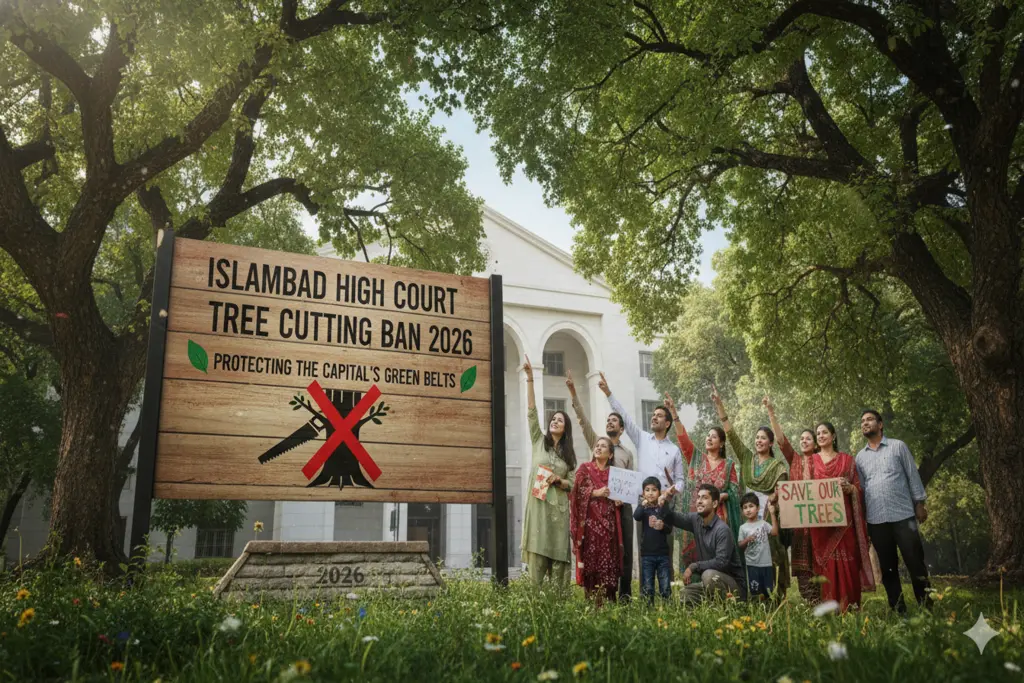
Today, April 17, 2026, the Islamabad High Court (IHC) made a bold move towards saving the dwindling green cover of the capital. The court passed an immediate stay order in a session which began early this morning against the commercial felling of trees within the green belts of the city of Islamabad and it heralded a big victory to the environmental activists and the people of Islamabad.
IHC Bans Commercial Tree Cutting
Islamabad, which used to be rated among the greenest capitals in the world, has had a hard time as a result of the high growth of urbanization and commercial invasion. The Islamabad High Court has responded in a keen move to curb this trend by declaring at 9:15 AM today that all business-related tree-cutting within the green belts of the city are banned. The decision points out that the green lungs of the city can not be sold and that they should be safeguarded according to the original Islamabad Master Plan.
The IHC Ruling: Protecting Islamabad’s Ecological Heritage
The court order was given under petitions to the court pointing at the illegal deforesting of the land to make way for private developments and commercial projects. The bench observed that green belts are non-commercial areas that are designed to purify the environment and to serve aesthetic purposes.
The court has instructed the Capital Development Authority (CDA) and Pakistan Environmental Protection Agency (Pak-EPA) to make sure that not even a single tree is cut on commercial grounds until further notice. This order in effect halts a number of infrastructural developments which were encroaching on the public green areas.
Why Commercial Tree Cutting in Green Belts Was Halted
The IHC indicated that there were a number of important violations that resulted in this emergency ban:
Breaking of the Master Plan: The initial 1960 Master Plan of Islamabad is a rigid segregation of residential, commercial and green areas.
Climate Change Concerns: As the capital warmed, the court acknowledged that clearing of mature trees would increase the effect of the urban heat island.
Absence of Environmental Impact Assessments (EIA): Lack of appropriate approval in conducting commercial clearances was being reported by many commercial clearances being conducted in Pakistan without the appropriate approval of the Pakistan Environmental Protection Agency (Pak-EPA).
The Role of the CDA and Enforcement Agencies
The Capital Development Authority (CDA) has now been under strict instructions to give a report with details of the current status of green belts in the city. The court threatened to punish any government official who was discovered to be helping in the illegal business or granting backdoor deals of cutting down trees would be subject to contempt of court.
This decision is likely to result in a city-wide inspection of all Blue Boxed lands under the Green Zone classification to determine whether it has been surrendered to commercial development without authorization which has been a source of dispute over years.
Long-Term Impact on Islamabad’s Urban Development
Environmentalists believe that such a ban is a needed reset to the development in the city. The IHC is leading the way in establishing a legal precedent, which could affect the way other metropolitan cities in Pakistan, including Lahore and Karachi, deal with their own environmental catastrophes.


1 Comment
Pingback: ECC Local Government Election Funds Clearance| Pakistan Truth