




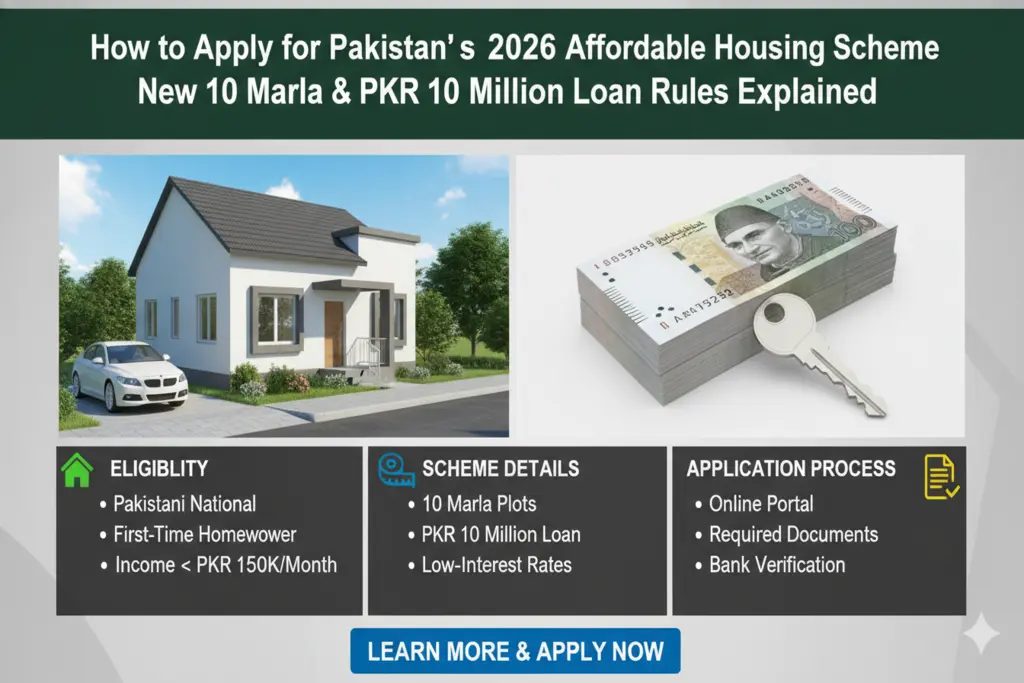
For everyone who is in the middle class and on a fixed income, owning a home is a much-awaited milestone. The Government of Pakistan (GP), the State Bank of Pakistan (SBP) and the Naya Pakistan Housing and Development Authority (NAPHDA) have introduced a subsidized mortgage system under Mera Pakistan Mera Ghar scheme to solve the shortage of houses in the country and boost economic activities.
This sovereign scheme has been designed to maximize its outreach by streamlining asset tiers with specific criteria for properties up to 10 Marla and financial assistance which had risen to PKR 10 Million (10,000,000 PKR). Available in both conventional and Islamic modes, this initiative enables commercial banks and microfinance institutions to extend credit at controlled, low interest rates. Whether you are aiming to buy a completed apartment, construct on an existing plot, or expand a pre-owned structure, this guide outlines the tiers, step-by-step documentation, and calculation structures for Pakistan’s 2026 Affordable Housing Scheme.
Financed Property Portfolios and Structural Tiers
The MPMG initiative splits capital disbursements into designated structural tiers to align with various socio-economic groups and project scopes. Financing under Pakistan’s 2026 Affordable Housing Scheme can be used for four core paths: purchasing a house/flat, purchasing a plot and building upon it, constructing on an already owned plot, or extending a pre-owned housing unit.
Tier 1: NAPHDA Specific Projects
- Maximum Financing Limit: Up to PKR 2.7 Million.
- Property Dimensional Caps: Residential houses measuring up to 125 Square Yards (5 Marla) with a maximum covered area of 850 Square Feet. Flat or apartment units are also capped at a maximum covered area of 850 Square Feet.
- Valuation Ceiling: To maintain low-cost parameters, the maximum market value of the single housing unit at approval cannot exceed PKR 3.5 Million.
Tier 2 & Tier 3: Non-NAPHDA Market Projects
- Tier 2 Allocation: Geared toward standard market houses or apartments up to 5 Marla. Financing brackets typically initiate at PKR 1 Million and move up to PKR 6 Million.
- Tier 3 Expansion (Up to 10 Marla): Formulated specifically to cater to larger family setups. This tier accommodates housing units measuring up to 10 Marla with specialized financing limits scaling all the way up to PKR 10 Million.
Subsidized Financing Rates and Monthly Installment Tiers
The main advantage of the scheme is the subsidy to the buyer for the neck in around the price structure which means that for the first 10 years of the loan tenure, the buyers are protected from the market prices (KIBOR) of such loans. The period of time in which they plan to repay the loan varies from 5 to 20 years.
The current interest rate of the benchmark KIBOR is 12.94% as of June 4, 2026, which makes these government-subsidized interest rates very attractive. The basic tier rates are as follows:
Year 1- 5: Fixed financing rate of 3% (Tier 1) or 5% (Tier 2/3) with a high subsidy.
Years 6 to 10: The markup shifts to a fixed 5% (Tier 1) or 7% (Tier 2/3).
Years 11 to 20 – Remaining Horizon: Standard Markets rates, dynamically calculated based on the KIBOR + up to 250 basis points (bps) applicable in the region at the time of the loan signature.
Estimated Monthly Installments (Based on a 20-Year Tenure)
| Financing Amount | Monthly Installment (Years 1 to 5) | Monthly Installment (Years 6 to 10) | Applicable Bracket |
| PKR 2.7 Million | PKR 14,974 | PKR 17,147 | Tier 1 (NAPHDA) |
| PKR 3.0 Million | PKR 19,799 | PKR 22,503 | Tier 2 (Non-NAPHDA) |
| PKR 6.0 Million | PKR 39,597 / PKR 46,518 | PKR 45,007 / PKR 52,492 | Tier 2 / Tier 3 |
| PKR 10.0 Million | PKR 77,530 | PKR 87,487 | Tier 3 (10 Marla Max) |
Framework Eligibility Requirements
The SBP enforces specific, transparent compliance baselines to ensure the subsidy directly benefits genuine, first-time buyers:
- Demographics: Open to all Pakistani citizens holding a valid Computerized National Identity Card (CNIC) or National Identity Card for Overseas Pakistanis (NICOP).
- The First-Time Owner Rule: Applicants must be first-time homeowners. An individual can access this subsidized mortgage facility only once in their lifetime.
- NAPHDA Allocations: For specialized public housing projects, NAPHDA directly shortlists eligible candidates and routes their financial portfolios to partner commercial banks.
Document Portfolio and Filing Requirements
The SBP has introduced standardized loan applications, facility offer letters, and property document checklists across all commercial, Islamic, and microfinance banks to fast-track verification.
Core Legal Documents (Required for All Income Types)
- Completed Loan Application Form (LAF) alongside a signed Central Registry (CF) Undertaking.
- Original signed Product Disclosure Sheet.
- Certified copies of the valid CNIC/NICOP of the primary applicant and co-partner.
- Two fresh passport-size color photographs.
- Signed legal undertaking confirming first-time homeowner status.
- Complete copies of property title files (Registry, Fard, allotment letters, or transfer deeds).
Income Verification Framework
- Formal Salaried Individuals: Original employment certificate or job letter, current salary slips (not older than 60 days; online e-slips are fully accepted without stamps upon digital verification), and an account maintenance certificate backed by the last 6 months of bank statements showing regular salary credits.
- Formal Business Owners: Valid proof of business operation, tax registration profiles, NTN certificates, and 6 to 12 months of certified corporate bank statements.
- Informal Income Persons: To accommodate workers in the informal sector, banks utilize standardized income proxy models and advanced statistical scorecards. These models assess behavioral patterns, telecom records, and utility histories, exempting informal workers from standard verifiable income slips.
Complaint Resolution and Regulatory Grievance Desks
To prevent processing delays or arbitrary rejections, the SBP operates a centralized Online Complaint Management System with a mandatory maximum resolution window of 8 working days.
Furthermore, help desks are active across 16 SBP Banking Services Corporation (BSC) offices nationwide. These physical hubs actively eliminate technology and language barriers, assisting applicants in filing grievances if they face ground-level operational resistance at commercial bank desks.