



With the continuous inflation and rising fuel prices in Pakistan, maintaining a car budget has become a major challenge for everyday drivers. This poor fuel mileage is more than a hassle, it’s a significant difference in your monthly savings. Poor fuel economy is a common complaint among drivers but some simple, wise driving mechanics could significantly reduce gas use. To get the best out of your car and for the longest time, it is necessary to understand how to increase your car’s fuel average.
Here are 3 practical, scientifically proven, and highly effective tips that will instantly improve your car’s fuel average.
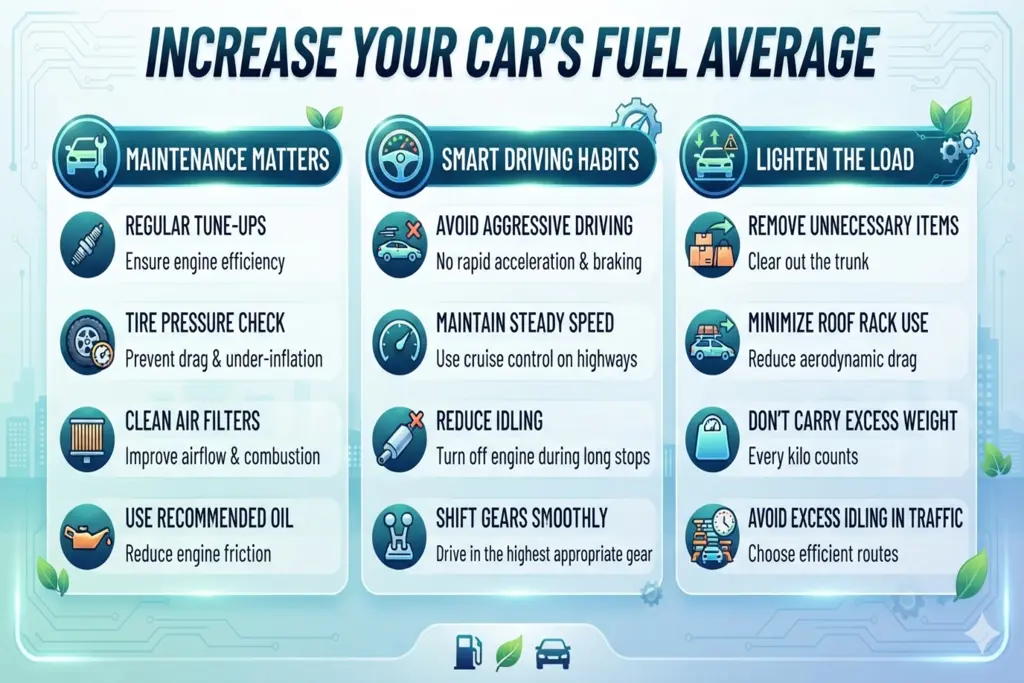
1. Maintain Correct Tire Pressure to Reduce Rolling Resistance
Your tires are the only place where they contact the asphalt. Under-inflated tyres have more area in contact with the road surface. This produces a large amount of ‘rolling resistance’, which is a term used for the frictional force.
Mechanical Strain: Tires with an improper tire pressure means that your engine has to work twice as hard to get your vehicle moving. To compensate for this physical resistance the electronic control unit (ECU) injects more fuel to the combustion chamber, which immediately causes fuel loss.
The Practical Fix: Do not guess your tire pressure by looking at it. Locate the exact pounds per square inch (PSI) recommended for your car on the sticker inside the driver’s side door frame. Check and fill your tires every week before driving long distances. According to global automotive data, maintaining the correct PSI can instantly boost your fuel economy by 3% to 5%.
2. Regularly Clean and Replace the Air Filter
In order for an internal combustion machine to function efficiently, a meticulously balanced fuel-to-air ratio is needed. The air filter in certain countries with high dust content and severe pollution, such as Pakistan, becomes clogged much faster due to the presence of dirt, sand and debris in the air.
The Engine Choke Phenomenon: A clogged air filter deprives the engine of fresh air. To compensate for the lack of air, the car’s computer automatically injects an excess amount of gasoline into the cylinders. This condition is mechanically referred to as “running rich.” It leads to delayed acceleration, black exhaust fumes and a huge loss in mileage.
Practical Fix: Regularly ask your mechanic to blow the dust from the air filter with a powerful air jet every 2,000-3,000 km. Also, change the air filter completely, as per the manufacturer’s instructions (typically at 10,000-15,000 km intervals). A clean air passage allows the engine to breathe better and that makes the best use of the fuel.
3. Optimize Aerodynamics and Smooth Out Your Driving Style
Driving aggressively, such as accelerating too hard (hard acceleration) or braking suddenly, can have a detrimental effect on fuel economy, up to 30%. In addition, the mechanical problems that are created when you open your windows at high speeds are huge and unseen to your engine.
Aerodynamic Drag: At speeds over 60/80 kmph, wind buffets the car as opposed to sliding over it, resulting in a loss of aerodynamic efficiency. This forms an air trap, called aerodynamic drag. The engine has to burn excessive amounts of fuel just to fight through this heavy wind resistance.
The Practical Fix: Adopt a smooth driving style by anticipating traffic and letting your vehicle coast naturally before reaching a stop. For speed management, follow a simple rule: keep the windows down while driving at low speeds inside local city streets. When you’re on a highway or motorway, however, roll the windows tight and use your air conditioner (AC) on the “moderate” setting. This helps to minimise drag and conserve more fuel on long trips.