


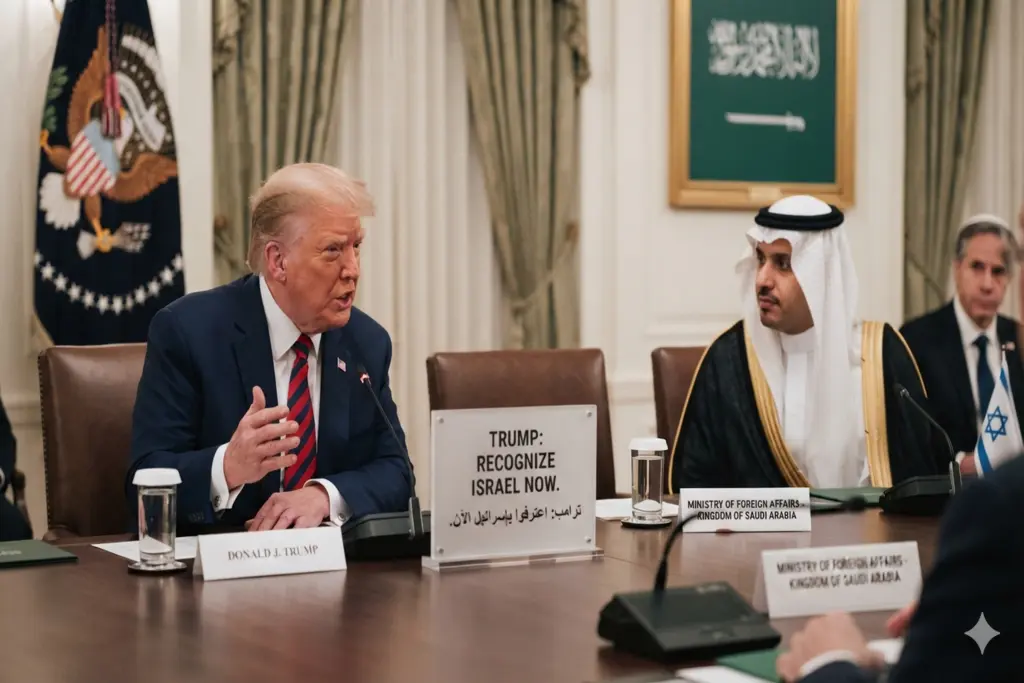
US President Donald Trump has opened a diplomatic Pandora’s box in Middle Eastern geopolitics by clarifying that the civilian nuclear cooperation pact signed between the United States and Saudi Arabia will only move forward if Riyadh formally recognizes Israel. In a recent statement issued on his social media platform, Truth Social, President Trump declared that the Washington-Riyadh nuclear accord is “fully conditional on Saudi Arabia joining the Abraham Accords.” This sudden pronouncement has stunned diplomatic circles globally, and analysts agree that when Trump tells Saudis to recognize Israel, it completely upends the strategic calculus of the entire region.
The US-Saudi Nuclear Deal and Trump’s Strict Provisos
Interestingly, this rigid ultimatum emerged just 24 hours after the Trump administration signed the civilian nuclear agreement.In the original terms of the bilateral agreement, announced by the US Secretary of Energy, there was no mention of the energy agreement being linked to the normalization of ties with Israel. The move sparked considerable criticism from pro-Israel lobbies and conservative media in Washington. In response, President Trump promptly tightened his stance, stating that the agreement “clearly and unambiguously” bars Saudi Arabia from enriching uranium within their own country, and only allows assistance to be used for peaceful domestic energy production. The stringent conditions were confirmed by White House Press Secretary Karoline Leavitt, who said the “deal is off” if Saudi Arabia declines to normalize.
TRUMP SAYS SAUDI RECOGNITION OF ISRAEL WOULD BE REQUIRED FOR NUCLEAR DEAL
— Washington Eye (@washington_EY) July 23, 2026
President Donald Trump said Saudi Arabia would need to formally recognize Israel as part of any agreement involving U.S. support for a Saudi civilian nuclear program. The remarks link progress on a… pic.twitter.com/paXHToKrOd
Saudi Arabia’s Principle Stance and the Question of Palestinian Statehood
Saudi Arabia’s long-standing and historic foreign policy position has been to not recognize an Israeli-Palestinian peace agreement without an independent, sovereign Palestine state. Saudi Crown Prince Mohammed bin Salman has also stated that the public and the entire Muslim world will not accept a deal that ignores the core Palestinian issue. Following this new friction, Riyadh has maintained a careful silence. The Kingdom is caught in a strategic gridlock, desiring state-of-the-art American civilian nuclear technology but remaining unwilling to compromise its foundational stance on Palestinian statehood.
The Abraham Accords and the Reshaped Geopolitical Landscape
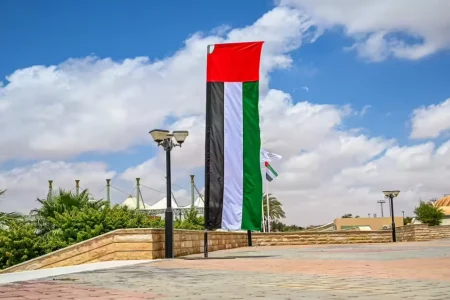
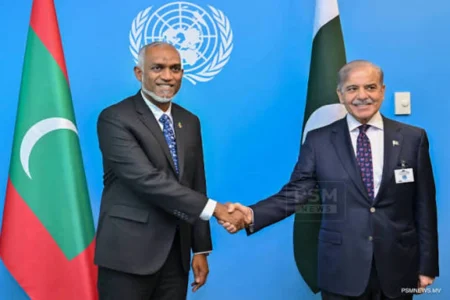
President Donald Trump has seen the Abraham Accords, which paved the way for Israel and Arab states such as the UAE, Bahrain and Morocco to normalize their relations, as the success of his foreign policy. Trump now intends to expand this framework to larger Muslim countries like Saudi Arabia, Qatar, and Pakistan to counter regional Iranian influence and secure Israel’s long-term integration. Strategic experts warn that this intense pressure could trigger a new diplomatic cold war or an arms race, as blocking US nuclear cooperation may push Riyadh to seek civilian atomic partnerships with alternative global powers like China or Russia.