




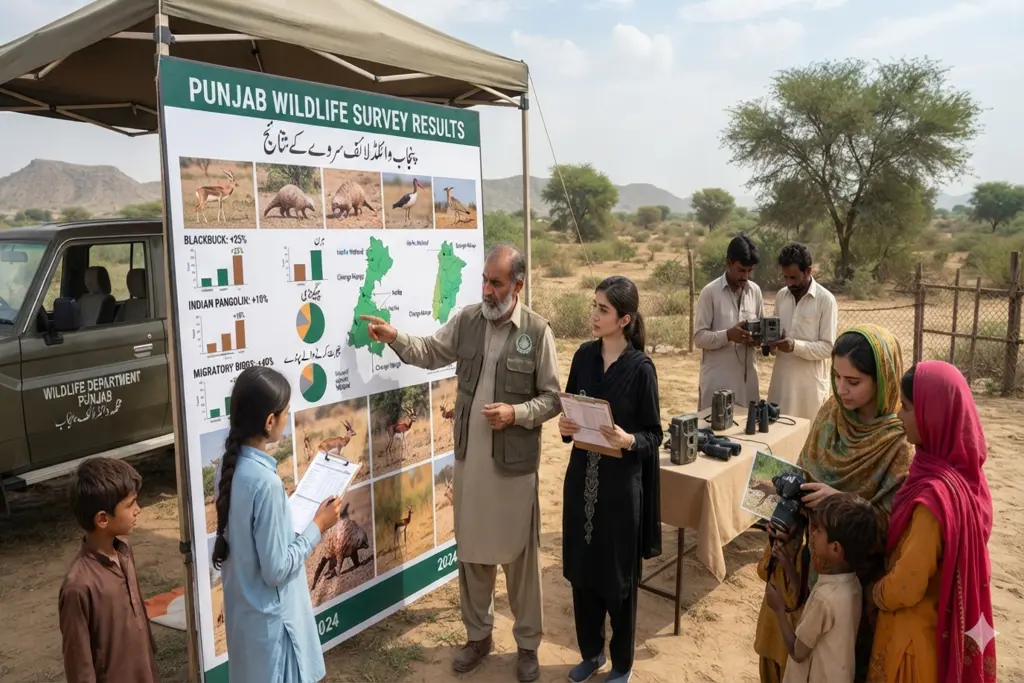
The Punjab Wildlife and Parks Department, in partnership with the International Union for Conservation of Nature (IUCN) Pakistan, has successfully completed the province’s first-ever comprehensive scientific animal census in a landmark effort for environmental conservation, biodiversity monitoring and evidence-based ecological planning. The officially released results of the wildlife survey carried out in Punjab have caught both environmentalists and policy makers off guard with the population baselines of several endangered and elusive native species being found to be very encouraging.
The large-scale ecological project utilized a substantial budget of Rs. 530 million to deploy advanced digital tracking, drone thermal scanning, spatial mapping software, and network-integrated camera traps across Punjab’s diverse ecosystems, including its dense forests, expansive deserts, and vital wetlands. The objective of this intensive field operations framework was to construct a transparent, computerised inventory of the province’s wildlife assets to effectively counter habitat loss and illegal poaching.
Encouraging Mammal Populations and the Indus Dolphin Recovery
The census data brought forward vital metrics concerning large and small mammals inhabiting Punjab’s protective zones, game reserves, and the rugged terrain of the Salt Range and Potohar plateau. The findings indicate stable growth paths for multiple vulnerable species:
One of the most remarkable findings of the survey to record was the successful logging of a total of 5,128 Punjab Urials which are flourishing in their natural habitat of the mountains.
In the protected plains and desert sanctuaries, field teams successfully counted 1,276 Chinkara Gazelles, 160 Blue Bulls (Nilgai), 138 Hog Deer and 93 rare Blackbucks.
The census, performed with cutting-edge underwater acoustic sensors and high resolution underwater cameras, along the Indus river’s fresh-water corridors, has confirmed that there are 540 Indus Dolphins, a critical step for freshwater marine conservation.
Extensive Avian Audit and the Identification of Rare Vultures
The bird population mapping framework, governed by strict operational standards and automated sound identification software, generated an extensive database tracking native and migratory avian species. The official audit highlights:
An impressive count of 92,636 Grey Francolins, 40,526 Black Francolins and 6,052 Chukar Partridges that were observed in agricultural and hilly areas.
Houbara Bustards and Game Birds: 1821 Houbara Bustards were recorded and 49 Kalij Pheasants were recorded in deep forest canopy of sub-mountains here.
Critically Endangered Vultures: The census identified 345 rare vultures nesting at sites which are vital to clean ecological cycles, as a great success in environmental management on the local level.
Comprehensive Mapping of Reptiles, Amphibians, and Flora
To paint an accurate, holistic picture of Punjab’s active biodiversity index, field biologists expanded their manual tracking charts to log reptiles, amphibians, and native tree covers. The validated tracking registry includes:
7,600 Bullfrogs and localized amphibians inhabiting critical marshlands.
1070 Bengal Monitor Lizards, 720 Indian Softshell turtles and 85 Indian Cobras.
The highest level of the province’s reptilian food chain is represented by 22 Indian Rock Pythons.
At the same time, the density of native tree canopies (covers) has been mapped by the teams, focusing on native trees like Shisham (Tahli), Kikar, Pipal, Phulai and Peelu trees. Project Director Asim Jamal said this is a verified scientific database that will be the foundation of making a first-ever official “Red Data Book” of Punjab. This publication will shape future wildlife legislation, regulate commercial hunting permits, and direct international conservation funding lines.