




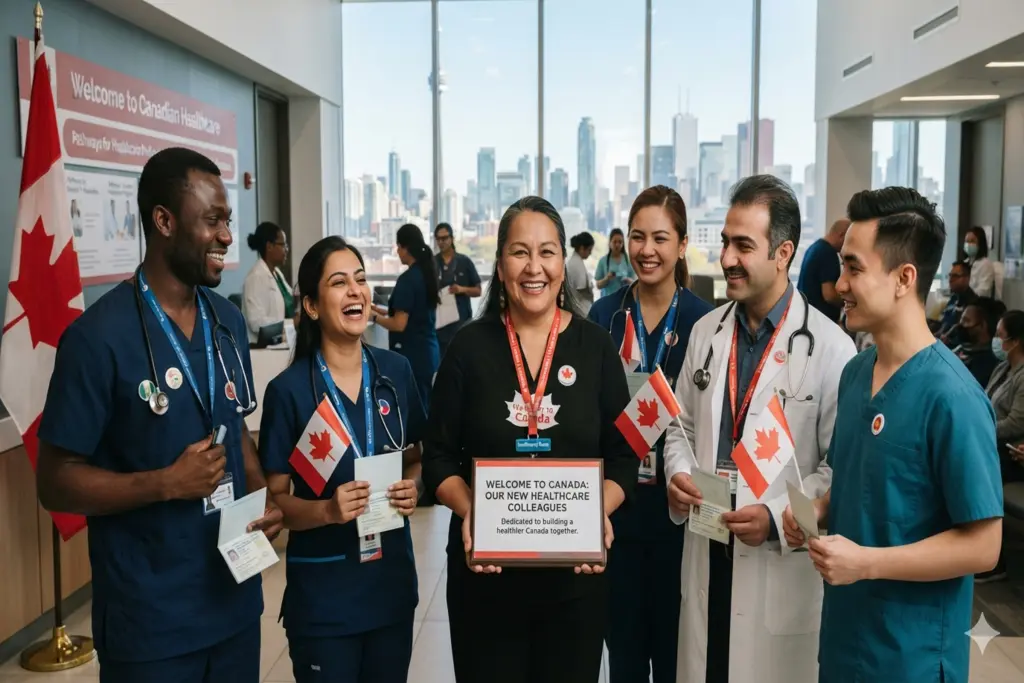
Canada has made a monumental effort to overcome the serious healthcare shortage in the country by substantially increasing the priority immigration stream for healthcare workers from around the world. Immigration, Refugees and Citizenship Canada (IRCC) is actively hiring qualified professionals from Pakistan including Nurses, Dentists, Pharmacists, General practitioners, Psychologists, and Social workers and has provided them with a fast-track pathway to Canadian Permanent Residency (PR).
The federal and provincial governments have updated their immigration handbooks as Canada’s aging population puts unprecedented strain on the country’s clinical care system. Outdated, manual processing queues have been replaced with automated, data-driven Express Entry draws to rapidly integrate foreign medical talent into the Canadian healthcare workforce.
The 12-Month Rule and Category-Based Express Entry Overhauls
The structural cornerstone of this recruitment drive is Canada’s Category-Based Express Entry Healthcare Draws. However, under a critical regulatory update implemented on February 18, 2026, the IRCC has enforced strict new compliance criteria known as the 12-Month Work Experience Rule.
Under this updated administrative framework, prospective medical applicants must fulfill specific operational targets:
Minimum Experience Threshold: The number of months of continuous or non-continuous minimum full-time work experience, or an equivalent number of months of part-time work in the same designated medical occupation, is 12 months.
Recency Parameter: All of this clinical experience must be obtained in the previous three years before completion of the Express Entry profile.
Historical Low CRS Thresholds: These draws are unique in that they are dedicated to those who work in the clinical sector, which is why the Comprehensive Ranking System (CRS) cut-off scores have been reduced. Compared to general draws, the last couple of years have seen a significant drop in healthcare-specific scores, now in a favorable range of 467-475 points, which means that qualified Pakistanis can now get Invitations to Apply (ITAs) with lower scores.
14-Day Fast-Track Work Permits and Specialized PR for Doctors
For fully qualified Pakistani physicians, family doctors, and surgeons, the Canadian government has launched an even more aggressive, fast-tracked economic migration model. Operating alongside the Provincial Nominee Programs (PNPs), Canada now guarantees a 14-day fast-track work permit for physicians who secure a valid employment offer from a Canadian provincial health authority.
This specialized mechanism allows Pakistani doctors to relocate to Canada in under two weeks. They can begin practicing under provisional institutional supervision while their formal permanent residency applications are processed by central migration data hubs.
Furthermore, for physicians who already hold 12 months of domestic Canadian clinical experience, the IRCC has activated a dedicated Physicians-Only Express Entry draw. In recent allocation rounds, the selection threshold for this stream hit an all-time low of just 169 CRS points, representing the most accessible immigration corridor in Canadian history.
Mandatory Document Verification and Professional Licensing Checklist
For Pakistani healthcare experts seeking to leverage these lucrative immigration opportunities, there’s a detailed and multi-layered process for credential verification:
The Educational Credential Assessment (ECA): Doctors need to have their medical credentials scanned and verified by the Medical Council of Canada (MCC). Nurses, pharmacists and other allied professionals must go through an authorized body, such as the World Education Services (WES), to obtain their degrees.
Healthcare in Canada is provincially regulated, meaning that in order to begin the evaluation of clinical skills, the applicant must register with the particular healthcare regulatory board of their province or territory (e.g., the College of Nurses of Ontario or the College of Physicians and Surgeons of Alberta).
Language Proficiency Testing: Candidates must pass an automated test (e.g. IELTS and/or CELPIP) and achieve minimum Canadian Language Benchmark (CLB) levels for their occupation code.