



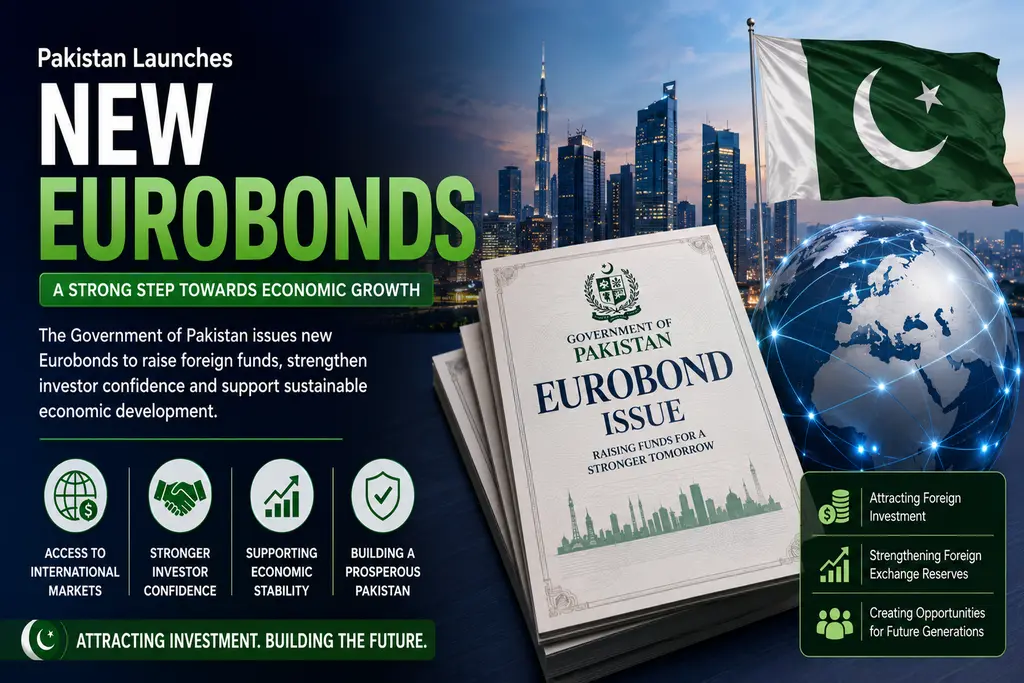
In a decisive move to strengthen its economic recovery and reinforce external financing, the Government of Pakistan has officially initiated the transaction process for a benchmark, US dollar-denominated dual-tranche Eurobond. Khurram Schehzad, Adviser to the Ministry of Finance, confirmed that the government has set the groundwork to issue long-term bonds. The rollout of Pakistan’s new Eurobonds launch takes advantage of a favorable shift in investor sentiment, following consecutive upgrades in Pakistan’s sovereign credit ratings and visibly strengthening macroeconomic indicators.
Introducing Five and Ten-Year Long-Term Tenors
According to the official circular from the Ministry of Finance, the proposed offering focuses on long-term maturities rather than short-term instruments. The government is inviting global institutional investors to subscribe to 5-year and 10-year tranches. This long-term borrowing framework serves as a major test of international market confidence regarding the sustainability of Pakistan’s sovereign debt profile.
The strategy follows a successful short-term intervention in April 2026, when Pakistan ended a four-year global capital market absence by securing $500 million through a 3-year Eurobond. Due to overwhelming investor appetite, that initial amount was upsized to $750 million via a green-shoe option. Building on that momentum, the economic team is now extending the country’s maturity profile.
Capitalizing on Sovereign Credit Rating Upgrades
The push for Pakistan’s new Eurobonds launch is strategically timed with international validation. Renowned international rating agency Moody’s recently upgraded Pakistan’s local and foreign currency sovereign ratings to B3 from Caa1, retaining a stable outlook. S&P Global Ratings and Fitch Ratings have similarly assigned stable benchmarks aligned with the sovereign threshold, rating the Global Medium-Term Note (GMTN) program at ‘B’ and ‘B-‘ respectively.
With improved governance, reduced domestic borrowing costs, and stabilizing foreign exchange metrics, the Ministry of Finance intends to negotiate a target yield lower than previous high-risk brackets. The broad-based capital drive is expected to raise between $1 billion and $1.5 billion depending on building book orders. Concurrently, the government is also advancing plans to float $750 million worth of yuan-denominated “Panda Bonds” to diversify funding streams.
Deepening Foreign Exchange Reserves and Debt Management
The injection of funds from this capital drive is vital to offsetting Pakistan’s heavy upcoming external debt repayment schedules. The proceeds, generated under the GMTN program, will flow directly into the State Bank of Pakistan (SBP) to serve as a financial cushion for the national treasury.
By successfully building up dollar reserves, the government aims to suppress volatility in the local currency exchange market. Financial analysts note that while commercial market bonds carry higher yields than multilateral concessionary loans, securing long-term institutional investment establishes a critical market-driven pricing benchmark. It also marks a transition away from an over-reliance on bilateral bailouts, paving a sustainable path for open-market fiscal operations.




1 Comment
Pingback: Pak Economy Growth Strategy: Finance Minister OICCI Update