




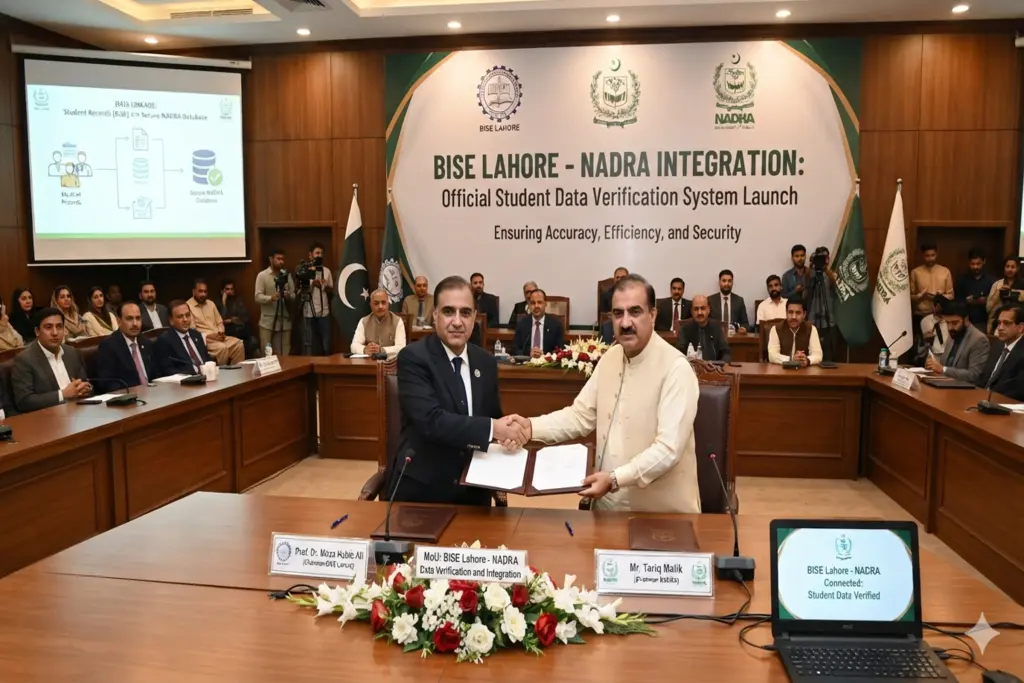
In a major citizen-centric deployment aimed at upgrading provincial academic administration, automating student data entry validation, and completely removing human error vectors from the public examination lifecycle, the Board of Intermediate and Secondary Education (BISE) Lahore and the National Database and Registration Authority (NADRA) have officially signed a historic data-integration agreement.
The comprehensive structural realignment transitions legacy manual student profile entry routines into a highly integrated, software-driven data verification sandbox. Validated directly by federal and provincial data security managers, the newly active regulatory framework connects student registration for Matric and Intermediate examinations directly with NADRA’s central national identity repository, ensuring absolute data integrity, paperless academic logging, and friction-free enrollment processing for thousands of examination candidates across the province.
NADRA and the Board of Intermediate & Secondary Education Lahore have signed an agreement to link student registration for Matric & Intermediate exams with NADRA’s national identity records. The secure data exchange will help reduce errors and improve record accuracy. pic.twitter.com/4usnmRm8G8
— NADRA (@NadraPak) September 24, 2026
BISE Lahore-NADRA Records Linking
To satisfy strict transparency benchmarks and ensure that the provincial education grid operates without localized document vulnerabilities, the specialized configuration establishes a secure data exchange between the two institutions. School administrators and corporate education managers can now safely bypass legacy manual checking routines by routing candidate profiles through automated verification systems.
The engineered database synchronization platform operates on three critical performance layers to ensure zero vulnerability:
Frictionless Identity Synchronization: The custom gateway interface links directly with NADRA cloud servers, cross-referencing biographical data in milliseconds to instantly auto-match and lock student names, parentage, and exact dates of birth, eliminating manual typos.
Eradication of Proxy Candidate Vulnerabilities: Shifting digital registration logs directly into a tamper-proof verification matrix allows invigilators to run automated carbon-copy matching against the national database, effectively blocking proxy entries or impersonation fraud at exam centers.
100% Cashless Grievance Rectification: Coordinating with provincial fintech networks to manage correction loops or data verification fees through secure online banking layers, establishing a completely paperless ledger for administrative auditing.
Restructuring the Academic Index
The socio-economic and administrative implications of this high-utility cross-platform integration are extensive, playing a crucial role in upgrading Pakistan’s secondary educational index ratings. By condensing a multi-week data validation lifecycle into an immediate digital lookup interface, the state directly removes administrative bottlenecks that historically injected severe transaction friction across thousands of domestic households during admissions season.
Furthermore, the centralized data grid ensures that downstream educational vectors—such as college entry allocations and high-yield professional university enrollments—remain perfectly aligned with authenticated biographical data models. A specialized technical help desk has been activated by the board to handle real-time synchronization inquiries and resolve communication network alerts for participating schools. By driving deep institutional digitization and removing legacy manual workflows, Pakistan establishes a resilient blueprint for sustained, high-utility student record protection across national public networks.