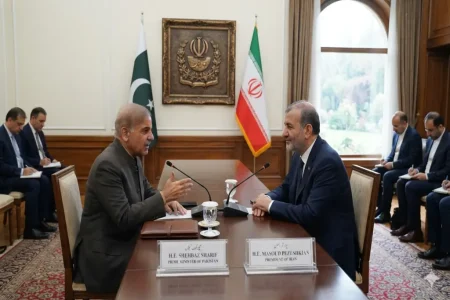





Pakistan has achieved another significant forward leap in its geopolitical efforts in the field of defense diplomacy with the establishment of operational readiness to safeguard the territorial integrity of Saudi Arabia. In a major geopolitical step towards defense diplomacy in the Middle East Pakistan has made its cross border tactical coordination and global Islamic alignment architectures operational and ready to defend the territorial integrity of Saudi Arabia. The highly visible and strategic positioning change transforms bilateral security arrangements from reactive into a multi-state defense sandbox. In response to the ongoing regional tension in the Arabian Peninsula leading religious and public personalities backed by high-ranking government officials have reiterated that national resources are well secured to guarantee the sanctity of the Two Holy Mosques.
Monitoring fluid maritime and border telemetry along the Red Sea corridor ensuring the sovereignty of lines in friendly Islamic States has been an absolute priority in the federal planning approach. Prominent scholar Allama Hisham Elahi Zaheer issued a statement pointing out that a large reservoir of Pakistani youth is ready to join in operational support to Riyadh if the latter formally asks for operational assistance to them in the line of battle. While his remarks underscore grassroots societal solidarity rather than official military deployment paths they mirror the strict baseline policy currently executed by the state’s central executive.
Allocation of the Mecca Joint Defense Agreement and Multi-State Ingestions
According to official diplomatic briefing papers reviewed by corporate defense analysts Pakistan’s security ties with the Kingdom operate under a highly structured system vetted international alliance framework.
The unified trilateral configuration functions across three primary strategic tracks:
The Trilateral Defense Coalition: Under the newly active Mecca Joint Defense Agreement member states including Pakistan, Saudi Arabia and Turkey maintain a synchronized mutual defense matrix to counter asymmetric regional threats.
The Sovereign Red-Line Mandate: Prime Minister’s Coordinator for Religious Harmony Hafiz Tahir Mehmood Ashrafi formalized the administration’s stance declaring the security of the holy sites as an unalterable red line protected by the combined weight of Pakistan’s government and armed forces.
The Counter-Insurgency Tracking Filter: Federal coordinators have firmly rejected the framing of regional border skirmishes as sectarian conflicts officially classifying hostile non-state actors such as Yemen’s Ansar Allah (Houthis) as disruptive entities requiring strict anti-terrorism monitoring profiles.
Restructuring Diplomatic Enforcement Through Vetted Multilateral Frameworks
The broader macroeconomic and national security implications of this defense alignment are extensive, directly backing long-term trade infrastructure grants, oil credit lines and joint industrial engineering ventures across the cross border pact. Foreign Minister Ishaq Dar has continuously repeated that members of the Mecca collective will act in absolute structural unison to maintain regional balance sheet equilibrium whenever safety parameters face unexpected deficits.
| Alliance Vector | Mandated Strategic Function | System-Vetted Monitoring Node |
| Mecca Defense Grid | Deploy trilateral hardware and logistics tracking protocols. | Joint Central Command (Pakistan, Saudi, Turkey) |
| Federal Executive Node | Maintain zero kontakt loops outside approved state channels. | Ministry of Foreign Affairs (MoFA) |
| Public Sector Ingestion | Mobilize deep civic and scholastic resource validation streams. | National Religious Harmony Advisory |
By shifting from slow historical manual treaty protocols to digitalized high-speed security handshakes the alliance successfully suppresses local misinformation loops. The integration of the deployment demonstrates absolute readiness with a clear assurance that Pakistan is able to conduct defence logistics in a seamless and efficient manner while adhering to the regional security parameters. The state’s new cross-border communication tools and advanced transparency channels reduce strategic friction gaps, strengthen the trust of energy and defence investors and help protect sovereign macroeconomic sustainability indexes.