


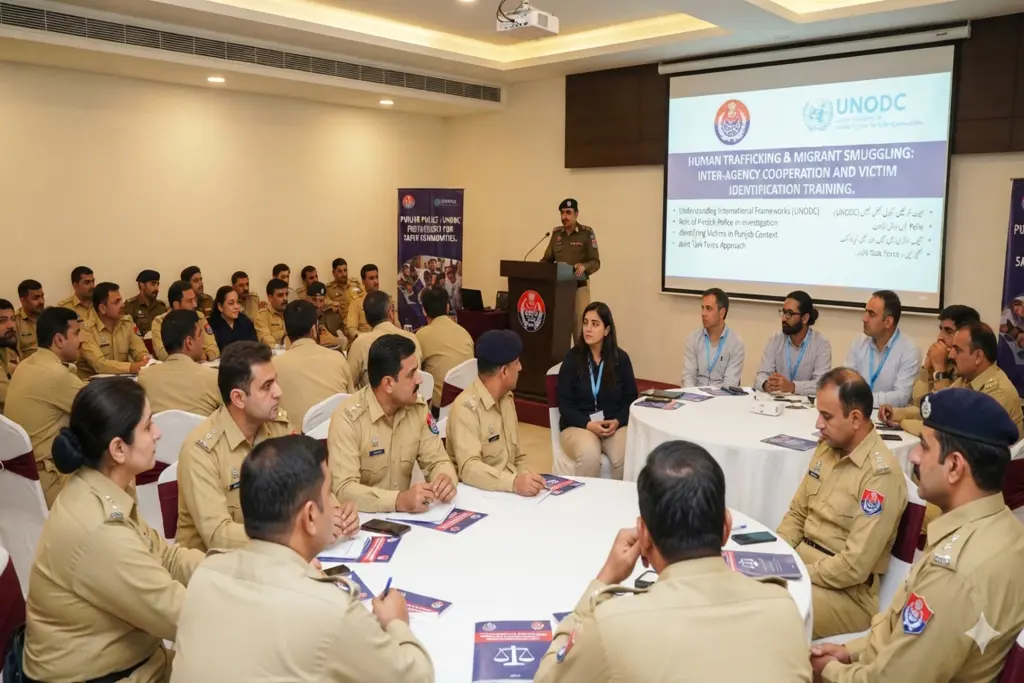
The United Nations Office on Drugs and Crime (UNODC) has officially asked the Punjab Police to nominate four police officers working on the ground for specialized training on cross-border crime interception and human rights compliance as a major institutional development for the province’s law enforcement modernization. The international initiative of training moves legacy cross-border crime monitoring into a system vetted advanced law enforcement sandbox. The UNODC mandate includes an explicit requirement for female staff to be represented appropriately in order to ensure gender parity in the operational tracking units which is sent to the Inspector General (IG) Punjab through an official communication.
International planners have an absolute priority in ensuring that regional police forces can be linked to data-verified screening and identification protocols as transnational organized crime syndicates severely challenge the transit networks of South Asian countries. Pakistan’s strategic geographical location makes it susceptible to businesses of irregular migration and forced labour in the critical geographical corridor to the Middle East and Europe.The strategic geographical location of Pakistan makes it vulnerable to businesses of irregular migration and forced labour in the critical geographical corridor with Middle East and Europe. The UN program directly brings sophisticated detection and forensics tool-kits to the first response officer, eliminating operational detection limits, tying bilateral law enforcement trust and giving institutions a progressive image of institutional accountability on the global stage.
Allocation of UNODC Counter-Trafficking Training Matrices
According to the official platform frameworks released by the UNODC Pakistan cell the specialized curriculum scheduled for deployment in Lahore entirely focuses on modern operational detection kits. The program handles frontline capacity building across several target configuration pathways:
The Interception Telemetry Module: Frontline law enforcement officers will be trained in more specialized data-driven methods to identify, detect and intercept complicated human trafficking grids operating within the region.
Vulnerability Identification Filter: Vetting procedures are clearly redesigned to enable field personnel to identify vulnerable irregular migrants and operate victim protection lines without delay.
The UN Compliance Protocol: Nominations are being processed ahead of schedule to synchronize logistics and administrative files in strict accordance with applicable United Nations rules and regulations.
Criminal justice responses to TOC: a need for restructuring
The wider socio-economic and security impacts of this UN-led synchronisation are significant, directly supporting indicators of internal security at state level as well as boosting international ranking on indicators of human development. The first-line police officers who deal directly with victims of trafficking suspected trafficking victims suspected traffickers and facilitators deal with them long before other judicial authorities which is why their ability to identify traffic victims on the spot is important for their success.
| Training Execution Vector | Mandated Operational Vector | Vetted Monitoring Node |
| UNODC Pakistan Core | Deliver fully funded specialized capacity-building packages. | UN Central Training Registry Islamabad |
| Punjab Police Nominations | 04 Frontline Officers (Mandatory Female Inclusion). | Central Police Headquarters Lahore |
| Transnational Crime Filter | Intercept South Asia-to-Europe irregular migration lines. | Global Border Surveillance Grid |
By moving away from slow uncoordinated investigative models and adopting the UNODC’s integrated multi-agency communication channels Pakistan systematically closes loopholes used by illegal border crossing rings. The operational setup confirms total system readiness verifying that the Punjab Police can execute transnational crime crackdowns that satisfy strict global transparency and civil rights metrics. Through these synchronized connectivity assets and modernized enforcement frameworks the state successfully drops localized crime footprint indices, protects vulnerable displaced populations and safely safeguards sovereign human development indices.