

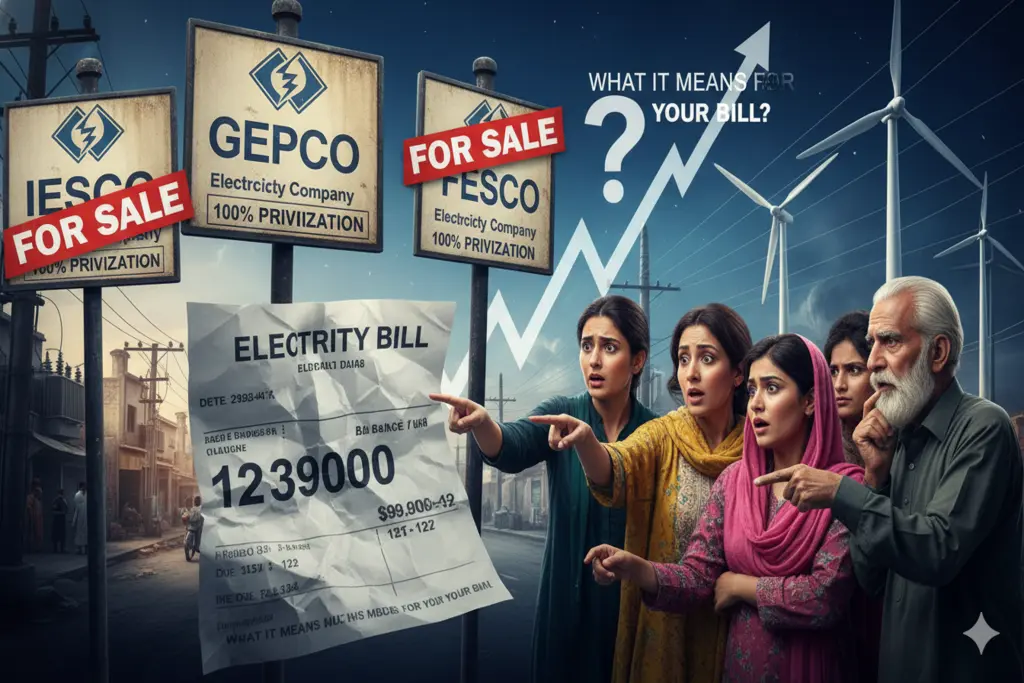
A monumental structural shift is officially underway in Pakistan’s power sector. The Cabinet Committee on Privatization (CCoP) chaired by Deputy Prime Minister Ishaq Dar, on Tuesday formally approved transaction structures for the outright sale of the Islamabad Electric Supply Company (IESCO), Gujranwala Electric Power Company (GEPCO), and Faisalabad Electric Supply Company (FESCO).
In this newly drafted system, the federation plans to sell up to 100% of its stake to private foreign or domestic groups and hand over full control of the company to them. Living in areas served by these power distribution companies (DISCOs) will significantly impact your family budget and the local job market. This big wave of privatization has an intricate background, and what it will entail for you is outlined below.
The Privatization Model: Total Management & Equity Transfer
Unlike previous attempts at public-private partnerships that only handed over partial administrative rights, the government is moving forward with a full-scale divestment strategy.
- Equity and Share Sales: The state will offload a controlling interest (up to 100% of strategic shares), which effectively strips the Ministry of Energy of active operational management over these entities.
- Autonomous Commercial Administration: Private buyers will hold unchecked power over pricing structures (within regulatory boundaries), consumer billing collections, technological upgrades, and internal staffing.
- The Main Objective: This aggressive move is driven by the state’s desperate need to curb the ballooning energy sector circular debt and inject private sector operational efficiencies into underperforming state infrastructure.
Deputy Prime Minister / Foreign Minister Senator Mohammad Ishaq Dar chaired a meeting of the Cabinet Committee on Privatisation to review key power sector matters.
— Office of the Deputy Prime Minister (@DPM_PK) May 15, 2026
The committee considered the privatisation of three DISCOs — IESCO (Islamabad), GEPCO (Gujranwala) and FESCO… pic.twitter.com/0UAkWIOono
Will Domestic Electricity Bills Skyrocket?
The most immediate concern for the average citizen revolves around the future cost of a kilowatt-hour. While the government claims privatization reduces power load-shedding, several economic variables point toward a pricing surge:
- The Uniform Tariff Struggle: While the state desires a unified national electricity tariff, private bidders are heavily lobbying for “Dollar-Indexed Tariffs.” If approved, consumer electricity rates will automatically fluctuate in direct response to the rupee-dollar devaluation.
- Elimination of Cross-Subsidies: Private corporations operate strictly for bottom-line profit. Consequently, government-backed cross-subsidies that currently protect low-income consumers (those utilizing under 300 units per month) are highly likely to be phased out, forcing baseline bills upward by an estimated 20% to 30%.
- Hyper-Aggressive Recovery Tactics: Unlike public offices bound by political pressures, private corporations will implement Zero-Tolerance policies toward line losses. Expect immediate remote disconnections, heavy penal fines, and strict legal prosecutions for power pilferage or late payments.
Is a Job Market Crash Imminent for Power Sector Workers?
The outright sale of IESCO, GEPCO, and FESCO is sending shockwaves through the thousands of public sector employees who view these positions as secure lifetime tenure.
- Corporate Rightsizing and Layoffs: Historically, private takeovers are immediately followed by thorough institutional restructuring. “Surplus” bureaucratic administrative staff and redundant clerical layers face a high risk of forced golden handshakes or absolute layoffs.
- Stripping of Public Perks: Traditional government employee perks, such as complimentary free electricity units and lifelong pension plans, will face immediate corporate cutbacks.
- The Silver Lining for Technical Experts: While administrative job fields face a contraction, the introduction of smart-metering grids, automated billing loops, and heavy engineering upgrades will create highly lucrative job openings for skilled technical professionals and data analysts.
Why is the State Enforcing This Decision Now?
The rapid execution of this privatization process is a non-negotiable structural benchmark tied directly to international financial obligations.
- IMF Mandate: The International Monetary Fund (IMF) has made the aggressive privatization of loss-making State-Owned Enterprises (SOEs) a core condition for releasing ongoing credit tranches and economic stabilization loans.
- Mitigating Line Losses: The national treasury can no longer afford to absorb billions in circular debt caused by inefficient state-run distribution systems. Private owners are being relied upon to absorb capital expenditure costs to repair leaky distribution infrastructure.
The privatization of IESCO, GEPCO, and FESCO is a double-edged sword. While it promises an end to systemic power theft, better voltage regulation, and an end to unannounced load-shedding, it firmly closes the chapter on cheap, state-subsidized energy. Consumers must brace themselves for strict corporate billing discipline, as electricity transitions completely from a public service into a premium commercial commodity.
READ: More Informative Content