




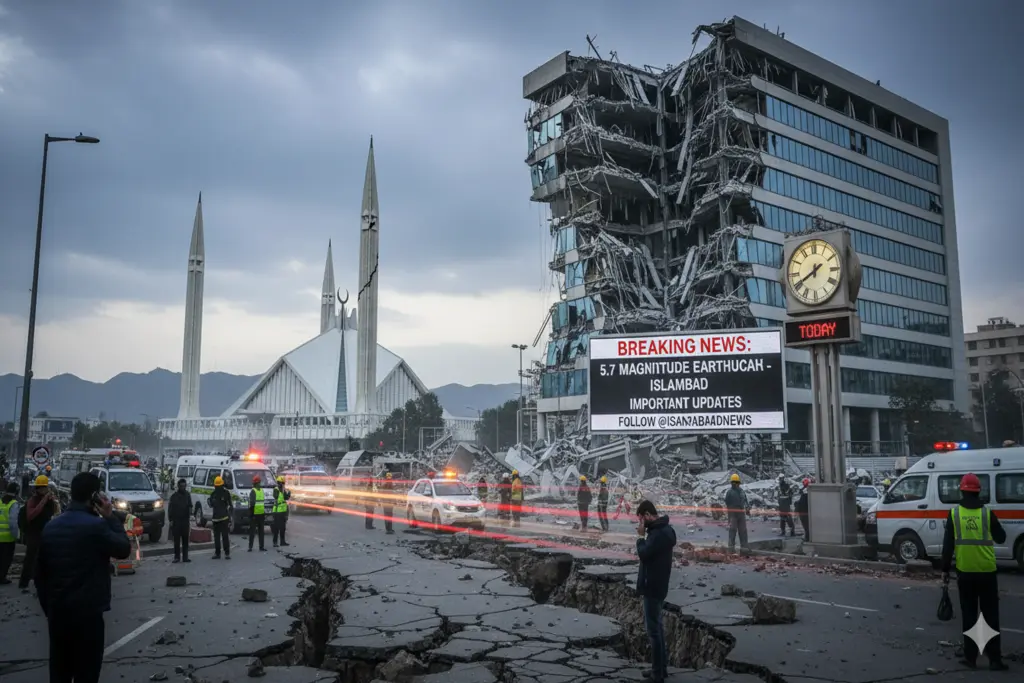
People in northern Pakistan had a shock on Monday, April 27, 2026. A powerful, prolonged quake at the start of the working day caused a mass panic on the streets of Islamabad, Rawalpindi and some districts in Khyber Pakhtunkhwa province (KP). Office holders and high rises in Islamabad did not require an invitation to go out to the streets and open areas to pray and meet relatives and friends.
The official magnitude of the earthquake is 5.7 on the Richter scale, as reported by the Seismic Monitoring Centre. The quake was short-lived (a few seconds) but was felt to such an extent that windows rattled and pendulums swayed in Peshawar, Swat, Nowshera, Shangla and Buner. Although the panic was tangible, the news has it that the region could have avoided a grave tragedy as there has been no reported death or great destruction.
Depth and Epicenter: The Science Behind the Shake
The Pakistan Meteorological Department (PMD) has said that the quake originated in the mountainous region along the border of Afghanistan and Tajikistan. For those who might be wondering why the quake was so strong, but did not cause any major collapses, it is because of its depth. The quake was 170 km deep.
For earthquake scientists, a deep earthquake is often a “best case” scenario. The waves from the earthquake travel further (hence the shaking was felt as far as Multan and in some parts of Punjab) but the initial violence on the surface tends to be less than for surface quakes.
Why Does the Ground Keep Shaking in Pakistan?
Pakistan is endowed and cursed with beautiful landscape. Pakistan is at the very active junction of the Indian and the Eurasian tectonic plates. It is this fight that has created the Himalayas and the Hindu Kush but it also means the rock is under considerable stress.
April has been a busy month. From quakes in Karachi back in April, to a 5.8 magnitude earthquake in February, 2026 that shook Hunza and Islamabad, it’s just a reminder we live on an active fault line. We remember the 2005 Kashmir quake that killed more than 73,000 people, and the 2021 quakes in Harnai. Geologists from the US Geological Survey (USGS) tell us that we can’t know when the next quake will hit, but say the regular occurrence of these mid-sized quakes shows the importance of rigorous building standards.
Safety First: The NDMA Survival Guide
In times of the quake, it may be time to panic but a plan in mind is what will keep you safe. The National Disaster Management Authority (NDMA) accentuates certain easy rules:
Drop, Cover, and Hold On: Inside–Take under a desk, or a table. Avoid windows and furniture.
Control your Elevators: Avoid using elevators during, or immediately after an earthquake; you can be stuck between floors due to electricity outage or otherwise.
Keep off High Places: Keep away from high trees, ancient buildings and electric poles (if outside).
Check Utilities: Check after the quake, turn off power and check gas leaks or short circuits before turning the power on.
READ: Today’s Latest News