




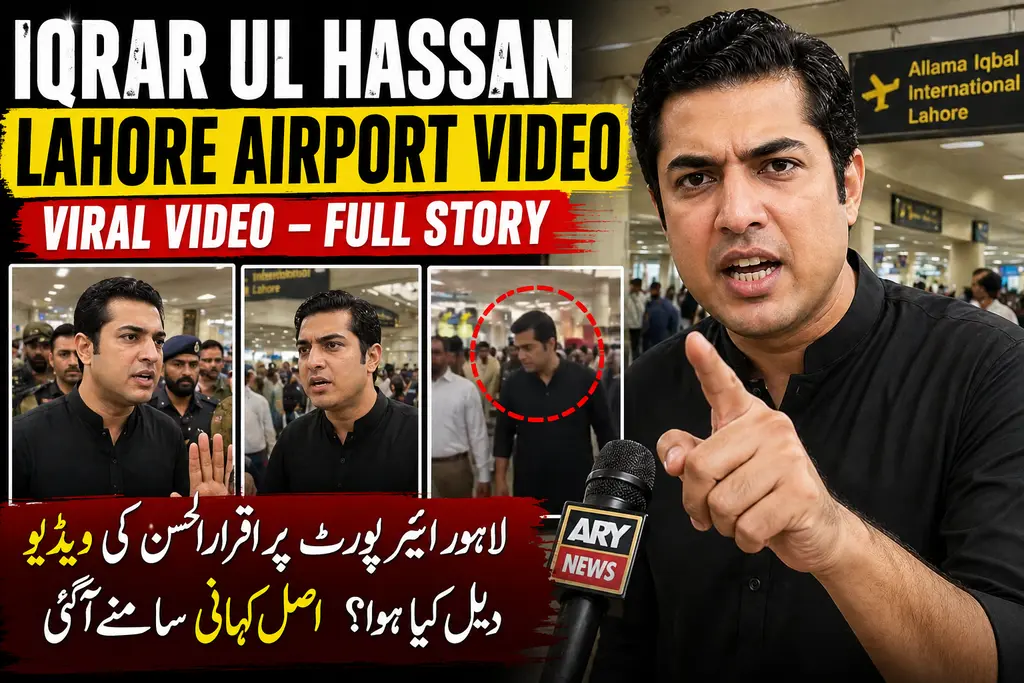
The Iqrar ul Hassan Lahore Airport Video portrays a tense conversation between the media personality and the airport security personnel. It is said that the encounter started when Hassan supposedly tried to break in on an incident involving perceived maltreatment of passengers or perceived requesting of bribes by ground crew. When the footage started trending, it soon went beyond the immediate incident, becoming an electric charge to larger grievances about the culture of VIP about the everyday experiences of overseas Pakistanis dealing with the immigration systems of the country.
The Incident: What Triggered the Viral Face-Off?
As per the initial reports and testimonies, the friction began when Iqrar ul Hassan addressed the problem of long queues and the unprofessionalism of some officials at immigration counters. Hassan is heard in the video demanding accountability and questioning why in most cases ordinary citizens are forced to wait when the game players have a way to go round the system. This was further complicated when the Civil Aviation Authority (CAA) security guards tried to halt the filming claiming there was a security measure, which banned unauthorized recording in sensitive areas of the airport.
The stand-off soon attracted an audience, as various passengers came to the cause of Hassan to make a localized conflict a bigger protest against perceived systemic corruption. Although the supporters of Hassan argue that he was only representing the voiceless, the airport management argues that such disruptions affect the running of activities within the airport and makes it unsafe.
The Public Verdict: Heroic Oversight or Digital Performance?
The social media response has been polarising to say the least. Iqrar ul Hassan has been welcomed as a hero by one section of the internet that believes that institutional change in Pakistan is unlikely to occur without this kind of guerrilla-style journalism. To these followers, the video is an uncommon sight of a government figure rising and speaking against the Federal Investigation Agency (FIA) and airport employees, who are mostly accused of being high handed. They feel that through the exposure of these problems through social media, Hassan is compelling some form of openness that cannot be achieved through regular complaint measures.
But there is a minority of critics who see the incident in a new light. They claim that the Iqrar ul Hassan Lahore Airport Video is an excellent demonstration of the so-called sensationalist press in which the main aim is to achieve the views and involvement instead of the actual reform. These critics note that an airport is a high security facility that is sensitive and where law and order must be upheld at whatever cost. They advise that crashing into restricted space with a camera crew or making a scene in the immigration lounge may result in security lapses and that complaints should be taken care of using the official Pakistan Citizen Portal instead of having fights in the open.
The Regulatory Stance: Security Protocols vs. Citizen Journalism
The Allama Iqbal International Airport administration has issued a preliminary statement reminding people that as much as they are determined to make the passengers comfortable, the law of the land is the supreme. According to the existing aviation legislation, one is not allowed to shoot in the vicinity of the immigration and security screening points to ensure that the privacy of the passengers and the security screening are not compromised. This puts it in a gray area of the law: does the right of the people to know and the obligation of a journalist to report corruption violate the status quo of the security orders of a national terminal?
The incident is not the first instance when a celebrity or journalist has had a conflict with the airport authorities in Pakistan, but the rate at which the video has been shared shows the increasing influence of digital platforms in 2026. According to experts, organizations such as the CAA and FIA must reform their grievance redressal systems to be more transparent and efficient, thus eliminating the necessity to use viral videos as a form of justice to be served by citizens.