


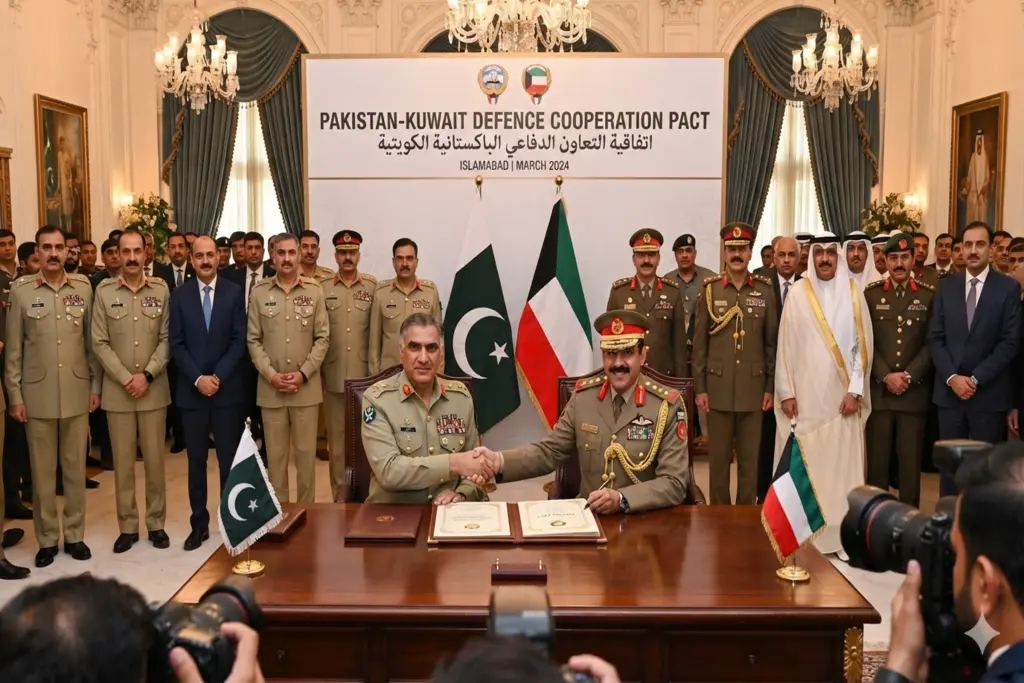
Pakistan’s defence ties in the Gulf keep piling up, and this week it was Kuwait’s turn. On August 27, 2026, Defence Minister Khawaja Asif and his Kuwaiti counterpart put pen to paper in Rawalpindi, building on a framework the two countries had already agreed to back in 2023. It might sound like just another diplomatic photo op, but for Pakistanis this kind of deal touches things closer to home, remittances, jobs abroad, and how much weight our passport carries when we sit at the table.
What Does the Pakistan-Kuwait Defence Agreement Cover
The Pakistan-Kuwait defence agreement, called the Protocol Agreement-2026, was only formally ratified by Kuwait last month, even though the base framework dates back to 2023. Under this arrangement, Pakistan’s armed forces will help train Kuwaiti forces, support border management along Kuwait’s frontier with Iraq, and take part in joint exercises and intelligence sharing through an annual military committee. It is worth noting this is not a mutual defence pact like the one Islamabad signed with Saudi Arabia last year, there is no clause saying an attack on one side counts as an attack on both. This is essentially a military assistance and training arrangement, plain and simple.
Why Gulf States Keep Calling Pakistan
None of this is really new. Defence cooperation between Pakistan and Kuwait goes back to the late 1960s, and Pakistani troops were stationed near Mecca and Madinah during the 1990-91 Gulf War. What is different now is how quickly these deals are stacking up, alongside the trilateral defence pact with Turkiye and Saudi Arabia signed earlier this month. A lot of analysts link this to shrinking trust in Washington’s security guarantees after recent regional attacks.
What’s In It For Pakistan
Honestly, this bit is still murky. Some experts think Kuwait could offer cheaper energy supplies or more visas for Pakistani workers, of which nearly 95,000 already live and work there. Pakistan pulled in a record $41.6 billion in remittances last year, a good chunk from the Gulf, so any goodwill here matters for the economy back home, even if big investment promises have moved slowly so far.
Conclusion
The Kuwait deal adds another layer to Pakistan’s growing Gulf security footprint, but whether it turns into real economic gains for ordinary families still depends on what comes next.