



With the sacred month of Dhu al-Hijjah not far off towards the end of May 2026, families in Pakistan are making their way in the complicated financial environment of executing their religious duty. As the world economy has influenced the cost of travelling and accommodation in Saudi Arabia due to inflation, knowledge of the Hajj Cost Breakdown 2026 is the initial step towards turning this spiritual dream into a reality.
As of April 21, 2026, pilgrims have entered a critical phase as the Ministry of Religious Affairs (MORA) works out the schedules of flights and accommodation. To the typical Pakistani family, Hajj has turned out to be a large investment, and it has to be budgeted and they must know the support that is available by the government.
Understanding the Hajj Cost Breakdown 2026
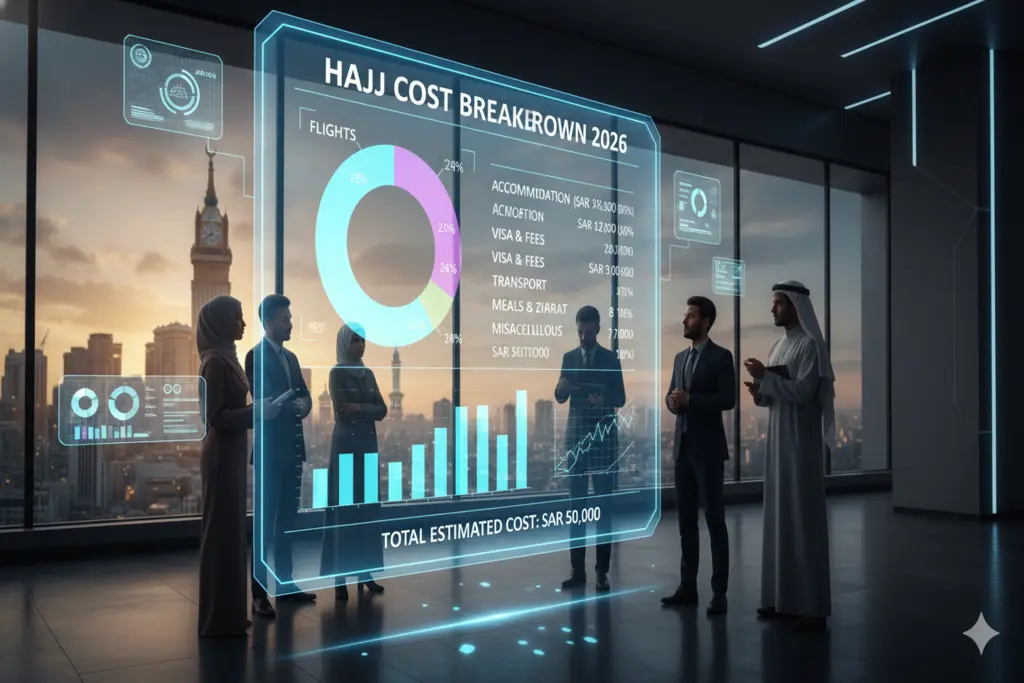
The cost of Hajj can be broadly categorized into two types, namely, Government Hajj Scheme and Private Hajj Packages. By 2026, the Hajj Cost Breakdown 2026 of the government scheme will cost between PKR 1,075,000 and PKR 1,175,000, based on the city of departure and facilities.
The primary components of this cost include:
Airfare: This is important because of fluctuations in fuel prices.
Accommodation: Makkah and Madinah Hotels that differ in distance to the Haram.
Compulsory Dues: These consist of the so-called Moallim fees, transport in the Kingdom, and the compulsory cost of Qurbani (sacrifice).
Mina and Arafat Services: Upgraded tent facilities and catering services.
How Families Can Afford Hajj This Year
Although the price is increasing, there are a number of ways in which families can cope with the financial burden. The government has also recently revitalized the Sponsorship Scheme which is currently a crucial facility and with the assistance of which foreign Pakistanis can send the foreign exchange back to the country to sponsor Hajj of their relatives in Pakistan bypassing the traditional ballot system.
Moreover, the Ministry of Hajj and Umrah (KSA) has announced the offering of Short Hajj packages in 2026. These 20-25 day packages are also less expensive than the standard 40 day residence, much lower the price of meals and daily sustenance. It is also advisable that families make use of the “Hajj Saving Accounts” provided by a number of Islamic banks that enable long term, Shariah compliant accumulation of wealth with the sole purpose of this in mind.
Government Subsidies and Digital Assistance
To facilitate the process, the government has incorporated the Nusuk App and the Hajj Awareness Portal, which gives real-time information on the costs. Families should stay updated through official channels to claim any “hardship” quotas or potential refunds on unused services, which are often credited back to pilgrims after their return.
READ: More Informative Content