


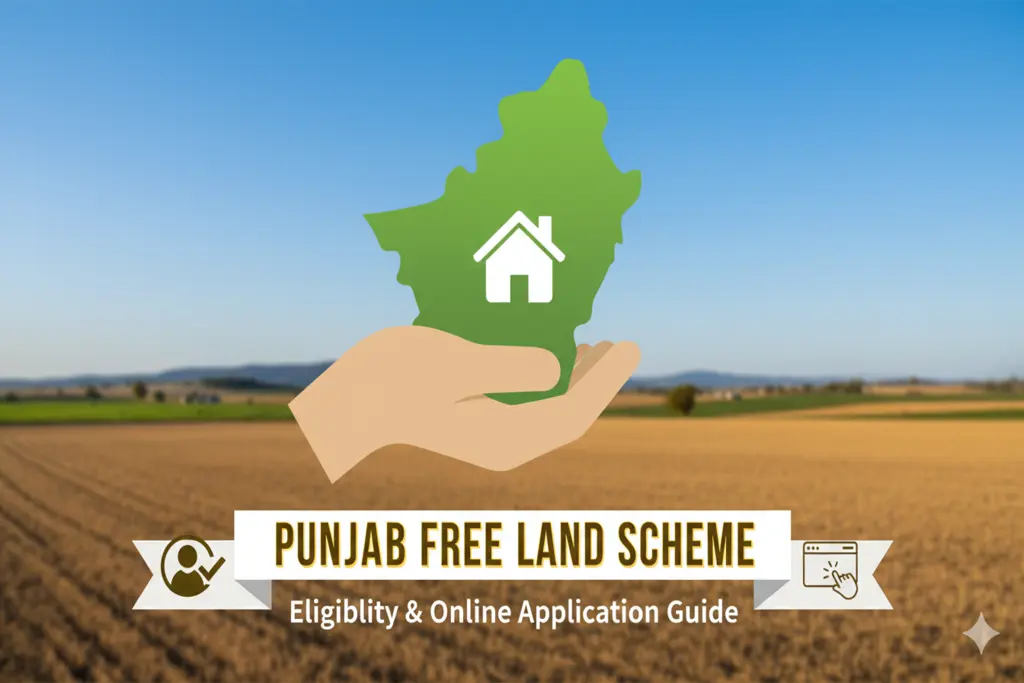
The Government of Punjab has launched an unprecedented housing welfare scheme under the leadership of former chief minister Maryam Nawaz Sharif, to avail economically backward and labourers with affordable housing. The Punjab Free Land Scheme (PFLC) was announced at the official ceremony held in Lahore and this scheme will provide free land and residential units to eligible citizens who have no land or property.
This comprehensive guide explains the housing project distribution phases, estimated construction costs, eligibility criteria, and describes the step-by-step digital application process.
Project Framework: Distribution Phases and Structural Financials
With rising inflation and economic pressures putting homeownership out of reach for ordinary citizens, the provincial administration has deployed immediate relief targets to support marginalized families:
Free Distribution of Residential Flats: In the initial phase, 720 residential flats are being distributed completely free of charge to deserving industrial laborers and low-income workers.
Per-Unit Cost Infrastructure: Each flat distributed under this program is constructed at an approximate cost of Rs3.5 million (Rs35 Lakhs), fully funded by the state to eliminate any financial burden on the beneficiaries.
Taxila Housing Expansion: Taxila has 500 houses to be built and allocated soon, under the same welfare rules.
The Socio-Economic Milestones program has been implemented successfully through the flagship “Apni Chhat Apna Ghar” program so far 100,000 houses have been built in the province.
The urban planners and applicants can track updates directly from the Punjab Housing and Town Planning Agency (PHATA) for all official updates, structural sketches, and developer magazines.
Eligibility Criteria for the Punjab Free Land Scheme
In order to be transparent about the verification process, and to avoid commercial property dealers exploiting it, the government has established strict verification criteria:
Zero Property Owner: The primary applicant should not be registered as owner of any house, office or any type of plot anywhere in Pakistan.
Provincial Residency: Applicants are required to be those who are Domicile of Punjab and have computerized (CNIC) National ID Card issued under Punjab Act No. 18 of 2016 confirming residency in the Province of Punjab.
Income Bracket Constraints: The selection matrix targets low-wage factory workers, daily wage laborers, and families falling into low socioeconomic brackets.
Labor Registry Validation: For the industrial flats phase, priority verification is given to registered workers holding active data records with the state social security network.
To verify registration policies, quotas, and worker protection rules, applicants can reference guidelines on the official portal of the Punjab Labour & Human Resource Department.
Step-by-Step Online Application Procedure
The entire registration process has already been put online by the provincial government, so as to avoid administrative delay and access based on merits:
Login to the Official Portal: Applicants need to log in to the integrated provincial housing portal or the dedicated mobile application called “Apni Chhat Apna Ghar”.
Fill in the Profiling Form: Provide personal information such as CNIC numbers, current temporary residential addresses, information about dependents and employment information.
Upload Required Verification Documents: Candidates must upload digital copies of their CNIC, domicile certificate, active proof of income (or labor registration card), and a signed legal affidavit certifying they do not own any property.
Computerized Balloting Process: Following background checks and NADRA-supported asset verification, names will be entered into an automated, public computerized draw to fairly distribute the available land deeds and flat allotment letters.
READ: More Informative Content