




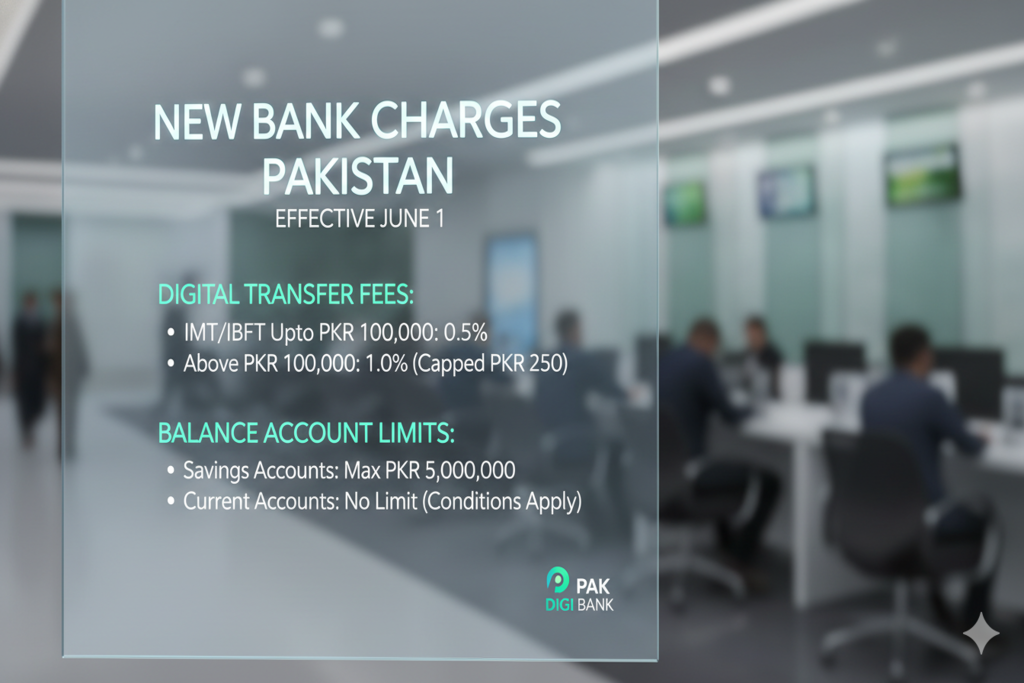
In an effort to increase transparency across the banking sector and promote digital payments under the State Bank of Pakistan’s (SBP) Vision 2026 guidelines, all commercial and Islamic banks have updated their Schedule of Charges (SOC) effective June 1. The revised rules streamline Inter-Bank Funds Transfers (IBFT), biometric cash withdrawals, and account balance requirements. This balance ensures that financial institutions can sustain their digital infrastructure without imposing unreasonable costs on daily banking consumers.
Whether you rely on mobile banking applications, automated teller machines (ATMs), or internet banking portals, staying informed about these updated regulatory tariffs is essential for managing your personal finances.
Digital Funds Transfer (IBFT) and Raast Fee Adjustments
Following structural guidelines set by the State Bank of Pakistan, intra-bank transfers—meaning funds moved between accounts held within the exact same banking institution—remain completely free of cost. However, transferring money to a different banking institution via Inter-Bank Funds Transfer (IBFT) or utilizing government payment channels is subject to a specific tariff setup.
All person-to-person (P2P) transfers processed through the government’s official ‘Raast’ instant payment system remain absolutely free with zero transactional fees or hidden taxes. Conversely, traditional IBFT channels allow users to transfer up to 25,000 PKR per account cumulative every month without incurring any fees. Once a single account exceeds this 25,000 PKR monthly digital transaction limit, banks are legally permitted to charge a fee of 0.1% of the total transaction value or 200 PKR, whichever amount is lower.
Bank Account Balance Limits and Service Waiver Rules
Commercial banking institutions have also updated the monthly average balance limits required to qualify for complimentary banking waivers, such as free checkbooks, complimentary banker’s checks, or annual debit card fee waivers.
For basic accounts, including Asaan Accounts and Asaan Digital Accounts, there are no mandatory minimum balance limits or penalty fees. This protection ensures low-income segments maintain unrestricted access to the regulated financial ecosystem. For premium banking categories, clients are required to maintain a strict daily or average monthly balance tier, often set at 500,000 PKR or 1,000,000 PKR. If a premium account holder falls below this required threshold, banks will systematically apply penalty service fees ranging between 3,500 PKR and 3,750 PKR per month.
ATM Transactions and Biometric Fee Modifications
Several automated transaction paths and branchless banking categories have received price updates starting June 1, directly altering the out-of-pocket costs for cardless and international interactions.
Cardless cash withdrawals processed at an ATM via biometric thumbprint authentication now attract a specialized service fee ranging from 15 PKR to 18 PKR per session plus applicable Federal Excise Duty (FED). Using a mobile banking app to withdraw money via an ATM on-screen QR code scan is now capped at nearly 20 PKR per transaction, while printing a physical receipt from an ATM will cost a separate 4.5 PKR. Additionally, whenever an international debit or credit card is processed at a local Pakistani ATM for cash withdrawal, banks will levy an international handling fee of 5 to 6 USD per transaction.
Federal Excise Duty (FED) and Mandatory Customer Alerts
The State Bank of Pakistan has strictly instructed all commercial institutions to actively clarify these structural deductions to consumers prior to execution.
Following any digital transfer, financial transaction, or ATM withdrawal, banks are legally required to send an immediate SMS alert, email notification, or in-app pop-up to the client’s registered contact info without charging an alert fee. These automated receipts must clearly separate the principal transaction amount from the exact service fees deducted. Consumers should keep in mind that all listed banking charges are subject to the government’s standard statutory Federal Excise Duty (FED) or provincial sales taxes, which are calculated on top of the base transaction fee.