


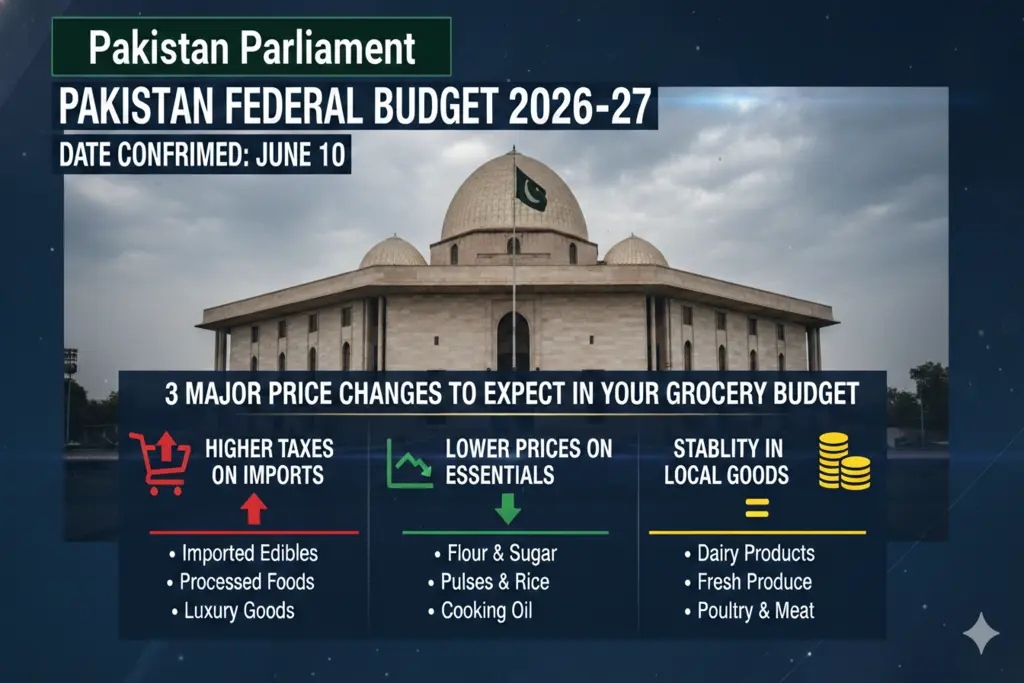
The Federal government has announced the final plan for the upcoming fiscal year financials. The ruling coalition delayed the presentation from its originally planned date of June 5, after high level political talks chaired by Deputy Prime Minister Ishaq Dar and Finance Minister Muhammad Aurangzeb. This adjustment enabled the finance division to bring their revenue targets in line with the IMF’s structural benchmarks in place and respond to demands of friendly political parties.
As the Federal Board of Revenue (FBR) aims to achieve tax collection targets set fairly aggressively by international lenders, considerable changes in the sales tax exemptions are likely to be brought about. These budget cuts will directly affect lower income families at the grocery store. This is a list of the 3 big price increases that are coming at consumers this legislative session.
1. Imposition of Standard 18% GST on Packaged Milk and Dairy Products
Dairy items, including packed milk, butter, cheese, and yogurt, form a substantial chunk of the average family’s monthly kitchen spending. The IMF has consistently urged authorities to eliminate zero-rated tax statuses and transition toward a uniform taxation model across all consumer retail segments.
Financial experts indicate that packaged milk (tetra packs) and commercial dairy varieties are highly likely to face the standard 18% General Sales Tax (GST) bracket without exceptions.
If approved, a single liter of packaged milk could surge by Rs. 30 to Rs. 50 overnight. This adjustment will create an instant inflationary ripple effect on breakfast essentials, tea, and child nutrition costs.
2. Increased Duties on Processed Foods, Commercial Spices, and Cooking Oil
Kitchen staples like branded spices, packaged lentils, ready-to-cook frozen foods, and noodles have already been hit hard by ongoing supply chain adjustments. The upcoming financial bill aims to tap into these consumer goods to generate fast tax revenue.
Alongside manufacturing and distribution tax revisions for local FMCG brands, custom duties on imported palm oil and crude soybean oil are actively under review.
These measures will force cooking oil and ghee prices upward per liter. Additionally, branded snacks and everyday recipe spice mixes are expected to witness a retail price spike of 10% to 15%.
3. Removal of Tax Exemptions on School Stationery and Household Cleaning Supplies
Grocery lists extend beyond edible items; monthly school supplies and sanitation products are also managed under the same domestic spending pool.
Under the strict revenue conditions set for the new bailout facility, proposals to implement a full 18% sales tax on stationery items—including school notebooks, drawing pads, and pencils—have received primary clearance.
This will serve as a double blow for parents preparing for the new academic year. Simultaneously, the rising costs of laundry detergents, dishwashing bars, and soaps will inflate the core maintenance expenses of every household.
Official Presentation Timeline and Key Dates
On June 8, 2026, the National Economic Council (NEC) will hold a high-level meeting under the chairmanship of Prime Minister Shehbaz Sharif, with the aim of approving the macro-economic framework.
The government is to make public on June 9, 2026, the official Economic Survey highlighting the economic conditions of the nation during the last fiscal year.
Subsequently the Finance Minister, Muhammad Aurangzeb, will deliver the official budget speech and present the Finance Bill, in the National Assembly on 10 June, 2026.