

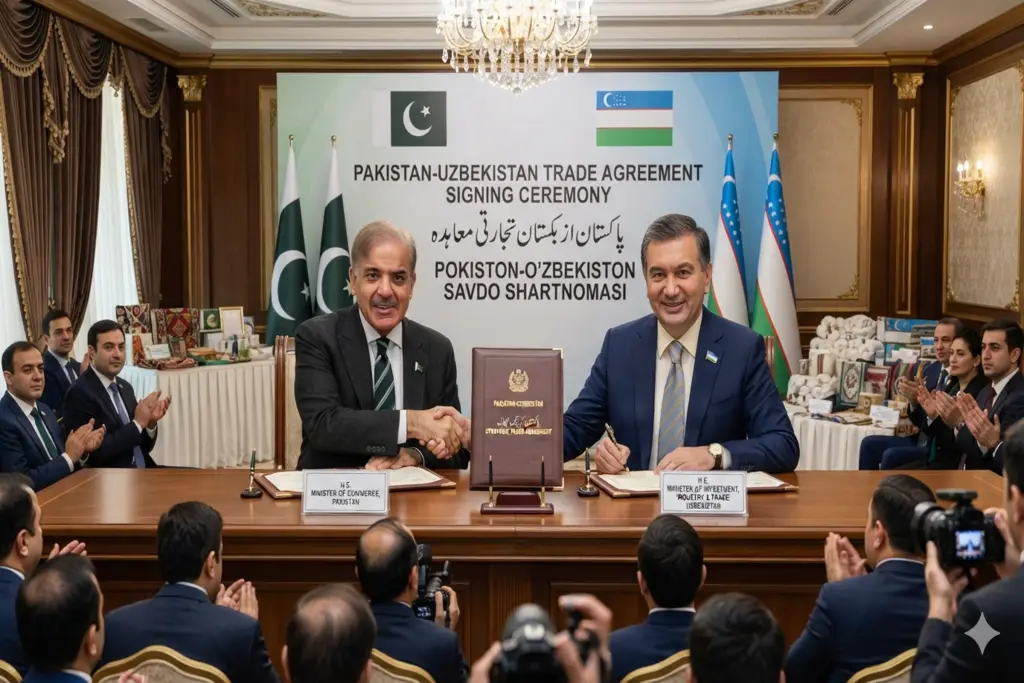
To boost economic integration with Central Asia, the Federal Government of Pakistan (FGP), under the Federal Board of Revenue (FBR), recently made an official decision to reduce customs and regulatory duties on various imports from Uzbekistan. The tariff cut has been implemented under the bilateral Preferential Trade Agreement (PTA) between the two brotherly countries. The strategic project is aimed to facilitate market access for the Uzbek commodities to the Pakistani market and to open up easier road corridors for Pakistani exports to landlocked Central Asian countries through Uzbekistan.
The Preferential Trade Agreement (PTA) and Tariff Reductions
High-level diplomatic visits and engagements between Pakistan and Uzbekistan have seen economic ties improve over the years. The new regulatory notification entails far reaching fiscal relaxations for eliminating non-tariff barriers and optimising the volume of trade. Customs tariffs have been reduced by 20% to 50% for certain types of raw materials for the textile industry, fresh and dry fruits, and selected industrial raw materials.
The idea behind this adjustment is to shift the bilateral trade volume of the two countries into the billions for the next few years. In addition to tariff reductions, the customs administrations of both countries have put in place automated information-sharing mechanisms to expedite border clearance and eliminate the duplication of paperwork.
Strategic Significance: Transit Trade and Logistics Infrastructure
Uzbekistan, a landlocked country, is dependent on its efforts to obtain viable access to deep sea ports. The two ports Gwadar and Karachi in the Arabian Sea are the shortest and economic corridors of Central Asian freight in Pakistan. The Uzbek government is providing parallel tax incentives and easing handling and transit duties for Pakistani goods in exchange for tax cuts by Pakistan.
The following projects are likely to bring huge regional supply chain benefits:
The process of tariff alignments serves as a facilitator for the trilateral railway project between Uzbekistan, Afghanistan and Pakistan, leading to a significant reduction in cargo transit time and freight costs across the borders.
Development of modern warehousing facilities: Public-private partnership (PPP) initiatives are being implemented to build modern cold-storage and dry-dock facilities at important border crossing points for smooth movement.
Supply Chain Resiliency: Reducing tariffs on raw materials will make it easier for industry producers in both countries to diversify away from global sources of supply and into lower cost regional sources.
New Horizons for the Business Community
The Pakistani business community, including various Chambers of Commerce and Industry, has widely welcomed the FBR’s decision. Pakistan’s textile and pharmaceutical sectors stand out as primary beneficiaries, as they can now import high-grade raw cotton and specialized chemical inputs from Uzbekistan at much lower costs. This, in turn, will enhance the global competitiveness of Pakistani finished exports.
According to FBR officials, the updated tariff slabs have been fully integrated into the electronic customs system for seamless execution. Importers and clearing agents are advised to consult the official Federal Board of Revenue Portal to review the modified duty structures for specific item categories.