



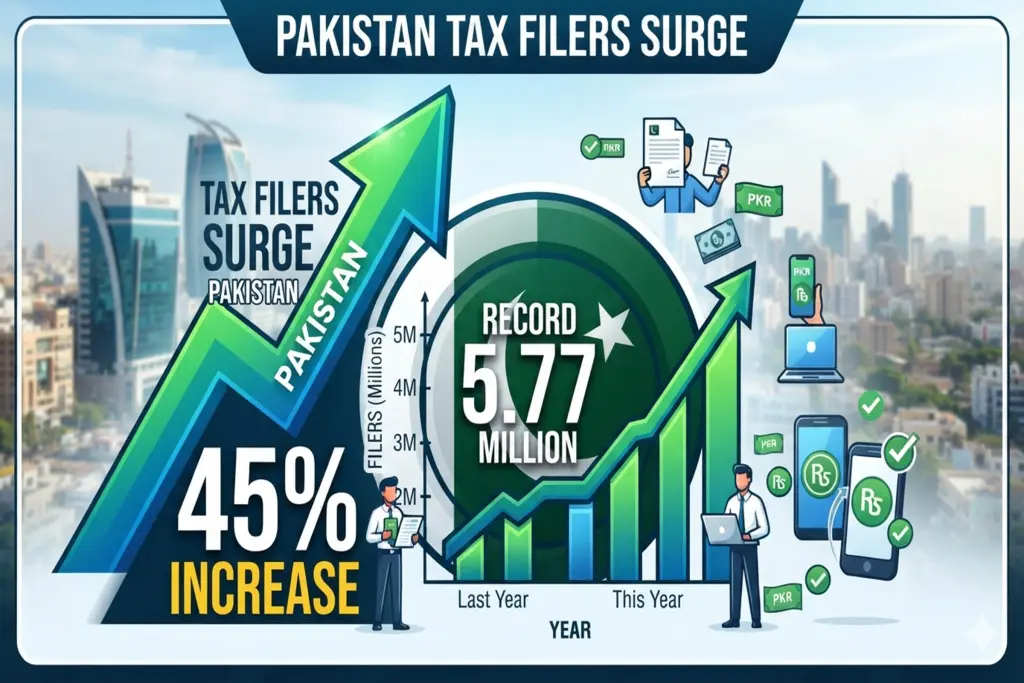
In a major macro-fiscal advancement for national asset documentation, automated wealth tracking and sovereign tax-base expansion the number of individuals filing income tax returns in Pakistan has jumped 45 percent over a single fiscal lifecycle. The massive administrative breakthrough transitions legacy unmonitored economic activities into a highly structured system-vetted financial database sandbox. Deployed directly through the upgraded digital portals of the Federal Board of Revenue (FBR) the historic tax compliance milestone confirms that 5,767,384 returns were securely locked by the September 30 deadline compared to 3,980,692 during the same transactional window last year.
The rapid onboarding of approximately 1.79 million fresh tax filers inside a 12-month horizon marks a critical priority for state financial planners working to satisfy structural covenanted agreements under active International Monetary Fund lending cycles. By deploying integrated analytics engines to automatically scan and cross-reference commercial activities the state aggressively expands its documented revenue streams, narrows the parallel informal network footprint and successfully projects a progressive system-vetted image of Pakistan’s tax administration onto the international financial landscape.
Allocation of Tax Ingestion Growth Vectors Across Macroeconomic Sectors
According to the official statistical dataset published by FBR’s data warehousing command the structural growth curve was driven almost entirely by the independent commercial trading and non-salaried professional sectors.
The engineered tax-net extension operates across three primary performance tracks:
The Non-Salaried Retail and Professional Domination: Individual filings routed from traders, shopkeepers, and self-employed professionals surged 60 percent to 3.81 million assets up from 2.38 million last year accounting for a massive 80 percent share of the absolute nationwide growth matrix.
The Salaried Corporate and Public-Sector Grid: Returns submitted by salaried taxpayers scaled 22 percent to reach approximately 1.9 million backed by automated payroll verification loops.
Associations of Persons (AOPs) Structural Uplift: Filings generated by registered partnerships and collective business ventures rose 33 percent to a total of 53,756 records.
This structural optimization has nearly tripled nationwide filing metrics over a three-year comparative timeline expanding the sovereign filer footprint from a base of just 1.92 million in September 2023 to the current 5.77 million threshold.
Audits of Taxable Threshold Growth and Corporate Filing Bottlenecks
The structural and macro-financial implications of this documented footprint are extensive showcasing a 37 percent expansion in files reporting income safely above the basic taxable threshold which grew to nearly 2.5 million. Concurrently citizens declaring direct tax liability payments alongside their returns grew 38 percent to 3.35 million. Direct cash-free tax revenues routed through individual filings expanded 11 percent to PKR 34.5 billion while payments from AOPs scaled 16 percent to PKR 3.7 billion.
| Filing Entity Bracket | Active Return Volume | Year-on-Year Growth Metric | Cash-Free Revenue Value |
| Non-Salaried Individual | 3.81 Million | 60% Expansion | PKR 34.5 Billion (Total Individual Pool) |
| Salaried Individual | 1.90 Million | 22% Expansion | Integrated Payroll Source Taxes |
| Associations of Persons | 53,756 Files | 33% Expansion | PKR 3.7 Billion |
| Corporate Companies | 7,953 Files | -29% Contraction | PKR 39.1 Billion |
However, corporate enterprise filings emerged as a prominent structural exception, sliding from 11,206 to just 7,953 active filings which dragged corporate collections down to PKR 39.1 billion from PKR 49 billion last year. To combat this localized shortfall and secure the annual PKR 15.264 trillion macro-target FBR is aggressively integrating data scraping scripts across commercial banking transactions, land registry deeds, vehicle management networks and third-party withholding logs. While roughly 39 percent of this year’s filings remained whitelisted as nil returns, the deep data synchronization minimizes evasion loopholes, lowers processing friction and safely preserves national fiscal stability indices.