



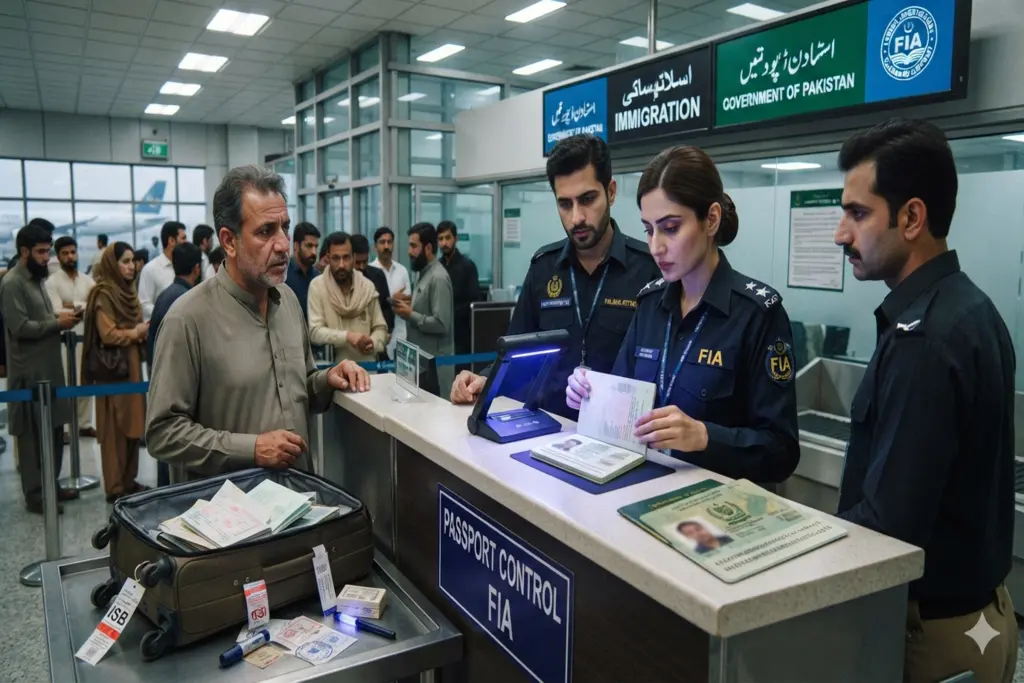
In a major border enforcement operation aimed at securing international transit channels, accelerating document validation telemetry and dismantling cross-border human smuggling cartels the Federal Investigation Agency (FIA) has offloaded a Saudi Arabia-bound passenger at Islamabad International Airport after discovering suspicious Malaysian stamps on his passport.
The targeted interception transitions legacy physical document checks into a highly rigorous, system-vetted immigration verification sandbox. Formally executed during a routine document screening phase by senior border management personnel the enforcement isolates the fraudulent travel credentials before the suspect could leave national airspace effectively curbing irregular transit paths and safeguarding Pakistan’s digital identity reputation across global aviation networks.
Detection Dynamics and Flight ED270 Interception Metrics
According to the official communique issued by the airport immigration command the passenger was attempting to bypass traditional screening metrics by traveling on a valid Saudi Arabian Umrah visa. However, high-precision scanning telemetry layers deployed at the terminal counters immediately triggered an anomaly alert.
The failure to operate the interception on three pivotal performance parameters was a major operational failure of the immigration interception:
High Precision Document Audit: In the deep visual and digital cross-referencing, immigration officers discovered highly irregular un-whitelisted Malaysian immigration entry and exit seals that were clearly localized on pages 8 and 9 of the passenger’s passport.
Immediate Tactical Offloading: Central Security Engine received confirmation of the document tamper profile, and immediately offloaded the passenger from flight ED270 and canceled his boarding authorization.
Inter-Agence Ingestion to AHTC: After successful arrest of the suspect Electronic profiling and investigation of the suspect was further conducted in the FIA Anti-Human Trafficking and Smuggling Centre (AHTC) in Islamabad by an inter-agency team.
Dismantling Illicit Facilitation Networks and Strengthening Border Predictability
The systemic and geostrategic implications of this interception are extensive, directly backing the interior ministry’s mandate to eliminate organized document forgery cells operating across major metropolitan hubs. The AHTC tracking sandbox has launched a comprehensive investigation to trace the exact source code of the counterfeit stamps and isolate any back-end fraudulent travel brokers or printing laboratories involved in supplying the fake seals.
By enforcing absolute transparency at international departure terminals and utilizing multi-layered validation filters the state aggressively lowers international visa default parameters. Shifting from slow manual passport reviews to digital, interconnected data matches with partner embassies minimizes security shortfalls, protects valid consumer travel rights and successfully projects a sophisticated secure image of Pakistan’s border control infrastructure globally.