




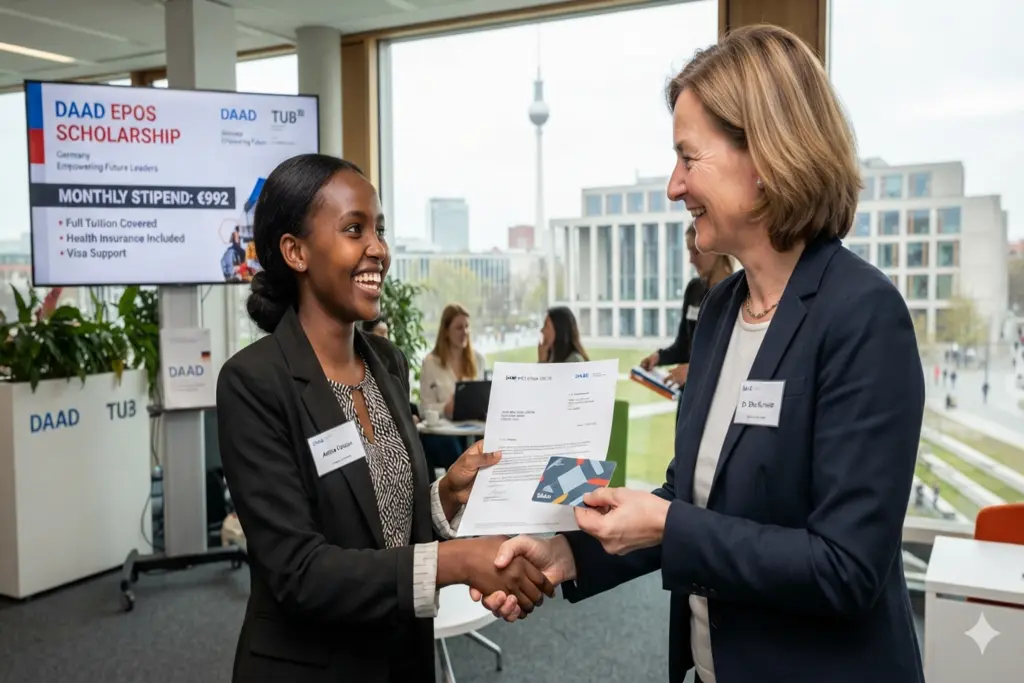
In a major development for national academic capacity building, international graduate mobility and trans-continental educational transfer validation the German Academic Exchange Service (DAAD) has launched its EPOS Scholarship framework. The highly anticipated programmatic release transitions standard self-funded international education cycles into a deeply competitive fully funded academic sandbox. The scholarship paves the way for targeted developing countries to offer specialised admission opportunities for Pakistani young professionals to study the advanced MSc Environmental Governance (MEG) programme at the prestigious University of Freiburg for the 2027/28 academic year.This scholarship provides an opportunity to pursue the advanced MSc Environmental Governance (MEG) programme at the historic University of Freiburg, with admission reserved for young professionals from targeted developing countries for the 2027/28 academic year.
Sovereign development councils are increasingly aligning public policies to models of environmental stewardship based on data and importing trained natural resource managers is a high priority for state planners. The DAAD EPOS initiative is implemented quickly to address in particular local skills shortages that have been a key hurdle for the implementation of green infrastructure projects in South Asia in the past. The German government’s innovative financial cushioning system effectively eliminates transaction friction at baseline, reinforces institutional academic trust and creates a safe marketing screen for advancing an image of educational governance that is just and fair in the world.
Allocation of Financial Support and Tuition Fee Exemptions
According to the official program blueprints distributed by the University of Freiburg’s admissions cell selected scholarship holders undergo extensive balance sheet scaling to strip out all major cost indices.
The financial infrastructure assigned to each qualified applicant functions across four central support tracks:
The Monthly Living Stipend: DAAD provides successful master’s scholarship holders with a steady system-vetted €992 per month throughout the direct funding phase to anchor baseline living security.
Absolute Tuition Fee Waivers: These are issued to the non-EU student consumer bases of the University of Freiburg exempting them from the €1,500 study fee normally charged for each semester.
Complete Medical Protocols: The award ensures payments are made towards comprehensive health accident and personal liability insurance coverage throughout.
Logistical Travel Allowances: If they choose scholars eligible for these awards can apply for a structured travel allowance that covers trans-continental travel restrictions unless the scholar’s home country organization handles the trans-continental transit budget.
Scholars can also receive additional support tokens under certain personal verification requirements based on family member support and monthly rent subsidies for their local apartment.
Audit of Admission Criteria and Professional Experience Demands
The University of Freiburg’s statutory vetting system is based on academic criteria and selects high-caliber talent. The two-year English-taught Master of Science is an intense study period of 120 ECTS.
| Admissions Variable | Mandated Requirement Log | System-Vetted Validation Metric |
| Professional Track Record | Minimum 2 Years Post-Bachelor’s | Data-backed proof of employment internships are excluded. |
| Academic Performance | Graduation rank within upper third | German grading equivalent benchmark of 2.5 or better. |
| IELTS Academic Ingestion | Minimum Band Score: 7.0 | Centralized electronic test transcript verification. |
| TOEFL iBT Inflow | Minimum Score: 95 | Score scale verification aligned with revised university rules. |
To secure entry into the selection pool candidates must present a relevant academic background such as Environmental Management Agriculture Forestry Geography Political Science Sociology Law or Economics. The applicant’s undergraduate degree certificate must not be more than six years old at the execution point of the file.
Execution Manual for the Linked Scholarship and University Application
To prevent data gaps and eliminate administrative delays the application process merges the institutional university admission link directly with the DAAD scholarship allocation process.
Candidates must combine all required documentation comprising the signed DAAD checklist official application forms, a tailored motivation letter, structured CV certified transcripts, verified professional experience proofs and an active English language certificate into a single compressed PDF file. This single file must be submitted via email directly to the MSc Environmental Governance program desk before the strict October 15, 2026 deadline.
Concurrently, candidates are required to coordinate the submission of two independent recommendation letters. One letter must originate from the applicant’s current corporate employer while the second must come from an academic professor or thesis supervisor. Referees must email these reference logs directly to the program dashboard files sent by the applicants themselves face automated rejection loops. Shifting from loose manual applications to strict centralized data sorting ensures total systemic transparency before the final decision. Through these synchronized educational platforms and updated talent acquisition tracking channels Germany successfully lowers boundaries for global academic entry guards institutional merit and safely enhances South Asian human development indices.