



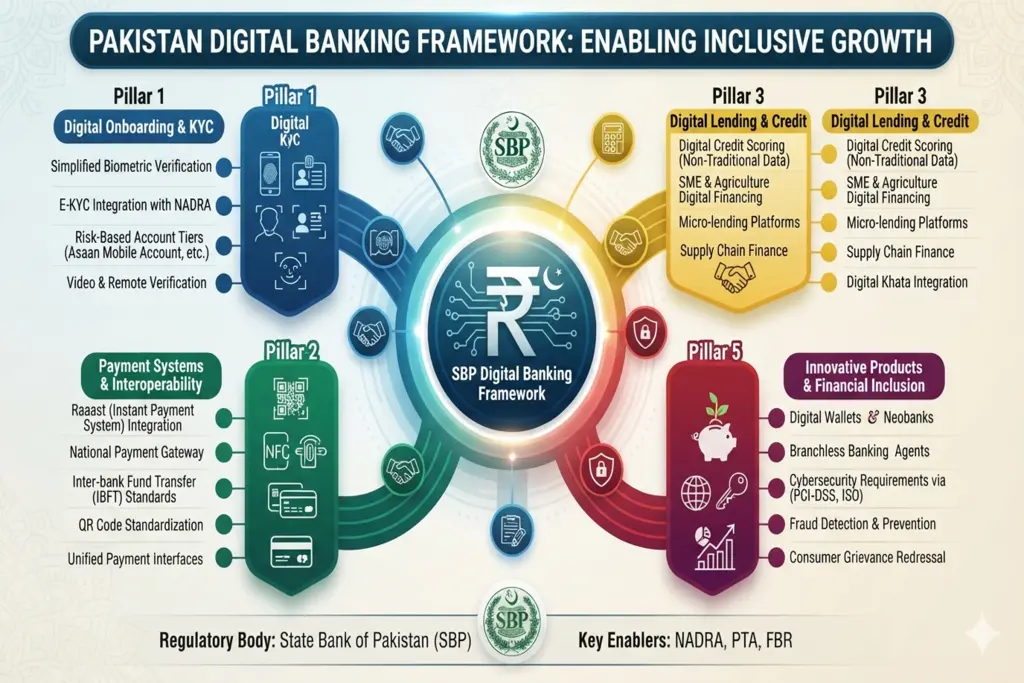
In a major macro-financial deployment aimed at structural financial sector stabilization, automated wealth tracking and sovereign tax-base expansion the State Bank of Pakistan has officially launched a comprehensive financial integration sandbox. The rigid regulatory configuration transitions legacy manual market monitoring tools into a highly advanced system-vetted ledger dashboard. Developed in strict alignment with the revenue targets of Budget 2026 and active International Monetary Fund covenants, the specialized infrastructure establishes real-time database locks across national capital networks, the bullion market and corporate fintech service portals.
As global emerging economies execute massive shifts toward touchless public utilities, eliminating unmonitored monetary vectors remains an absolute priority for federal economic planners. The rapid onboarding of computerized transaction networks directly counters speculative parallel market loops that historically generated imported inflation and localized revenue leakage patterns. By blending high-speed biometric synchronization scripts alongside unalterable backend data auditing the central bank successfully shields public resources, lowers institutional processing friction and projects a progressive image of Pakistan’s economic governance onto the global financial landscape.
Allocation of Bullion Telemetry and Anti-Smuggling Verification Channels
According to the operational directives distributed to regional exchange pools the upcoming framework completely discards slow manual trading registries by introducing automated data scraping logs across the gold market. To control market asset manipulation and block illicit wealth movement the system deploys a synchronized data mapping architecture:
The Centralized Bullion Portal Gateway: All primary bullion distributors, gold traders and enterprise brokers are bound to integrate daily purchase and liquidation records into a shared kclaud database linked with the FBR and NADRA.
Cashless Money Market Enforcement: Inter-bank liquidity adjustments and foreign exchange settlement pools are forced to execute exclusively via synchronized electronic kourriers to suppress speculative asset hedging.
Pixel-Level Algorithm Price Spotting: The core trading interface processes live international commodity pricing data loops generating auto-locked commodity benchmarks to block manual price-fixing or underground black-marketing attempts.
Expanding Fintech Footprints and Securing Budget 2026 Fiscal Targets
The commercial and national security implications of this unified fintech grid are extensive, directly backing the finance ministry’s mandate to control the fiscal deficit. To accelerate deep financial inclusion state planners have whitelisted specialized automated layers to expand access lines to underserved consumer segments.
The system-vetted configuration metrics of the newly integrated financial architecture break down as follows:
| Financial Sector Ingestion | Current Fiscal Scaling | Dedicated Monitoring Protocol |
| Fintech User Node Registries | 36% Year-on-Year Expansion | Real-time Raast transaction streams and touchless QR configurations. |
| Capital Market Liquidity Inflows | PKR 26 Billion (13 IPOs Settled) | Automated public equity fund allocation modules. |
| Budget 2026 Structural Cushioning | Vetted Balance Sheet Optimization | Systematic phased removal of non-essential manual subsidies. |
By forcing all primary financial providers to maintain absolute institutional transparency and moving toward tamper-proof digital audit trails, the state directly shields young microeconomic startups from localized compliance errors. The executive synchronization demonstrates absolute structural readiness confirming Pakistan’s capability to execute secure high-yield multi-sector market changes safely across its main metropolitan hubs.