


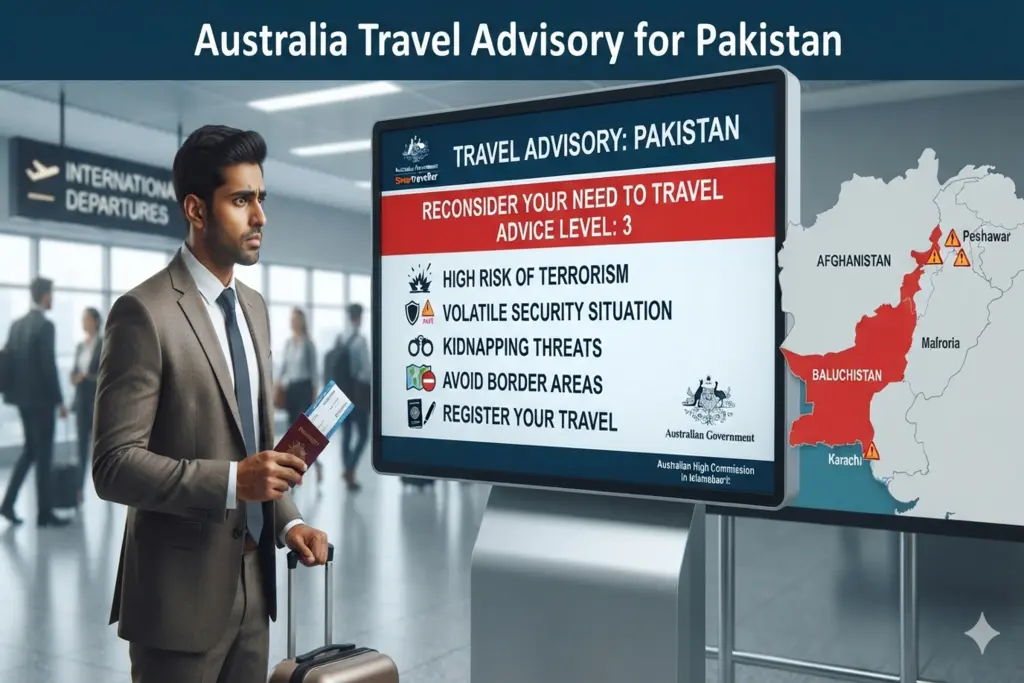
The Australian Government’s Department of Foreign Affairs and Trade (DFAT) has released an updated high level Travel Advice for Pakistan in a significant development in relation to international transit regulations as well as diplomatic security protocol. The notice, issued by the government on the official Smartraveller notice on its digital platform, urges Australian citizens to reconsider their travel to Pakistan because of the “unpredictable threat matrix” and potential for civil unrest, as well as the volatile security situation.
The safety indicators at ground level can change very rapidly without any manual warnings, which can affect the operation of the local infrastructure, flight parameters, and domestic transport systems.
Critical Mandates for Dual Australian-Pakistani Nationals and Citizens of Afghan Heritage
The updated administrative manual outlines strict structural compliance rules for dual citizens and travelers with specific regional heritage traveling to or within Pakistan:
Mandatory Use of Australian Passports: Dual Australian-Pakistani nationals are explicitly instructed to travel exclusively on a valid Australian passport. According to updated digital entry logs, utilizing a Pakistani passport instead can lead to severe manual processing delays and heavily restrict the Australian High Commission’s ability to provide emergency consular assistance.
Australian citizens with Afghan heritage or background are at risk of being subject to more rigorous scrutiny, enhanced interrogation or temporary detention by local security authorities for failure to provide the appropriate documentation, even when they have a valid visa or national identification card.
Civil Unrest Metrics Across Urban Centers and Active Border Constraints
Major cities like Islamabad, Rawalpindi, Lahore and Karachi are still very vulnerable to any sudden political event such as rallies, sit-in and mass religious processions, the Smartraveller advisory says. These gatherings can immediately close down arterial roads, block out sections of the road and cause bottlenecks to transport hubs. It is advised that travelers avoid crowds and stay away from protest areas and follow live media updates.
In addition, there are strict “Do Not Travel” (Level 4) advisories for areas considered to be high-risk on the frontiers.
All travel is now totally banned near the Pak-Afghan border (within 10km radius), and in the entire Balochistan province as well as in certain districts of Khyber Pakhtunkhwa (excluding Haripur and Abbottabad).
Non-military transit networks can be affected by military counter-operations and ongoing military deployments that may result in sudden checkpoints, communications blackout and lockouts.
Safety Guidelines for High-Profile Commercial and Transport Terminals
Sovereign tracking data suggests that foreign interests, international luxury hotels, public hospitals, airports, and crowded marketplaces remain potential soft targets for disruptive regional elements.
Australian nationals currently in Pakistan are strongly advised to secure soft copies of their documentation on encrypted cloud storage, keep active contacts for local security managers, and log their itineraries on the Smartraveller digital portal to ensure immediate activation of state-backed rescue channels during emergencies.