




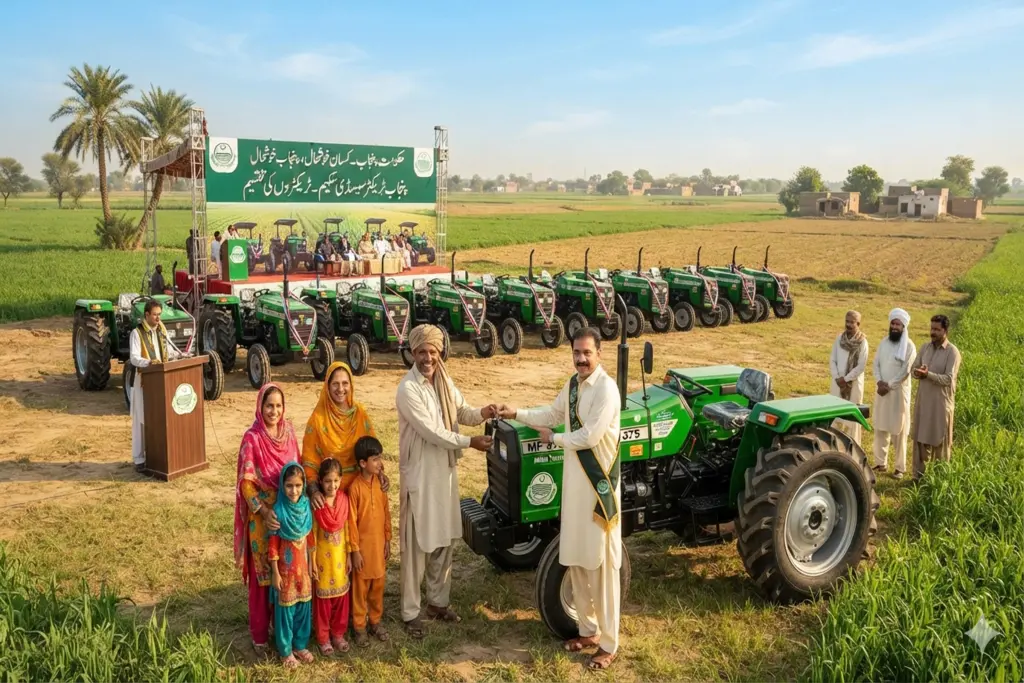
In a major geostrategic advancement for national food security, macro-financial asset protection, and automated agricultural industry integration, the Punjab Government is officially offering a massive Rs. 750,000 subsidy on 10,000 tractors. The landmark social welfare configuration, deployed directly via an integrated cloud platform by Chief Minister Maryam Nawaz Sharif, transitions legacy manual asset distribution into a highly structured, software-driven vetting sandbox. Engineered to support thousands of independent rural growers across the province, the newly operational financial framework eliminates traditional manual processing barriers, providing 100 percent paperless entry verification, computerized balloting, and cashless fund allocation directly through state financial registries.
As global agricultural markets adjust to volatile economic transitions, establishing highly competitive, digitized farming sandboxes remains a primary directive for Punjab’s fiscal planners. The newly introduced tractor subsidy serves as a vital utility that bridges the mechanization gap for small and medium-scale landholders, transforming legacy cultivation logistics into an efficient, tech-driven operation. By presenting an advanced economic manual backed by deep institutional overhauls, the provincial cabinet builds strong capital networks with domestic manufacturers, ensuring long-term market predictability and drawing high-utility machinery directly into the country’s primary economic sector.
Performance of Land Vetting Software and Biometric Cloud Compliance
To satisfy strict transparency benchmarks and ensure that the provincial development funds reach eligible smallholders without operational delays, the Punjab Agriculture Department has completely discarded old paper-based applications and hand-written land titles. School and corporate land managers alongside daily independent farming entities route all registration steps through automated vetting sandboxes linked directly to active provincial land databases.
The engineered agricultural protection framework operates on three critical performance layers to ensure zero vulnerability:
Frictionless Land-Net Cross-Reference: Deploying computerized data verification loops between the digital portal and the Punjab Land Record Authority (PLRA) cloud servers to seamlessly verify exact acreage ownership parameters, removing manual evaluation friction.
NADRA Integrated Identity Protection: Cross-referencing applicant profile data against NADRA biometric validation servers in milliseconds to instantly verify the legal identities of applicants, effectively eliminating identity theft or duplicate submissions.
Automated System Balloting: Shifting away from manual selections, the system utilizes computerized balloting software that actively processes all verified applicants on a live, tamper-proof dashboard to eliminate administrative coordination delays and human bias.
Enhancing Industrial Production Volumes and Corporate Market Predictability
The commercial implications of this automated agricultural machinery shortcut are highly extensive, offering massive financial growth vectors to digital financial operators, equipment dealers, and independent automotive manufacturing plants utilizing regional industrial sandboxes. By decreasing the financial barriers required to acquire modern heavy machinery, the state-of-the-art framework removes transactional friction and minimizes capital investment shortfalls for small-scale growers.
Furthermore, this operational shortcut enables domestic tractor manufacturers to manage cross-border raw material acquisition and local production loops with absolute ease. The organization has integrated computerized inventory tracking algorithms to monitor supply chain matrices, ensuring that aggressive delivery schedules do not disrupt market supply dynamics. This balanced regulation successfully upgrades market safety, protects consumer purchasing indices, and establishes a secure space for sustainable agricultural business brand development globally.
Compliance Frameworks and Future Agrarian Reporting Standards
To ensure continuous adherence to modern environmental guidelines and state consumer protection acts, the federal and provincial administrations have deployed dedicated compliance tracking portals across multiple financial and agrarian ministries. Commercial banking entities, local vendor networks, and verified agricultural cooperatives can now securely upload their transaction logs, machinery certifications, and processing data to verify system readiness prior to subsequent balloting phases.
A specialized technical help desk remains active across corporate server cycles to handle real-time regulatory inquiries and resolve documentation processing anomalies for registered agricultural and automotive legal representatives. This collaborative sandbox bridges the gap between state digital policymakers and corporate technology executives, transforming public welfare reporting into a transparent, data-driven utility. By driving institutional digitization and honoring its social product commitments, Pakistan establishes a resilient blueprint for sustained, high-utility workforce and investment protection across global commercial networks.