
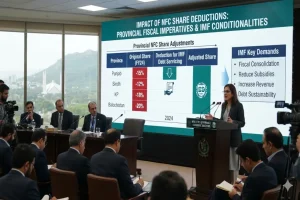


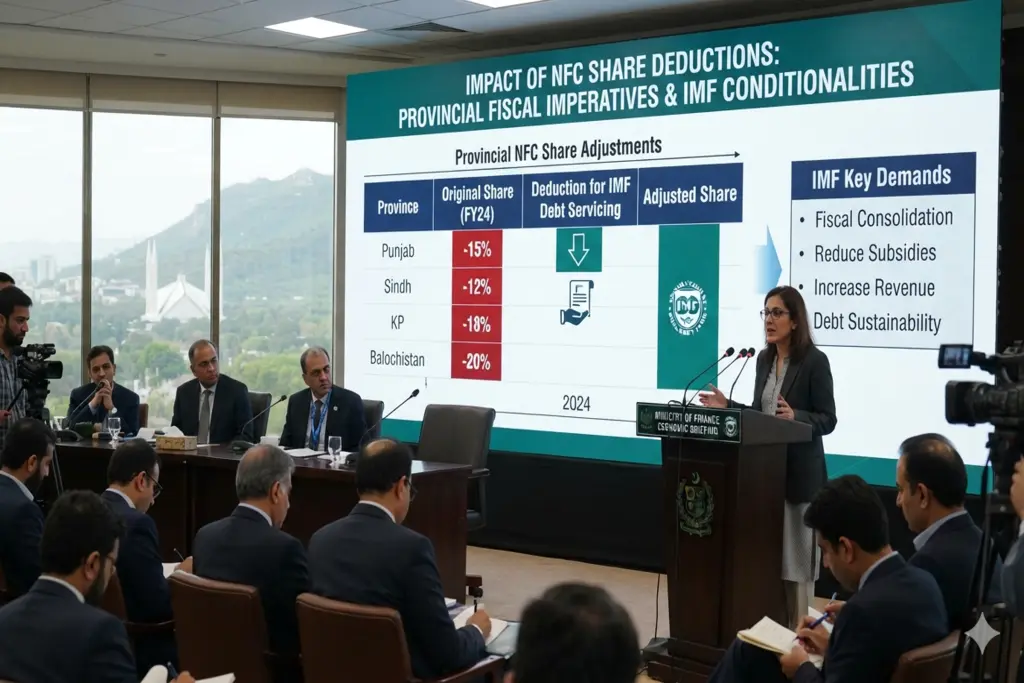
In a major fiscal realignment for national treasury coordination inter-provincial balance sheet optimization and structural debt resolution, the federal government has informed the International Monetary Fund (IMF) of its intent to recover over Rs. 110 billion from provincial National Finance Commission (NFC) award shares. The strategic financial directive transitions legacy, un-reconciled inter-governmental payment defaults into a rigorous, system-vetted fiscal enforcement sandbox. Engineered by the Power and Finance divisions the mechanism directly seeks to settle outstanding provincial electricity liabilities by cutting into regional revenue distribution grids to lower macro-financial volatility.
As the central economic team navigates critical Lending Program check-ins optimizing sovereign cash positions remains an absolute directive for public finance coordinators. The proposed automated deductions explicitly target deep-seated liquidity gaps within the energy sector forcing regional governments to take financial responsibility for local consumption grids. By implementing centralized fiscal deductions alongside hard structural targets the state aggressively contains the expansion of circular debt, maintains institutional market predictability and successfully projects a sophisticated image of sovereign debt governance onto the global financial landscape.
Audits of Power Arrears and Central Bank Debit Authority Bottlenecks
According to executive briefing sheets analyzed during the ongoing IMF consultations approximately Rs. 110 billion in provincial electricity arrears has been successfully verified and reconciled with an immediate extraction target of Rs. 50 billion set for the upcoming phase. However, the calculated financial sweep faces severe administrative and legal constraints within the central banking framework:
The Mandatory Debit Override: The State Bank of Pakistan (SBP) is statutorily blocked from deducting funds from provincial accounts without explicit written debit authority from the respective regional governments.
The Historical Rejection Precedent: A similar attempt by the Finance Division to cut Rs. 6 billion per month from Khyber-Pakhtunkhwa’s NFC share against a reverse cash grant failed after the provincial setup refused to issue centralized debit clearance to the central bank.
Provincial Budgetary Compression: The IMF has voiced explicit reservations that these top-down deductions could dangerously drain provincial revenues, especially since regions are already bound to generate a massive Rs. 1.7 trillion cash surplus and deliver Rs. 1.036 trillion in cash grants to the federal core.
To eliminate future billing disputes and lock in flawless consumption logging the Power Division is aggressively deploying high-speed smart meters across all state-administered provincial connection nodes.
Circular Debt Acceleration and the K-Electric Dispute Matrix
The broader macroeconomic implications of this federal-provincial fiscal standoff are extensive, directly threatening the sovereign deficit targets vetted by international rating agencies. Data warehouse logs show that the power sector’s circular debt accelerated by Rs. 61 billion during fiscal year 2026 anchoring at a record Rs. 1.675 trillion. Power managers attribute this cash-burn to compressed budgeted subsidies combined with an active multi-million payment dispute with K-Electric.
| Fiscal Tracking Bracket | Asset Value / Target | Primary Systemic Risk | Vetted Monitoring Node |
| Provincial Arrears Log | Rs. 110 Billion Reconciled | Legal debit authority denials by provinces. | Finance / Power Divisions |
| Gross Circular Debt | Rs. 1.675 Trillion Locked | Deficit defense shortfalls before IMF Executive Board. | Central Power Registry |
| Mandated Regional Cash Surplus | Rs. 1.7 Trillion Target | Severe compression of local development plans. | Provincial Treasuries |
The IMF mission heavily questioned why internal budgetary savings were not instantly routed to scale down the circular debt warning that the current trajectory is becoming increasingly difficult to defend before its Executive Board. Shifting from slow manual dispute reconciliations to automated smart grid streams remains the absolute priority to stabilize energy accounting. Through these strict central banking interventions and updated billing controls Pakistan targets deep structural balance sheet healing, anchors institutional developer confidence across energy corridors and safely safeguards sovereign fiscal sustainability indices.