


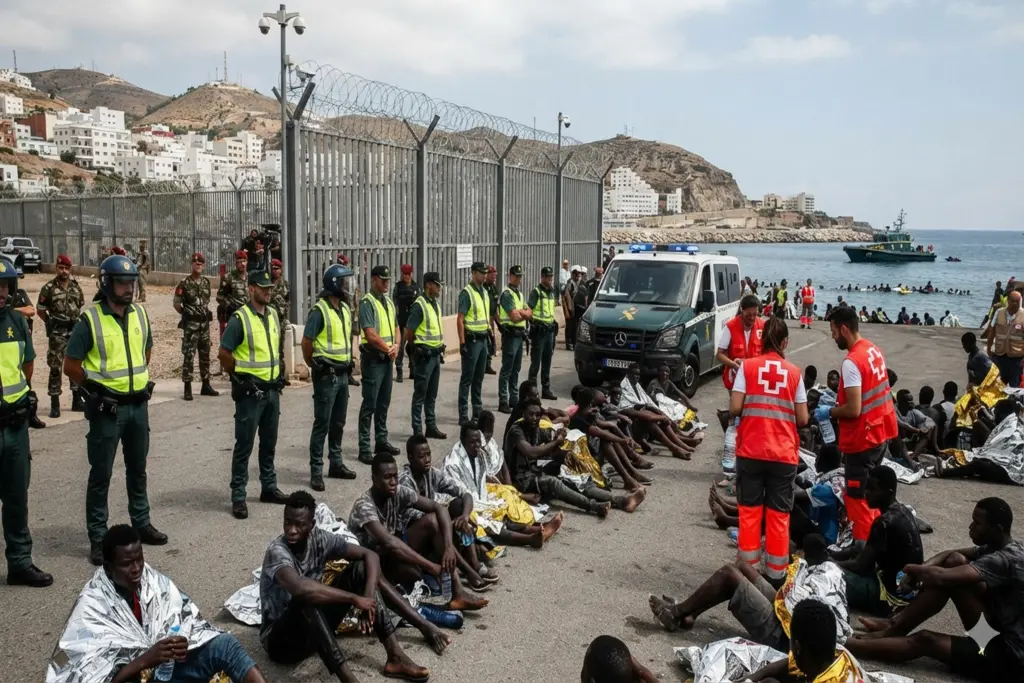
There’s an unprecedented humanitarian and security emergency in North Africa and the Spanish Interior Ministry believes that between 40,000 and 50,000 migrants arrived in the Spanish enclave of Ceuta from Morocco in just one 24-hour period. This huge wave has completely outstripped local infrastructure, and the central government in Madrid has had to dispatch the Spanish military to restore border control.
It is the largest migration wave in history: Ceuta has a total population of only 83,600. The population of the enclave, in a matter of minutes literally more than doubled after just one day. Thousands of people were observed swimming around breakwaters or using makeshift inflatable devices, or climbing the heavy fortifications on the landside to escape for asylum on European soil.
What Triggered the Sudden Escalation in Ceuta?
The legal catalyst for this explosive surge is a critical one, according to Spanish authorities and geopolitical analysts, who believe that regular migration attempts are going on across the Mediterranean. The Supreme Court of Spain gave a precedent-setting decision on maritime interceptions earlier this month. The court ruled that any migrants stopped at sea who tried to reach the autonomous enclaves of Ceuta or Melilla could no longer be summarily sent back to Morocco under immediate “border rejection” policies.
The BBC News Report said human trafficking networks and criminal gangs exploited this loophole in the law. Smugglers lied to thousands of people that when they crossed the water they would be safe under the law of Spain. This policy U-turn, coupled with the other regional economic pressures, translated into a border explosion of sorts.
Severe Human Toll and Frontier Chaos
The crowds trying to cross were so dense that it caused a terrible human tragedy. At least 19 bodies have been recovered so far from the sea, either by drowning or being crushed against the rocks close to the shore.
Vulnerable Groups: Local NGOs estimate at least 7,000 are unaccompanied minors and young children out of the total arrivals.
Urban Strain: Thousands of migrants have been forced to sleep in public parks and sidewalks, wander the streets in search of a place to rest for the night, as temporary holding areas are already at capacity.
Violence in the Border: Before military force was used, significant violence erupted on the Moroccan side of the border, leaving burnt remains of buses and commuter cars.
<blockquote class=”twitter-tweet”><p lang=”en” dir=”ltr”>Spain estimates some 49,000 migrants crossed into the enclave of Ceuta in North Africa over the past 24 hours, as they rushed by sea and land from Morocco <a href=”https://t.co/sBZzgKOT9M”>https://t.co/sBZzgKOT9M</a> <a href=”https://t.co/fmNh2iZq9i”>pic.twitter.com/fmNh2iZq9i</a></p>— Reuters (@Reuters) <a href=”https://x.com/Reuters/status/2083106191060910176?ref_src=twsrc%5Etfw”>July 31, 2026</a></blockquote> <script async src=”https://platform.x.com/widgets.js” charset=”utf-8″></script>
Military Mobilization and Political Fallout in Europe
On the request of the local government, Spanish Prime Minister Pedro Sánchez mobilised soldiers in order to disperse the crowds and strengthen the border’s defenses. In the border town of Fnideq, Moroccan police fired water cannons at the protesters who lined the streets, all under the banner of a joint commitment to the bilateral approach.
The Ceuta migrant crisis has quickly reverberated throughout the European Union, revealing strong divisions on external border management. Italian PM Giorgia Meloni strongly denounced the security breach, with threats of EU suspension of Spain from the Schengen zone, which is a network of European countries that allow free travel. In the meantime, France has stepped up its vigilant surveillance of its common border with Spain, which it has been doing proactively to block migration flows, particularly secondary migration, from the south.
Although a joint military operation has temporarily prevented mass crossings, the political debate surrounding deportations, human rights, and the integrity of EU borders will be the main discussion for months to come.