



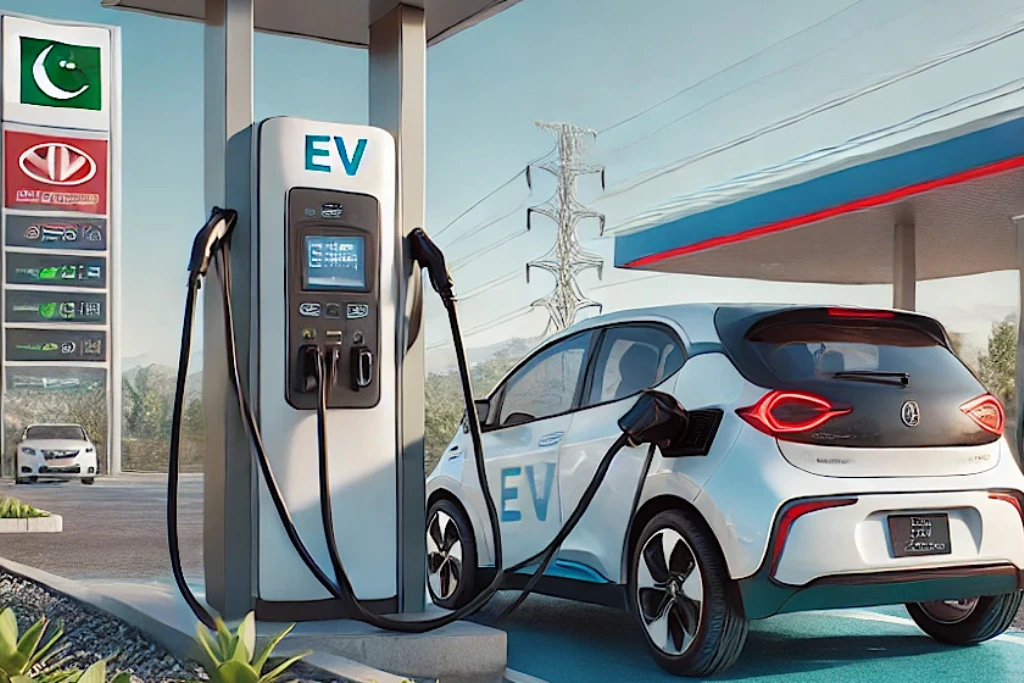
The Ministry of Industries and Production has officially revealed a huge infrastructure plan according to which public fast charging stations will be installed along all important routes and motorways at an average distance of 50 kilometers. The roadmap is a formal written response to the National Assembly and it has a lofty goal: Deploy approximately 3,000 charging units throughout the nation by 2030.
According to the newly drafted New Energy Vehicle (NEV) Policy 2025-30 the initial phase will kick off with the strategic installation of 40 high-capacity fast-charging hubs along the motorways and selected corridors of the National Highway (N-5). The government plans to encourage conventional fuel stations to install commercial Level 1, Level 2 and advanced DC fast charging stations in the boundaries of the existing fuel station. Additionally, the regulatory framework introduces specialized battery swapping points uniquely tailored for electric two wheelers and three wheelers.
The state is providing a very low commercial electricity tariff regime and expediting distribution network connections to promote private sector involvement. The roll out will also be based on the concept of public-private partnership arrangements that use dedicated viability gap funding mechanisms to manage capital costs. Furthermore, the policy in the large-scale “eco-friendly” approach takes long-term sustainability into account and establishes an eco-friendly recycling system in the local area. This grid will monitor and manage the collection, standard transportation, dismantling and processing of end-of-life lithium ion EVs to ensure no toxic environmental degradation.
Will 3,000 charging stations be enough?
Uncover the long-term master plan to transform public transport by 2030.
Can investors profit from subsidized tariffs?
Find out how private investment models are fast-tracking new installations.
How does battery swapping change travel?
Experience the seamless new technology designed for electric two-wheelers.
Where will old batteries be recycled?
Look into the specialized green networks handling toxic lithium-ion waste.
Are traditional fuel stations disappearing soon?
Browse the massive structural shifts occurring across modern highway stops.