

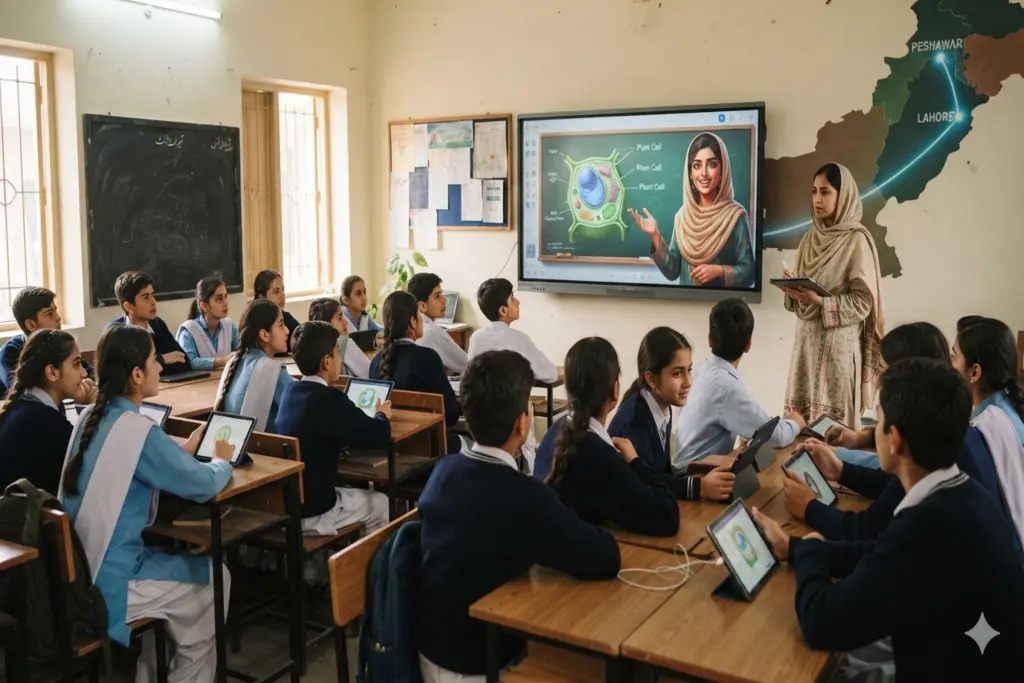
A child in a small village in Khyber Pakhtunkhwa now attends class through a screen, taught by an AI teacher instead of a human one. This is not a pilot experiment tucked away in a research lab. It is happening right now, in real government schools, and it is part of a much bigger shift. Pakistan’s education sector is embracing artificial intelligence faster than most people expected, and the change is reaching students in cities and remote areas alike.
What Is Actually Changing in Schools
Khyber Pakhtunkhwa has launched the country’s first public sector virtual school, backed by a new AI Education Authority. Forty-six government schools are already running on a pilot basis, teaching English, Mathematics, Physics, Chemistry and Biology through a central digital studio. Another 175 schools are set to join soon. The system works in Urdu, English and Pashto, so it is built for local learners, not just English-medium students in big cities.
Punjab is moving too, with plans for dedicated AI schools in Lahore and AI labs being added to primary schools under the provincial government. In Islamabad, the Federal Directorate of Education has made artificial intelligence in schools a formal part of the curriculum starting this year, introduced step by step from nursery through to Class 12.
Why This Matters for Ordinary Families
Most Pakistani households do not have a laptop for every child, and many rely on a single shared mobile phone for internet access. That is exactly why these programmes matter. Virtual schools and AI-based lessons are designed to reach children in areas where qualified teachers are scarce, especially in merged districts and rural regions where schools often sit empty of staff. For families already stretched by school fees, transport costs and the Benazir Taleemi Wazaif stipend system, free access to a well-trained AI teacher can be a real lifeline rather than a luxury.
A Checklist for Parents and Students
- Ask your local school or education department if AI or virtual school pilots have started in your district.
- Encourage your child to build basic digital literacy, even simple smartphone use counts.
- Check whether your child’s school offers the new AI or Computer Science elective from Grade 6 onward.
- Look into public Wi-Fi spots or affordable data packages if home internet is limited.
- Register for BISP or Taleemi Wazaif support if the cost of devices or connectivity is a barrier.
- Stay updated through provincial education department pages or WhatsApp groups for rollout news in your area.
Looking Ahead
None of this means classrooms will empty out or teachers will disappear. Officials describe the AI teacher system as a support tool for areas where trained staff are hard to find, not a full replacement for human educators. What it does mean is that a child in a remote village now has a real chance at the same core subjects as a child in Lahore or Islamabad. As AI in Pakistani schools expands from Khyber Pakhtunkhwa to Punjab and beyond, the biggest task for parents is simple: stay informed, ask questions at the school level, and make sure your child does not get left behind in this shift. The classroom of 2026 looks different, and it is worth paying attention to.