


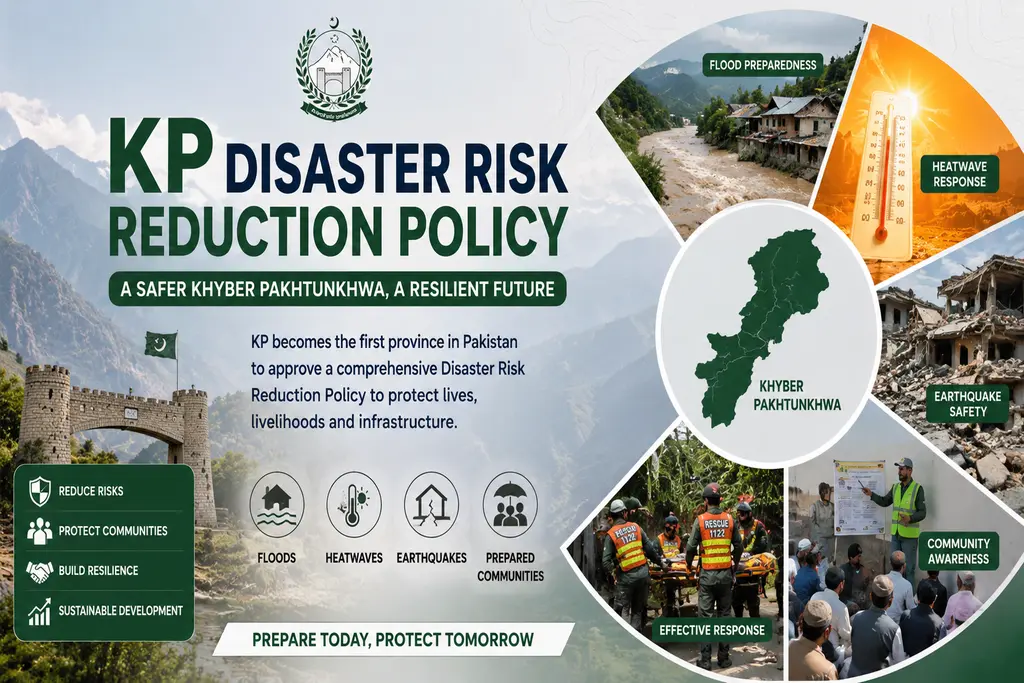
Khyber Pakhtunkhwa has become the first province in Pakistan to introduce a comprehensive Disaster Risk Reduction Policy. It is a change in government thinking from rushing relief trucks in the wake of a flood or earthquake to preventing the damage in the first place. For the families of Peshawar, Swat, Chitral or Dera Ismail Khan, this policy could mean the difference between prompt help or not when disaster strikes again.
Why this policy matters today
The event was held at Chief Minister House Peshawar and was jointly organized by the Provincial Disaster Management Authority (PDMA) and the Relief, Rehabilitation and Settlement Department with technical and funding support from Germany’s development agency. Officials called it a step away from a “reactive relief culture” to one of early warning and planning, a long overdue move in a province where 17 districts are regularly threatened by floods, glacial lake outburst floods, forest fires and heatwaves.
What the Policy Really Covers
The five-year framework has some practical pillars:
•Community alerts for floods or heatwaves—Early warning systems.
•Risk-informed development, meaning new housing and construction projects must consider hazard zones.
•Community-level resilience programs.
•Disaster risk financing, including a rapid response fund.
•Adaptive Social Protection for the Poor and Highly Vulnerable Households
Implications for the Average Household
How useful this policy will be in the real world for families in flood- or earthquake-prone areas will depend on how well it filters down to the ground level. Here are some things to watch for and act on:
•Keep in touch with your local PDMA or district administration for early warning alerts, especially during the monsoon season.
•You can check with your union council or tehsil office if your area is included in any new risk mapping or resilience program.
•If you belong to a poor family, you should ask how you can be linked to existing social protection schemes like BISP, as officials have suggested that disaster response should be integrated with these schemes.
•Keep important documents and a list of emergency contacts on hand; remember, preparedness starts at home, too.
•The policy also calls for more rigorous land use planning, so report unsafe or informal construction in flood-prone areas to your local authorities.
A Practical Way Forward
Pakistan has faced a series of disasters with the same reactive approach. The new Disaster Risk Reduction Policy of Khyber Pakhtunkhwa is an effort to break that cycle before the next flood or heatwave season. Whether it works will depend on implementation at the district and union council level, not just paperwork in Peshawar. The message to families in vulnerable areas for now is to be alert and well informed and to push their local representatives to make this policy visible on the ground.