

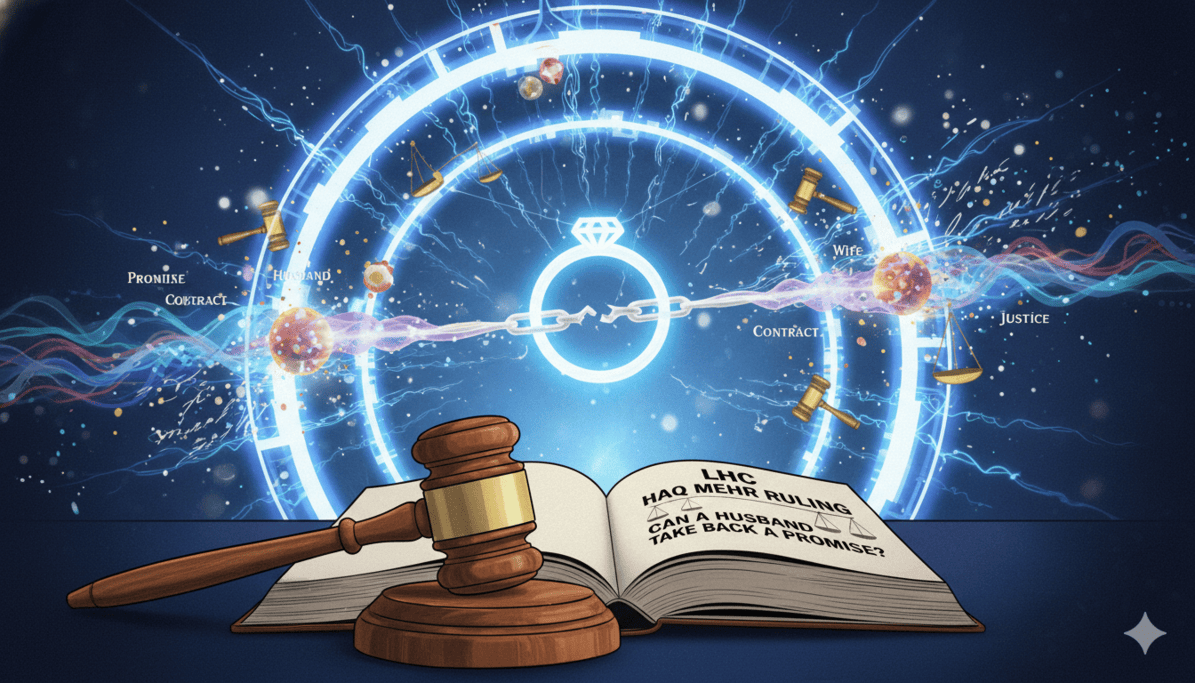
The Lahore High Court (LHC) has issued a landmark and progressive ruling on Financial Security of Women in Marriage in Pakistan. In his detailed 11-page written judgment, Justice Muhammad Sajid Mahmood Sethi decided that any oral or written assurance given by a husband during the time of marriage is legally binding. A husband is not allowed to withdraw from Haq Mehr (dower) or Bridal Settlement obligations legally or religiously even when the promises are made apart from the official marriage contract (Nikahnama).
The Case Background: Challenging Parallel Agreements
The milestone judgment came after a man, Muhammad Khan, who appealed against the lower court’s judgment demanding his transfer of a five-marla house to his divorced wife, Anwar Bibi, was put through a long ordeal. The husband said that the claim was fraudulent as it was not recorded in the official columns of the Nikahnama. He also claimed that the separate stamp paper deed that was signed on the wedding day was a post-marriage document.
After reading through the evidence and witness statements, the Lahore High Court rejected the appeal of the husband. The court indicated that witnesses at the trial testified specifically that the independent written agreement was authentic. This was a very important precedent; minor irregularities in the Nikahnama cannot invalidate a woman’s right to her dower.
Core Legal Principles Established by the LHC
1. Validity of Outside and Parallel Agreements
The LHC Haq Mehr ruling clarifies that agreements executed on ordinary stamp papers or entered into via separate parallel contracts on the wedding day hold full legal weight. Under the statutory frameworks of the Muslim Family Laws Ordinance 1961, family courts are empowered to look beyond the four corners of a Nikahnama to enforce the true intent of the matrimonial agreement.
2. Silence Does Not Equal a Waiver of Rights
A profound aspect of the judgment addresses the socio-cultural realities of Pakistan. Due to intense domestic and societal pressures, women frequently avoid aggressively demanding their dower during the marriage or at the wedding ceremony. The LHC explicitly remarked that a woman’s silence or delay in claiming her Haq Mehr does not mean she has waived her legal right. The right remains persistent, active, and claimable at any juncture.
3. Flexibility of Haq Mehr Under Islamic Jurisprudence
Aligning statutory law with Islamic principles, the court observed that Haq Mehr can be fixed:
- Verbally during the ceremony.
- In writing via a formal contract or separate deed.
- Post-marriage through mutual consent.
Furthermore, a husband can legally increase the dower amount or add assets to it at any point during the marriage, and such increments are fully enforceable by family courts.
| Common Misconception | Legal Reality |
| “If it’s not written inside the Nikahnama, it isn’t enforceable.” | Separate written agreements (such as independent stamp papers) are fully valid and enforceable in a family court. |
| “She didn’t demand it for years, so she surrendered her claim.” | Silence or delay due to social and domestic pressure does not equate to a legal waiver of her financial rights. |
| “Verbal marriage promises cannot be legally verified or recovered.” | Under Islamic principles and Pakistani law, verbal dower promises backed by credible witness testimony constitute a binding legal debt. |
Broader Implications for Family Law in Pakistan
This judicial precedent has made a significant impact on the approach of family courts in financial matters when dealing with divorce, Khula or maintenance (Iddat) cases. The court emphasised that laws need to be interpreted progressively so that justice prevails on a balanced basis and judges should consider the social realities of Pakistan and not just the technical loopholes which are too restrictive.
Ultimately, a husband’s verbal or external written promise is now treated with the same severity as a commercial or financial debt under the law.