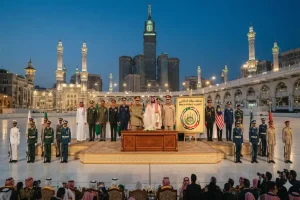


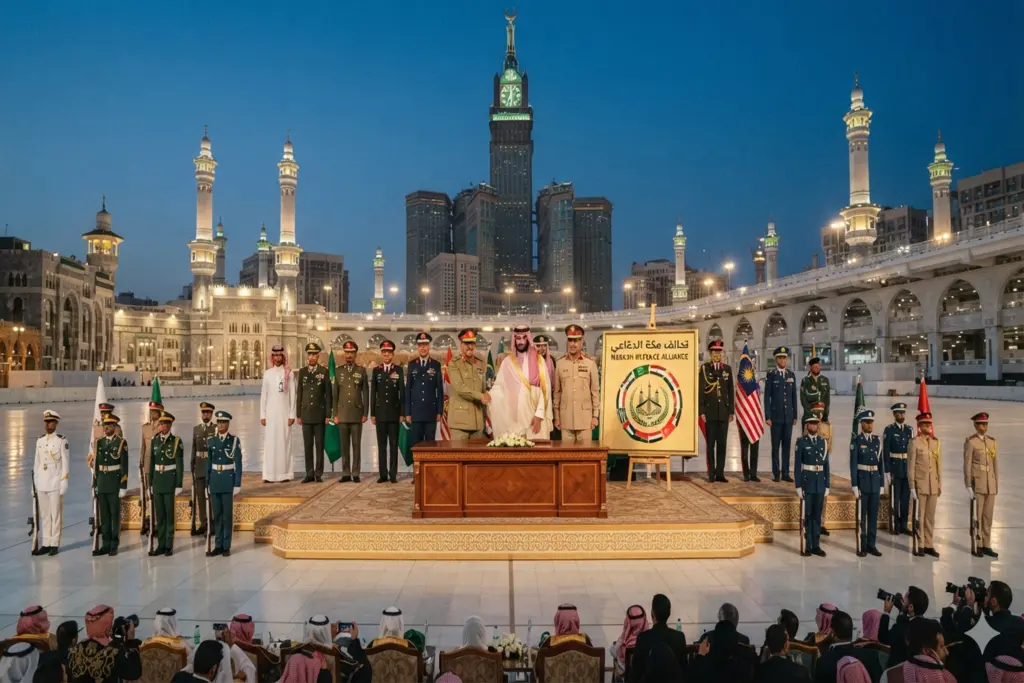
People across Pakistan have been talking about the Makkah Defence Alliance this week, and for good reason. With the Yemen-Saudi situation heating up, military officials had to step in and explain, once again, what this pact really is and, just as importantly, what it isn’t.
What Is the Makkah Defence Alliance?
The pact was signed in August by Pakistan, Saudi Arabia and Turkiye. Under its terms, an attack on one member country counts as an attack on all three. Pakistan is currently running the alliance’s secretariat, a job it agreed to hold for three years after the group’s first meeting in Istanbul.
Why “Not a Club” Matters
DG ISPR Lieutenant General Ahmed Sharif Chaudhry recently addressed a question a lot of people had been asking quietly: is this just a Muslim security bloc? His answer was straightforward. He said the alliance has no hidden regional ambitions and isn’t reserved for Muslim-majority states. He described it as resting on three ideas:
- Non-aggression, meaning the alliance doesn’t target anyone
- Non-interference, so member states stay out of each other’s internal matters
- Collective deterrence, where a threat to one becomes a concern for all
This distinction actually matters a great deal. Framing it this way keeps the alliance looking like a stabilising arrangement rather than something built on religious lines, which helps avoid unnecessary suspicion from neighbouring states or global partners.
What This Means for Ordinary Pakistanis
This isn’t just diplomatic talk that stays in press briefings. Defence Minister Khawaja Asif has said Pakistan would stand by Saudi Arabia “practically and diplomatically” if the Yemen conflict worsens, especially after reports of a drone threat near Makkah. Given how closely tied Pakistan-Saudi Arabia relations are, through millions of Pakistani workers in the Gulf, remittances, and Hajj and Umrah travel, whatever happens next in this region will land close to home for a lot of Pakistani families.
Quick Checklist: Understanding the Alliance
- It’s defensive, not offensive, by design
- Membership isn’t limited to Muslim countries
- Any expansion decision rests with the leaders of Pakistan, Saudi Arabia and Turkiye
- Turkiye has mentioned Egypt as a possible future partner, though nothing is confirmed
- Pakistan’s Foreign Office has said formal expansion isn’t happening right now
Conclusion
The Makkah Defence Alliance shows Pakistan taking on a bigger security role in the region, one built around shared principles rather than religious identity alone. As things in Yemen keep shifting, it’s worth keeping an eye on how this alliance grows, since its next moves will matter for regional stability and for the millions of Pakistanis whose daily lives are connected to the Gulf.