



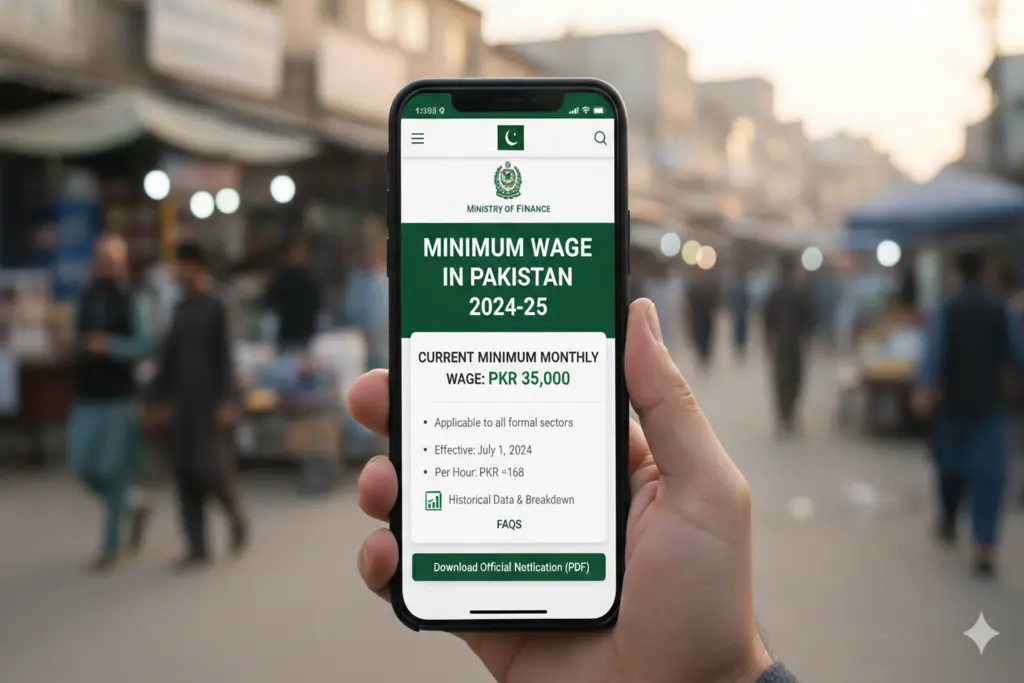
As federal planners enter the final stages of drafting the fiscal year 2026-27 budget, a significant regulatory development has emerged targeting private sector employees and daily-wage laborers. In response to mounting economic pressures and escalating cost of living, the Pakistan Institute of Development Economics (PIDE) and other senior policy groups, as well as political allies, have made a formal recommendation to the federal government. The draft suggests that the minimum wage in Pakistan should be increased from Rs 40,000 per month to Rs 45,000 per month, which is the statutory minimum wage.
This proposal comes at a crucial moment after recent increases in consumer prices which have severely curtailed the purchasing power of the poorer segment of the population.
If incorporated into the final finance bill, this legislative floor will serve as a mandatory benchmark providing necessary financial protection to unskilled and mid-range private employees nationwide.
Technical Framework of the Proposed 12.5% Wage Increment
According to policy metrics evaluated in recent fiscal briefs, setting an equitable wage floor requires balancing household subsistence costs against the financial capacities of medium-sized enterprises. The proposed model urges a baseline ad-hoc increase of Rs 5,000 (a 12.5% increment) to establish the Rs 45,000 monthly threshold.
To accommodate regional variations in structural living expenses, researchers have proposed a multi-tiered provincial deployment strategy:
- Punjab and Balochistan Tiers: For these tiers, a flat figure of Rs 45,000 to Rs 45,500 per month is suggested for private sector unskilled labour baseline.
- In the Sindh and Khyber Pakhtunkhwa Tiers it is recommended to raise the mandatory baseline to Rs 46,000 per month because of high urban living indexes and high density of urban industries.
Expected Regulatory Rules and Deduction Limits for Private Employees
Each time the minimum wage is increased or decreased in Pakistan, there are certain labour ordinances and compliance parameters that apply to private corporate bodies, factories and commercial establishments immediately.
According to expected implementation guidelines, the following rules will govern private contracts:
- Unskilled Labor Protection: The mandatory floor applies explicitly to non-specialized operational roles, including private security guards, janitorial crews, assembly-line factory workers, and construction laborers.
- Authorized Institutional Deductions: Consistent with previous provincial labor notifications, employers providing structured corporate amenities—such as daily meals, managed on-site accommodation, or dedicated transport pools—are legally permitted to make calculated, fixed deductions from the gross baseline pay.
- Social Security Integration: State assemblies are actively working to align provincial Employees’ Social Security Acts with the incoming wage tiers. This harmonization ensures registered private workers receive proportional, uninterrupted cover under EOBI (Employees’ Old-Age Benefits Institution) and regional healthcare programs.
Enforcing Compliance in the Informal Economic Sector
The proposed strategy formally acknowledges that the primary challenge facing domestic labor laws lies within the informal sector, which employs nearly 80% of the country’s workforce. Small businesses, cottage industries, and employers in the local economy are often not subject to state documentation processes, and often pay workers considerably below the state’s minimum wage.
To overcome these enforcement obstacles, the draft recommends that the federal and provincial labor departments conduct thorough corporate inspections—without warning and with no hesitation—and enforce stiff financial penalties against rogue companies. Private workers have a right to formally complain about being underpaid to the regional Minimum Wages Boards or special labor tribunals.



1 Comment
Pingback: PM Approves Timeline for FBR Tax Monitoring System Expansion