


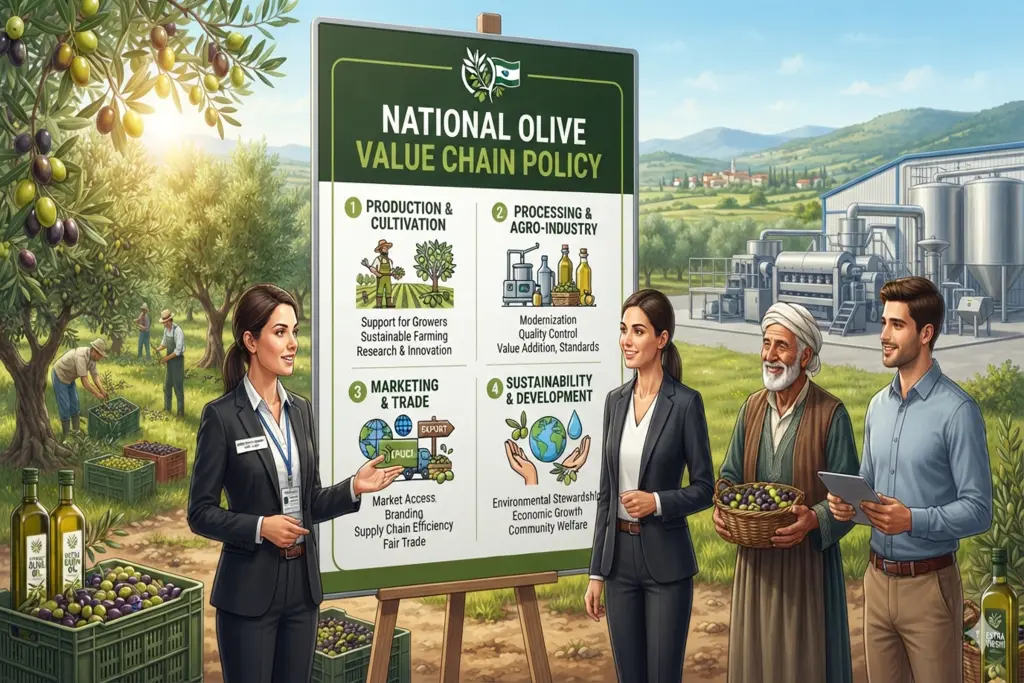
In a major policy shift toward agricultural self-reliance, import substitution, and high-value agro-industrial growth, the Government of Pakistan has unveiled its comprehensive national strategy for the olive sector. Prime Minister Muhammad Shehbaz Sharif officially launched the Pakistan National Olive Value Chain Policy during a specialized institutional session held in Islamabad.
The primary objective of this new regulatory framework is to systematically transform Pakistan’s massive untapped wild and arable land potential into a lucrative, commercial-grade olive industry. By expanding localized orchards, processing mills, and certified marketing corridors, the state aims to secure long-term food security and relieve extreme pressure on national foreign exchange reserves.
Mitigating the Financial Burden of Edible Oil Imports
Addressing the launching ceremony, Prime Minister Shehbaz Sharif highlighted the staggering economic drain caused by the country’s reliance on imported food commodities. He revealed that Pakistan currently spends four billion dollars annually solely on importing edible oil.
The prime minister mapped out several immediate financial goals embedded within the value chain strategy:
Targeted Short-Term Savings: Securing a reduction of at least $400 million in a single fiscal year by aggressively optimizing domestic oil-seed crushing output.
Achieving Absolute Self-Sufficiency: Deploying long-term infrastructure overhauls to transition Pakistan from an import-dependent state to a self-sufficient olive oil producer within the next few years.
Value-Addition Mandate: Shifting focus from basic crop harvesting to sophisticated downstream processes, including professional oil extraction, premium bottling, and global value addition.
Prime Minister @CMShehbaz has launched the Pakistan National Olive Value Chain Policy, aimed at turning the country's olive potential into prosperity @PakPMO @GovtofPakistan @ItalyinPakistan @ForeignOfficePk #RadioPakistan #News https://t.co/eiOtBq2ETU pic.twitter.com/ej1x1fKwqt
— Radio Pakistan (@RadioPakistan) August 24, 2026
Seven Decades of Alliance: The $100 Million Pakistan-Italy Strategic Partnership
The Prime Minister extended deep institutional gratitude to the Italian Government for its consistent technical and financial support in developing Pakistan’s olive ecosystem . Speaking on the occasion, Italian Ambassador to Pakistan Ugo Ciarlatani highlighted that Rome and Islamabad share a robust partnership spanning over seven decades, with collaborative programs extending across agriculture, science, education, trade, and regional security.
The Italian Ambassador detailed the historical investment pipelines that laid the foundation for the new value chain policy:
The Pakistan-Italy Debt Swap Programme: The deployment of a 100-million-dollar structural debt-swap framework served as the primary financial catalyst to plant and maintain massive olive orchards in designated terrain.
The 7-Million Plant Milestone: Driven by shared agricultural initiatives, Pakistan now boasts a thriving baseline of more than seven million operational olive plants across its provinces.
The Olive Culture Project: This bilateral support network has funded state-of-the-art testing laboratories, certified sapling nurseries, small business collectives, and hands-on operational training for more than 700 cross-provincial stakeholders.
Empowering Youth: 100 Agricultural Graduates to Be Sent to Italy
To eliminate the acute shortage of specialized local processing experts and counter outdated farming techniques, Prime Minister Shehbaz Sharif announced a prominent human capital development package. The Government of Pakistan, operating entirely at its own financial expense, will send 100 young Pakistani agricultural graduates to Italy.
These sponsored scholars will enroll in advanced Italian research institutes to acquire bleeding-edge operational knowledge in modern olive cultivation, oil extraction chemistry, high-tech commercial processing, and international supply chain marketing. Upon their return, these graduates will lead regional agro-industrial clusters as certified technical managers.
Furthermore, Ambassador Ciarlatani confirmed that Italy is reinforcing Pakistan’s technical and vocational training networks through a dedicated 20-million-euro capacity-building program focusing on high-value agriculture. The implementation of this policy framework is expected to reshape rural economies, providing resilient, climate-smart livelihoods for local farmers, rural women, and the youth workforce.