



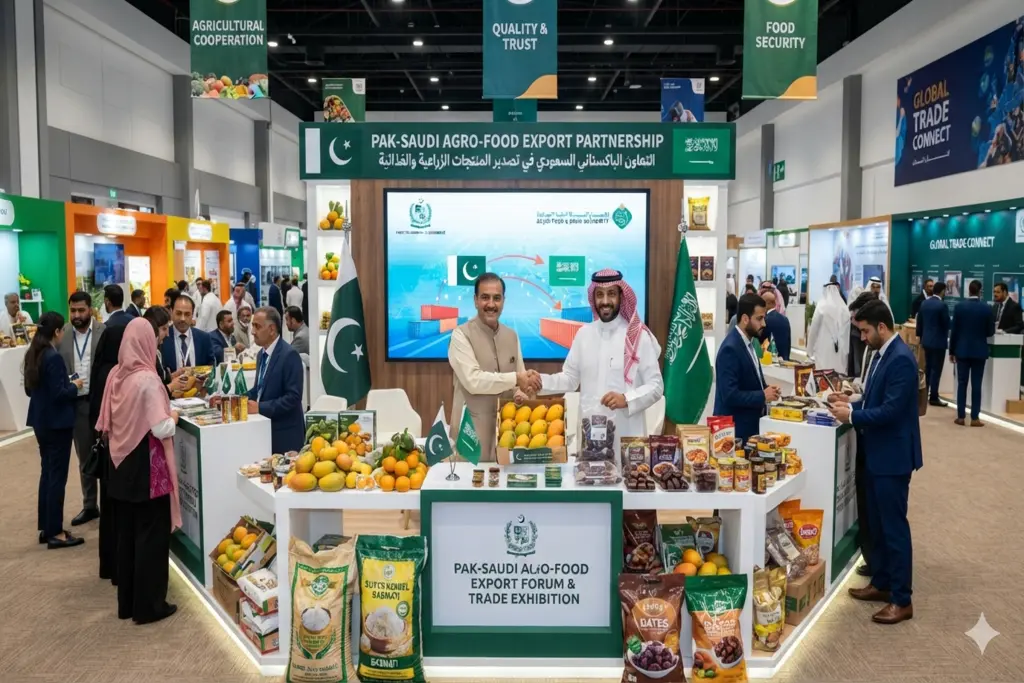
In a major geo-economic development aimed at maximizing agricultural value chains and accelerating foreign exchange inflows, the governments of Pakistan and Saudi Arabia have formalized a bilateral agreement to elevate Pakistan’s agro-industrial and food sector exports to a landmark $3 billion within the next two years.
The extensive economic target was finalized following an intense, high-profile three-day official visit by a specialized Saudi economic delegation to Islamabad. Operating under Business-to-Business (B2B) and Government-to-Government (G2G) frameworks, the new policy matrix seeks to integrate Pakistan’s prominent farming output directly into Saudi retail infrastructure and long-term food security reserve pipelines.
Technical Streamlining of High-Yield Export Commodities
The strategic dialogue was co-chaired by the Saudi Minister for Environment, Water, and Agriculture, Engineer Abdulrahman A. Alfadley, and Pakistan’s Federal Minister for National Food Security and Research, Rana Tanveer Hussain. Both delegations analyzed baseline shipping data to eliminate manual trade friction and isolate high-yield growth corridors.
The structural execution blueprint establishes strict operational mandates across several core agricultural components:
Investing in upgrading processed grain exports for realizing the competitive advantage of the Rice Value Chain. The new treaty seeks to aggressively double financial data showing Pakistan exported 169,000 tons of high-quality rice worth $163 million to Saudi markets in 2025, which the new treaty is geared towards doubling.
Red Meat Logistics Overhauls: Double the existing livestock trade by streamlining the cold chain transport networks.
Pakistan currently exports 30,000 tons of fresh beef and mutton worth $167 million to the Kingdom annually, which will now bypass traditional manual screening bottlenecks via synchronized quarantine certificate.
Horticulture and Green Fodder Synching: Digitalisation of phytosanitary approvals and implementation of automation in fresh fruit and citrus concentrate grading, as well as high protein alfalfa fodder grading, to ensure smooth passage through Saudi food-standard audits.
Aligning Saudi Vision 2030 with SIFC Corporate Farming Models
A central objective of the delegation’s itinerary was linking Saudi Arabia’s macro-prudential Vision 2030 food security targets with the automated production capabilities managed by Pakistan’s Special Investment Facilitation Council (SIFC) . The visiting dignitaries conducted extensive technical assessments at the National Agricultural Research Centre (NARC) and held high-level briefings with defense-led corporate farming managers.
In a formal gesture, Saudi Arabia extended an official invitation for Pakistan to become a formal member of the International Dates Council, which was readily accepted by Islamabad. This alignment will enable local date growers to tap into the automated water-efficient irrigation networks and advanced post-harvest date preservation software that will reduce manual crop losses to a great extent.
Global Market Entry: The 43rd Saudi Agriculture Exhibition
To immediately transition these diplomatic parameters into tangible trade figures, Saudi authorities have officially invited Pakistani agri-exporters and corporate farmers to participate in the upcoming 43rd Saudi Agriculture Exhibition, scheduled to run in Riyadh from October 19 to 22, 2026 .
The federal government has initiated an automated screening portal to select local enterprises capable of matching the strict quality control manuals mandated under the new bilateral protocol. This network-integrated clearing system is engineered to permanently bypass traditional bureaucratic red tape, processing export compliance clearings instantly.


1 Comment
Pingback: Benazir Kissan Card Balochistan 50k Wheat Plan