




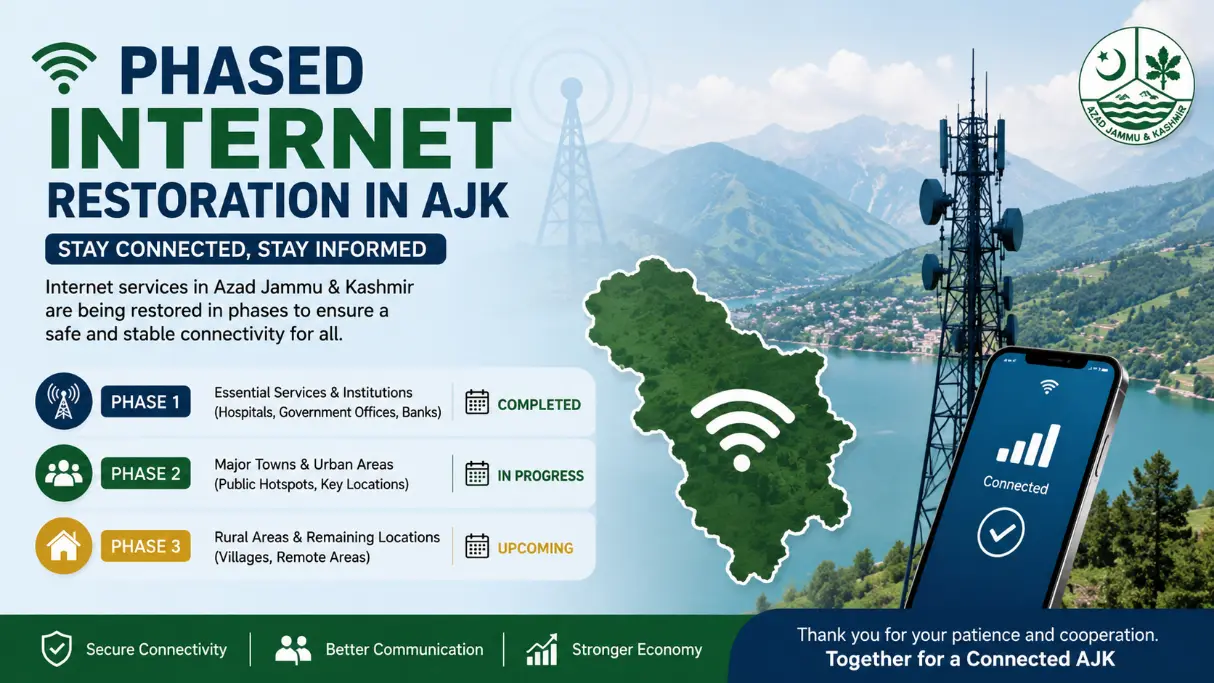
In an immediate fulfillment of public governance pledges authorized by the newly elected administration of Prime Minister Barrister Syed Iftikhar Ali Gillani, the state has initiated a structured, calculated restoration of digital infrastructure. Officially authorized via an executive circular from the AJK Home Department, network connectivity has entered a phased recovery process across Azad Jammu and Kashmir after nearly three months of blanket suspensions implemented to preserve regional stability and safeguard critical civil assets.
The security-vetted deployment replaces blunt, manual telecom lockouts with automated, data-vetted routing configurations to systematically reboot the region’s disrupted freelance markets, commercial portals, and university access networks.
Spatial Dissection of Regional Network Restorations and Technical Limits
Operating under the strict directives of the AJK Home Department and local telecommunication managers, the network infrastructure is not transitioning into absolute uptime simultaneously. Instead, access is being scaled according to localized security baselines:
Complete Restoration Corridors: Unrestricted high-speed broadband services have been successfully reactivated across the Neelum District of the Muzaffarabad Division and the Haveli Kahuta District of the Poonch Division.
Mirpur Division Commercial Access: Fixed-line Digital Subscriber Line (DSL) and GPON arrays have been restored across Mirpur and Bhimber to enable local corporate entities and import-export managers to resume financial transactions.
Conditional Institutional Whitelisting: Fixed broadband lines across Jhelum Valley, Bagh, Dhirkot, and Kotli remain heavily restricted, routed exclusively to verified educational installations and financial banking nodes.
Mandatory Affidavit Compliance for Whitelisted Public Entities
To prevent the newly restored network assets from being exploited for subversive hybrid campaigns, decentralized propaganda vectors, or civil disruption, the Home Department has enforced strict compliance criteria. Administrators of all whitelisted schools, colleges, public universities, and banking terminals are legally required to execute formal legal affidavits before their IP pools are formally whitelisted by central routers.
The regulatory framework binds institutional network managers to two strict operational mandates:
National Security Guarantees: Institutional heads assume direct personal and legal responsibility to guarantee that no connected workstation or local wireless router facilitates content that undermines state sovereignty or local law and order.
Hardware Audit Inventories: IT managers must submit complete physical and hardware records of their current network terminals to enable automated scanning software to easily trace and audit all active data traffic.
Continued Mobile Data (3G/4G) Prohibitions and Poonch Division Exclusion
Despite these positive developments for fixed-line consumers, the Home Department verified that total data bans remain in place across the most politically sensitive zones of the Poonch Division, specifically the Rawalakot and Sudhnoti districts. Networks in these conflict-prone corridors will remain completely offline until localized security clearances are updated.
Furthermore, the phased recovery is strictly limited to landline DSL and commercial fiber networks. Mobile cellular data services including 3G, 4G, and LTE arrays remain entirely suspended across all ten districts of Azad Jammu and Kashmir. Federal telecommunication regulators and cellular operators are currently executing comprehensive digital audits of regional towers, confirming that mobile internet nodes will only go live once sovereign security agencies grant unconditional clearance.




1 Comment
Pingback: UN Secretary General Nishan e Imtiaz Pakistan: Award Live