


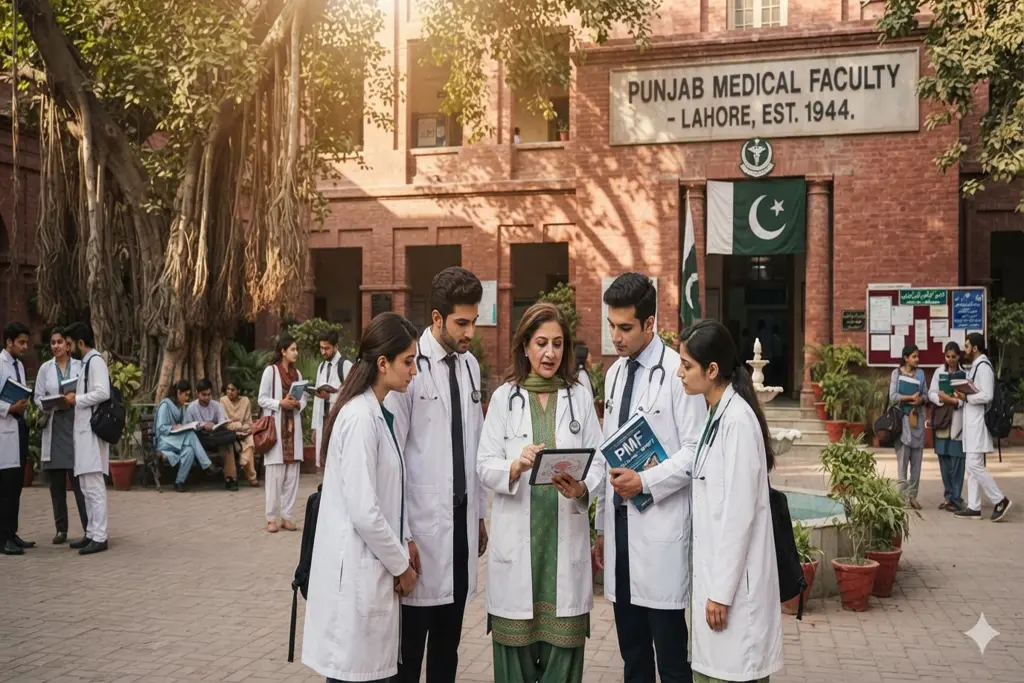
Punjab is lacking trained support staff in healthcare and has now taken a direct step to fill that gap. Punjab Medical Faculty (PMF) has launched new medical diploma courses in seven allied fields of health. The new courses are a shorter and more practical way into the medical field for young Pakistanis who cannot commit to a five-year MBBS degree.
What are the new diploma courses?
PMF has approved two-year diploma programs in seven special areas. They are esthetic technicians, audiology & speech rehabilitation technicians, cardiac perfusion technicians, ECG & echocardiography technicians, emergency & critical care technicians, nuclear technicians, and radiotherapy technicians. Each of these fields feeds directly into hospitals, diagnostic labs and private clinics, which are running short of trained technical staff.
Why it matters for health care in Punjab
In Pakistan, hospitals, especially in smaller cities, face difficulties hiring qualified technicians for machines like ECG monitors, radiotherapy units and cardiac perfusion equipment. Doctors cannot run this equipment alone. The shortage means that patients have to wait longer and the few trained staff have to deal with more pressure. Punjab hopes to train more technicians locally to reduce dependence on a few urban centers and push skilled healthcare workers into the smaller towns too.
How Institutes May Apply
PMF has issued a formal notification to public and private allied health institutes in the province to apply for permission to run these new diploma programs.
If your institute is interested in applying, here’s a quick checklist:
•Register your interest with PMF by 28th August.
Proceed to pay the inspection fee of Rs. 110,610 as required.
•Ensure labs and clinical facilities are compliant with PMF technical standards.
•Use qualified faculty in the particular diploma field being offered.
•Enroll students only after PMF site inspection and approval.
What This Means for Students
For Punjab students, it is a pragmatic alternative to long and costly medical degrees. With a two-year diploma, you can get real hospital jobs faster and more affordably, without the super-competitive entry requirements of MBBS or BDS programs. It is also a good option for students from smaller towns who want to stay in the healthcare field but don’t want to move abroad or take on years of debt for a longer degree.
A Practical Step toward Filling a Real Gap
Punjab’s decision to increase the number of allied health diplomas is a small but important step toward creating a more balanced health workforce where hospitals aren’t just short of doctors but also the technicians who keep critical equipment running. The opportunity is open now for institutes but the window to apply is short. This is a faster, more affordable path for students to get into healthcare. Anyone interested should contact their nearest allied health institute soon to find out if it is planning to offer one of the new diplomas.