


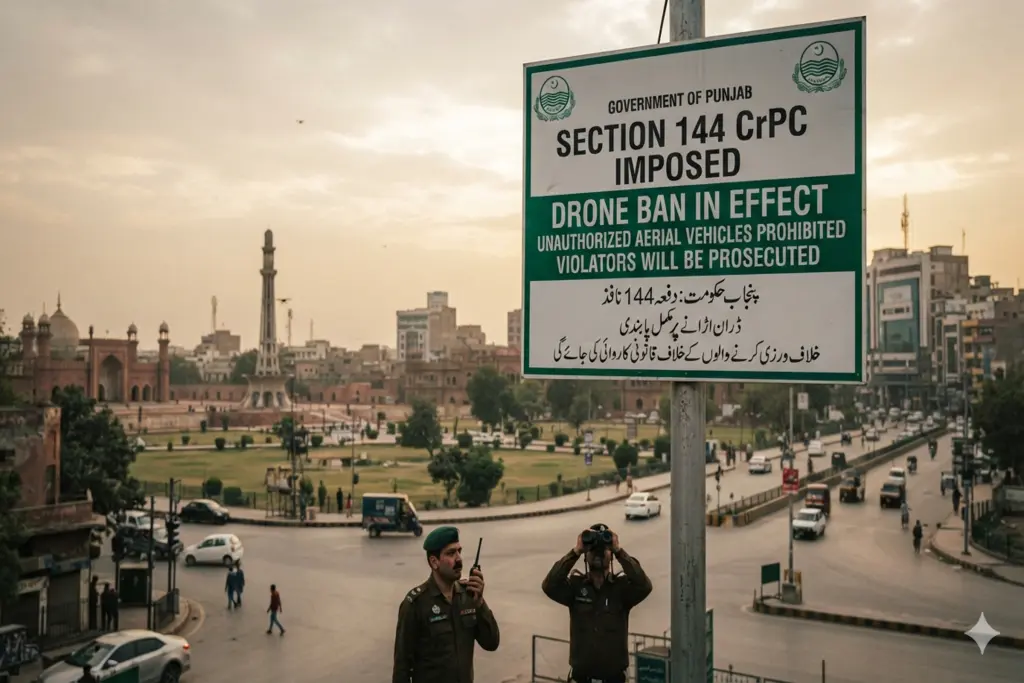
In a major geons legacy unmonitored commercial aerial photography into a highly secure, restricted airspace sandbox. Prompted directly by critical strategic advancement for provincial internal security, localized threat mitigation and structural aerospace regulations the Punjab Home Department has officially imposed a 30-day ban on outdoor drone flights under Section 144. The calculated administrative enforcement transitiol alerts from internal intelligence matrices the new emergency mandate deploys a complete statutory freeze on the usage of Unmanned Aerial Vehicles (UAVs) in open public spaces across all administrative districts.
As micro-aerial technology advances globally, regulating regional low-altitude operations remains an absolute priority for Punjab’s home coordinators. The swift invocation of Section 144 establishes an urgent regulatory framework designed to safeguard sensitive border areas, public gatherings and strategic shipping loops from asymmetric aerial threat vectors. By integrating strict automated compliance gates alongside localized law enforcement monitoring, the state successfully handles domestic risk indices, safeguards high-volume population nodes and projects a highly sophisticated, transparent image of public safety administration onto the global security landscape.
Allocation of Indoor Exemptions and Organizer Compliance Metrics
According to the official circular distributed by the Home Department’s operational command the spatial boundary of the restriction applies strictly to outdoor fields. The system matrix maps out explicit conditional layers to accommodate commercial events held inside enclosed setups:
The Indoor Event Extension Sandbox: Private event coordinators and commercial production managers retain the structural capability to utilize small consumer drones exclusively within bounded wedding halls, covered arenas and sealed marquees.
Organizer Asset Accountability: The operational manual shifts full legal and manual liability onto event organizers. The hosting firm assumes complete ownership of safety telemetry, ensuring zero structural friction or data privacy leakage inside the designated venue.
Law Enforcement Security Vetting: National intelligence operators, border patrol squads and localized law enforcement institutions hold absolute immunity from the statutory freeze to maintain continuous aerial surveillance logs.
The Safe Drone Usage Committee and Research Data Logging Parameters
To manage unavoidable commercial and scientific operational loops, the provincial administration has successfully formed the Safe Drone Usage Committee. This specialized regulatory panel serves as the central clearing hub for all exceptional flight requests across the province.
The custom operational framework processes applications based on automated logging baselines:
| Application Sector | Statutory Obligation | Vetting Protocol |
| Academic & Scientific Research | Prior Written Approval | Direct synchronization with verified institutional cloud databases to prevent tracking anomalies. |
| Industrial Mapping & Commercial Media | Formal Committee Waiver | Real-time cross-referencing against NADRA corporate registries to validate business profile integrity. |
Intending commercial drone operators must submit their requests through the centralized e-governance tracking portal before executing any programmatic data gathering. Any un-whitelisted outdoor flight picked up by automated anti-drone scanning networks during the current 30-day window will trigger an immediate system alert, resulting in vehicle confiscation and legal prosecution under active state penal rules. Through these friction-free security boundaries, Punjab minimizes security shortfalls, establishes institutional predictability and safely preserves state public safety indices.