


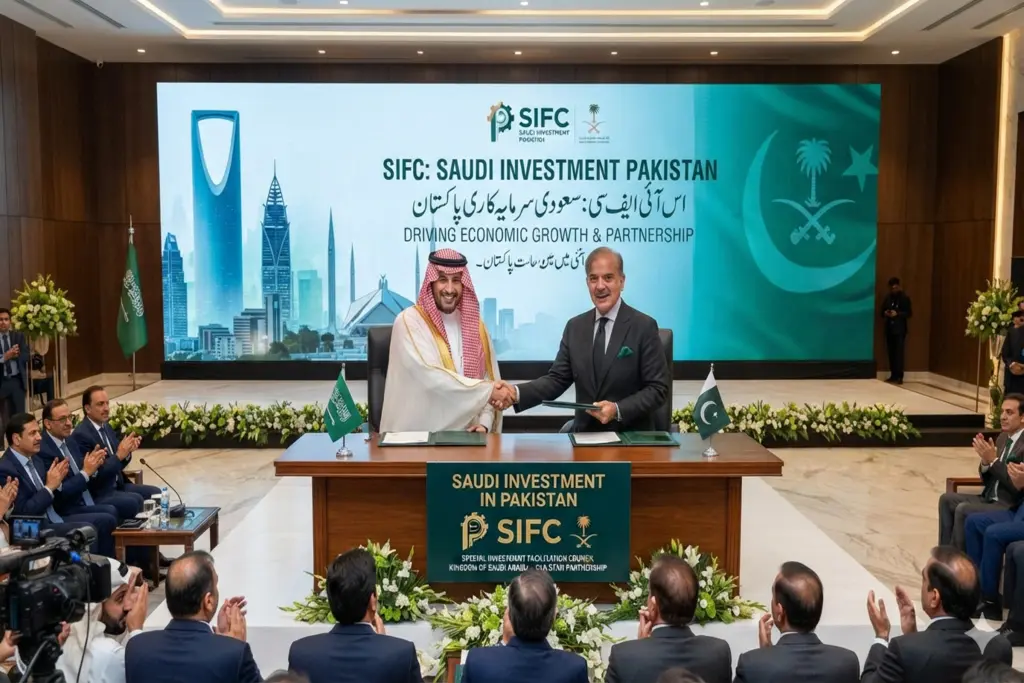
Saudi Arabia has announced its plans to take huge steps to increase its investment portfolio in Pakistan, in a significant sign of convergence in geo-economic interests and a structural change in bilateral relations. The formal statement was made at the end of a high-level consultative meeting of a Saudi economic delegation and the executive leadership of the Special Investment Facilitation Council (SIFC) in Islamabad.
The delegation led by top Saudi-Pak Joint Business Council (SPJBC) members met federal line ministries, private enterprise managers and military officials to finalise a single roadmap for the speedy capital injection process, both through Government-to-Government (G2G) and Business-to-Business (B2B) channels.
Technical Overhauls of Critical Infrastructure and Municipal Terminals
The core of the inter-governmental dialogue focused heavily on identifying priority projects ripe for Saudi capital allocation. SIFC administrators provided the delegation with comprehensive data briefs outlining structural advantages across several targeted growth tracks:
Green Energy and Petroleum Infrastructure: Expanding Saudi funding for automated solar grids, distributed power systems, smart metering hardware, and a world-class greenfield oil refinery project.
State Privatization Frameworks: Exploring sovereign wealth fund acquisitions and joint-management setups for underperforming state-owned enterprises (SOEs) under the federal government’s active privatization push.
Supply Chain and Logistics Upgrades: Overhauling transit infrastructure, including the financing and modernization of critical arterial highways and digitized logistics hubs to optimize the movement of commercial goods.
Aligning with Vision 2030 and Regional Strategic Defense Accords
Prime Minister Muhammad Shehbaz Sharif welcomed the trade delegation at the Prime Minister’s House, stating that Pakistan is fully committed to aligning its domestic economic reforms with Crown Prince Mohammed bin Salman’s ambitious Vision 2030 blueprint.
Financial and security analysts note that this wave of commercial integration is strongly backed by the recently signed Makkah Joint Defense Agreement between Pakistan, Saudi Arabia, and Türkiye. This trilateral defense and economic alliance forms a powerful $3 trillion economic block, providing a stable security umbrella for high-value strategic projects. This includes accelerating Saudi sovereign equity participation in the landmark Reko Diq mining and copper-gold exploration project, alongside large-scale corporate farming ventures utilizing automated satellite scanning and modern agricultural research.
Institutionalizing the Bilateral Implementation Mechanism
A major milestone of the SIFC review session was the formal establishment of a Bilateral Implementation Mechanism. The unified administrative protocol is engineered to completely bypass traditional manual bureaucratic red tape and eliminate technical delays.
By implementing network-integrated digital clearings and automated regulatory tracking, both countries have established a frictionless investment environment. The Saudi delegation praised the SIFC’s centralized dispute resolution portal, affirming that absolute legal clarity and structured investment guarantees will foster rapid private sector business expansion across international borders.




1 Comment
Pingback: LESCO Smart Meter Overbilling Controversy | Pakistan Truth